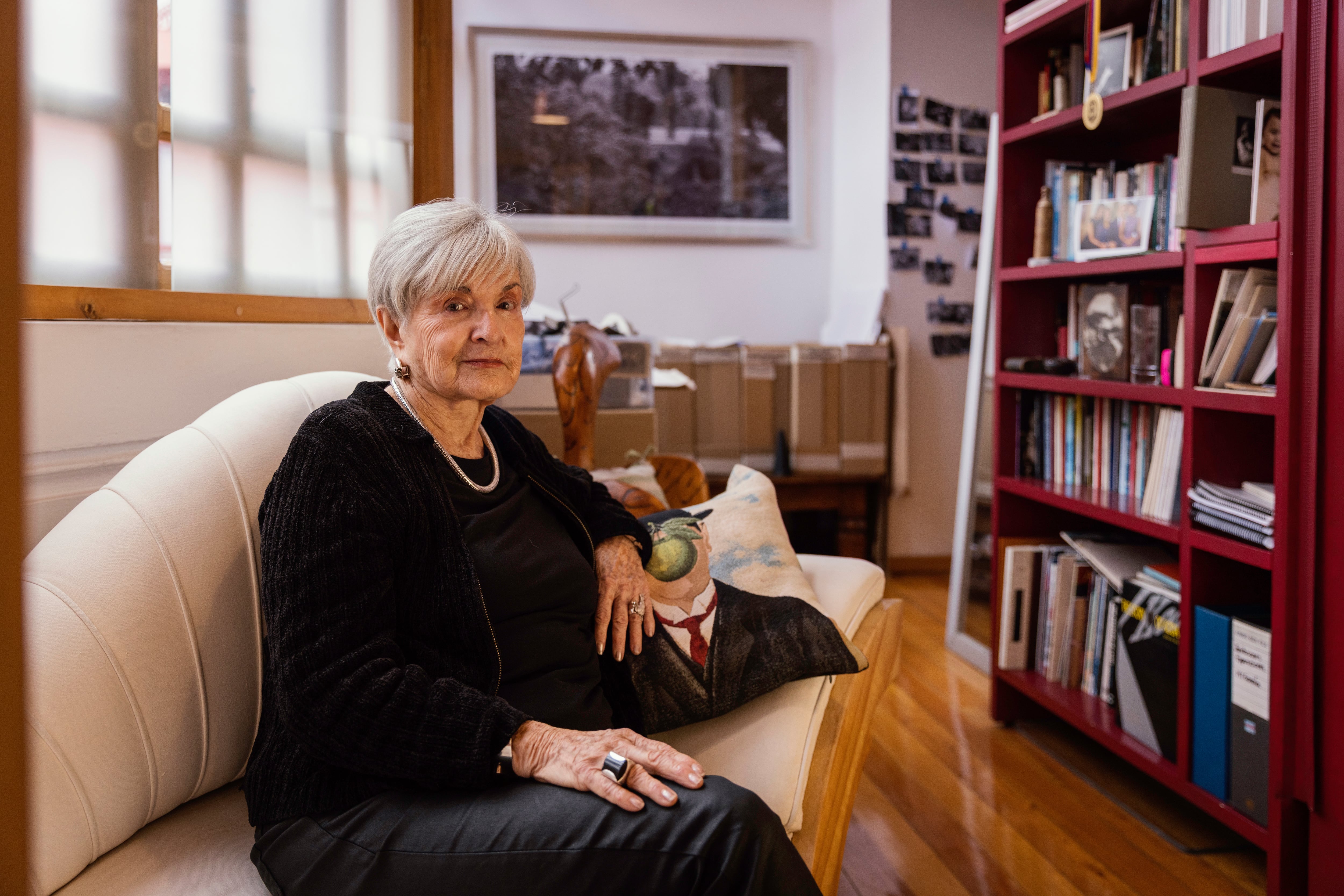
I didn’t want to leave them a load. The two children of the photographer María Teresa García (Sangolquí, 1945) are not too interested in their mother’s trade and do not live in Ecuador. Therefore, in 2022, at the end of the Covid-19 Pandemia, he hired a historian to help her organize, for the first time, her archive. He feared what would happen to other photographers: that his work died with her.
That same year, with a portfolio that covers five decades, Garcia applied for the first time to the National Mariano Aguilera award, one of the most prestigious artistic awards in the country, but did not win. Insisted again in 2024, but before he published the book The other sangolquí (Catharsis Editorial, 2023), an essay on the urban parish where he was born, grew and formed, located in the southeast of Quito, who, according to researcher Lupe Álvarez, “has been doing 40 years.”
These days, until mid -September, the contemporary art center of Quito (CAC) hosts the exhibition Latent image, A retrospective of García’s work, awarded the Mariano Aguilera Award for Trajectory 2024-205. The photographer is happy with this recognition of her art and for the opportunity to share unpublished material: 80% of the 260 photos of the collection, mostly in black and white, had not been exhibited.
Divide into seven series, the sample is an immersion in its searches and curiosities. From their complicit portraits to Ecuadorian relatives and artists to their stays in Manila, Yakarta, Vietnam. From its careless self -portraits to their penitent monitoring of religious rituals and their syncretisms. And, of course, and perhaps above all, there is his love for Sangolquí, so present in it, in his memory and in his body. The day he receives El País in his study in the historic center of the capital, Garcia has a silver rooster in his left hand. A ring that, he says, represents the sangolquileños: “Tozudos, direct, fighting, resilient.”
Ask. This year turns 80, in November.
Answer. Yes, 80! But I better not think about that. So that. Age is an impossible thing to control or change. I better worry about continuing to review my photos, to do my job, more important things than that. One ages faster when he is thinking: ‘I have so many years’.
P. But fulfilling 50 was decisive for you, as your book shows Reaching fifties, on Becoming Fifty. In one of the photos he appears as a butterfly about to free himself from his cocoon. Did you feel that way?
R. In certain things yes. But at that time I was in another skate. I was returning to the country after having lived nine years in Asia, my last son went to university, the feeling of the empty nest came, my marriage was not in his best form and, above all, I turned 50, and I thought it was too much. That is why now I don’t even think about age. The 50 were traumatic.
P. Despite not thinking so much about age, he has always photographed a lot of old age and childhood.
R. I think it’s unconscious. Perhaps because, precisely, those are the end and the beginning of life. At my age you already start having pain, to think otherwise, to be more fearful. Although I have never been afraid of anything, except my dad. I have always been very adventurous, very irresponsible many times. Once I photographed three days in a row without sleep. It was on a trip to Java Central, in Indonesia, when the lighting of Buddha was celebrated.
P. Does Nostalgia see your five decades of work exhibited?
R. No, I am happy that those latent images have finally shown. The prize was a great impulse. In 2022, at the end of the pandemic, I began to organize my file and hired a historian: Érick Peralvo. He came and opened all my hiding places, because I have always kept everything. Not even thinking about awards, but because I always had in mind that this, one day, could be interesting for the history of photography in Ecuador.
P. She is the only photographer, woman, who has won the Mariano Aguilera.
R. And I am proud, because that opens the way to many aspiring photographers. Photography in Ecuador is finally in its seat, with all other arts. Although, really, I have not ever thought in terms of being a woman or not to do what I do.
P. The curatorial text of the sample says, in fact, that it has always been far from the claims.
R. Yes. The claims are very good, but I do not think they must be used for other purposes that are not improving society, not to sell your art. We need to be more aware of individual work as a way of contributing to the improvement of the world, of the country.
P. Returning to nostalgia, the researcher and art critic Lupe Álvarez says that her gaze on her beloved Sangolquí is anything but nostalgic.
R. Yes that’s how it is. I have never believed that it is nostalgia, but a very affectionate, very loving, sangolquí recognition is better, where my roots are. Although now everything has changed. My photos of sangolquí of the 80s are totally different from those now, because it is no longer a small town, now it is a town.
P. Regarding villages, Graciela Iturbide recently said in an interview with this newspaper that photographing indigenous peoples is not magical realism. Do you agree?
R. Graciela says that is life, which is nothing magical. And he is right. She was the first photographer I met with the one I went to photograph here, by the center of Quito. When I was in Mexico, it also let me accompany her very generously. I have pleasant memories of her. He is a photographer who has had a great influence on me. With her I understood the potential to do photographic trials. And Sangolquí was calling myself for a while.
P. Many of Sangolquí’s photos show rooster fights, animals detention in camales and markets … issues that ignited the alarms of political correction.
R. In those years there was no Such to Thing as political correction. My photos show everything that happened in the town, what has happened and what will continue to happen. The fights of roosters, in fact, are now returning. My same dad crio fighting roosters. People build brotherhood around these events. And there are codes of honorability, such as Gallero’s word. It is not only violence as many want to see.
P. Will self -portraits continue to be taken, taking selfies? Showing the body can be seen as a claim.
R. I will continue, of course. It is my life. I have always been curious about the body’s relationship with the chamber, its reactions. When I am self -portrait to feel, a little, how the photographed will feel. The camera is a tool, but it is also a weapon. The camera literally shoots. It shoots you. And that intimidates.
P. With a weapon and everything, photograph, for you, it has to do above all with seduction and coquetry.
R. Clear! And it must also be. Otherwise, it’s not fun (series).
For more updates, visit our homepage: NewsTimesWire