Israel Premier Tech cyclists have participated this week in the Tour of Spain in the midst of boos, flanked by Palestinian flags or against women disguised as Palestinian mothers with their children wrapped in white shrouds in their arms. The activists thus emulated the images of death that, increasingly atrocious and for almost two years, which the Israeli offensive lasts, they arrive from the strip. These prints, to which those of children reduced to skin and bones for malnutrition have now joined, are promoting protests that, in recent weeks, have increased their number, intensity and also their global reach, in parallel to a famine that the United Nations officially declared on August 22.
The numerous and constant, although only sometimes massive, global rejection samples to Israel for an offensive that has already caused more than 64,300 dead in the strip will not stop on their own to that country. The Benjamín Netanyahu government has iron support: the United States and its weapons – as well as its veto in the Security Council – or that of Germany. He also protects his impunity in the passivity of his first commercial partner, the European Union – a 32% of its exports in 2024 – that has not adopted any sanction against him.
The Vuelta protesters have failed to expel the Israeli team from the race, but they have obtained victories of high symbolic content. Israel Premier Tech announced on Saturday the withdrawal of the name of Israel from the Maillot of his cyclists. The activists have reached these days the covers of the international media and their posters, which “Israel Genocida” said, have been seen in the 190 countries where the competition is broadcast.
Above all, Haizam Amirah Fernández, executive director of the Center for Contemporary Arab Studies (CEARC), that mobilization, and others of very diverse people in different parts of the world, “have achieved since the name of Israel” is associated with a genocide. “
The protests in the Vuelta have also led political leaders to pronounce. On Thursday, the Spanish Foreign Minister, José Manuel Albares, was “supporter” of expelling the team from the competition to “send a message” to Israel. The Government announced this Saturday that in the Council of Ministers that will be held next Tuesday, it plans to approve a package of sanctions against Israel and accelerate the entry into force of the arms embargo on that country by approving it with a decree-law. That has been one of the main demands of the Spanish solidarity movement with Palestine.
A “Paria State”
The best measure of the impact of the wave of popular indignation is, the expert of the CEARC emphasizes in the Middle East, “the reaction” of the Jewish state. On the eve of the announcement of the withdrawal of the country’s name in the equipment of cyclists, Israeli Prime Minister Benjamín Netanyahu, personally congratulated in a tweet to members of Israel Premier Tech for “not yielding to hatred and intimidation.” After the thirties of ships of the Fleeta de la Libertad – another mobilization of international scope – Zapara de Barcelona towards Gaza last week, the Israeli government announced that it is studying to consider its activists “terrorists”.
For Amirah Fernández, these responses suggest that the offensive rejection actions in the Palestinian enclave are cracking “the containment dike” that until now had prevented Israel from being considered a “outcast state.”
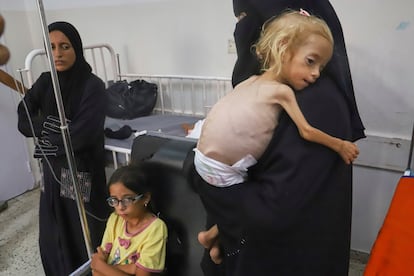
Especially in recent weeks. On August 22, the UN declared the famine in the strip. Already before, the manifestations of repulsion to the Israeli offensive had proliferated. The agony of Palestinians such as the 104 that, since that date, have succumbed to the starvation imposed by the Israeli blockade- more than 25% of the 382 people starving since the beginning of the offensive- is marking a turning point in censorship of Israel for the destruction of Gaza.
That rejection is expressed in different areas: from sport to culture, academia or international organizations and humanitarian aid NGOs, which have been crying out for two years against hell suffering from the Palestinians. Also in the streets. This Saturday, there were proper demonstrations in London, Paris, Madrid, Seoul (South Korea) or Pennsylvania (USA), among other places. In the British capital, the police arrested 425 people. The repression of Gaza protests in traditionally allied countries of Israel is considered another measure of measure of the scope of these manifestations.
On August 9, an international mobilization for Palestine gathered in all protests to tens of thousands of people in Istanbul (Turkey), Madrid and other Spanish cities, Amsterdam (Netherlands), Geneva (Switzerland) and Kuala Lumpur (Malaysia), among others. The famine in the Palestinian territory took two days later to 100,000 people to march in the streets of Brisbane (Australia), according to the Local Police.
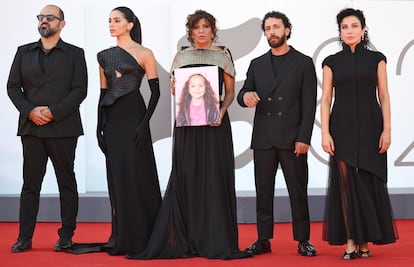
Last Friday, the San Sebastián Film Festival issued a statement that condemns Israel’s genocide “in the Strip. Two days before, the public of another festival, that of Venice, rewarded with the longest standing ovation that is remembered – almost half an hour – the film that tells the terrifying final of Hind Rajab, a six -year -old Palestinian girl killed in her family’s car, riddled with more than 300 bullets by an Israeli tank in the strip. On the 22nd, the Venice4Palestine organization, which brings together 1,500 names of Italian cinema and some international – as director Ken Loach – had requested by letter to that contest a clear conviction of Israel.
In Spain, the artist platform with Palestine, which brings together public figures such as Pedro Almódovar or singer Rozalén, is demanding, on the other hand, the Spanish government that cuts relations with Israel.
More than 200 exembajadores and former high European officials reproached on August 23 to the European Union, in an open letter, its total absence of sanctions against Israel. That same week, the International Association of Academics of Genocide (IAGS), the largest global institution dedicated to the study of that crime, defined with that term the military offensive in Gaza.
Jorge Ramos Tolosa, Professor of Contemporary History at the University of Valencia and expert in Palestine and Israel, sees in all these acts of censorship the demonstration of an “abyss”: the one that separates those who have joined this “wave of unpublished international solidarity” with Palestine of some governments, especially Western, mostly “accomplices with the genocide in Gaza.”
Only four countries, Bolivia, Colombia, Nicaragua and Belize have broken their relations with the Jewish State for the offensive that the UN International Justice Court (TIJ) considers a “possible genocide.” Ten, all of the Global South, have suspended their relations with the Jewish state, including Brazil and South Africa.
Nine states have joined since October 2023 to the hundred UN members who already recognized the Palestinian state: now there are 147 of 193. One of them is Spain, which leads, together with countries like Ireland, the group of EU members most critical with Israel: who ask for the suspension, at least, of the commercial chapter of the Association of the Association of the Twenty -seven with that country.
That possibility has been encountered so far with the veto, above all, from Germany. And this despite the fact that a survey in charge of the public chain ARD in August raised to 66% the German Germans to apply more pressure on Israel.
“The new phase of genocide, famine and horrible images that we are seeing has made global outrage growing much more, “confirms Ramos Tolosa. If governments” do not attend to this growing citizen demand, you can start leaving them very expensive. “
Small steps
The global outrage due to the brutality of the Israeli army in the Palestinian strip has already forced several European governments to take steps, although still irrelevant, to press Israel. On August 11, the Norwegian Sovereign Fund was forced to sell its participations in 11 Israeli companies after the newspaper Afetposten He would reveal that he had invested in a company that manufactures pieces for the airplanes that bombard the strip.
On August 8, after Benjamín Netanyahu announced a plan to invade all of Gaza, the German chancellor, Friedrich Merz, reported that his country will limit the supply of weapons to Israel in a decision without real military scope- Berlin is the second armament provider of the Israeli army, behind Washington- but that it is a political gesture.
Slovenia announced on Friday that it will not participate next year in Eurovision if Israel does. And, in principle, on September 22, France will recognize the Palestinian State in the United Nations General Assembly. The United Kingdom has also announced that it will materialize that recognition if Israel does not accept fire in the invaded territory. Both countries are permanent members with the right to veto in the UN Security Council and sit in the G-7.
In a European Union that still does not adopt any sanction against Israel – in contrast to the 18 packages of punishments applied to Russia for its invasion of Ukraine – the lack of political action is beginning to take its toll. Especially in terms of discredit.
At the national level, European passivity has struck tensions in several governments. In Netherlands, five ministers resigned on August 22, after their coalition executive blocked his proposal to adopt sanctions against Israel. In Belgium, the threat of the VicePrimer Minister and Foreign Minister, Maxime Prévot, of causing a government crisis forced the coalition led by Wever Flamenco Nationalist Bart of Wever to open the door to a possible recognition of the state of Palestine.
In Spain, the solidarity movement with Palestine has summoned demonstrations throughout the country for next Tuesday. Its purpose is to press the Government to comply with, in the Council of Ministers of that day, its commitment to approve an embargo on weapons against Israel.
For more updates, visit our homepage: NewsTimesWire