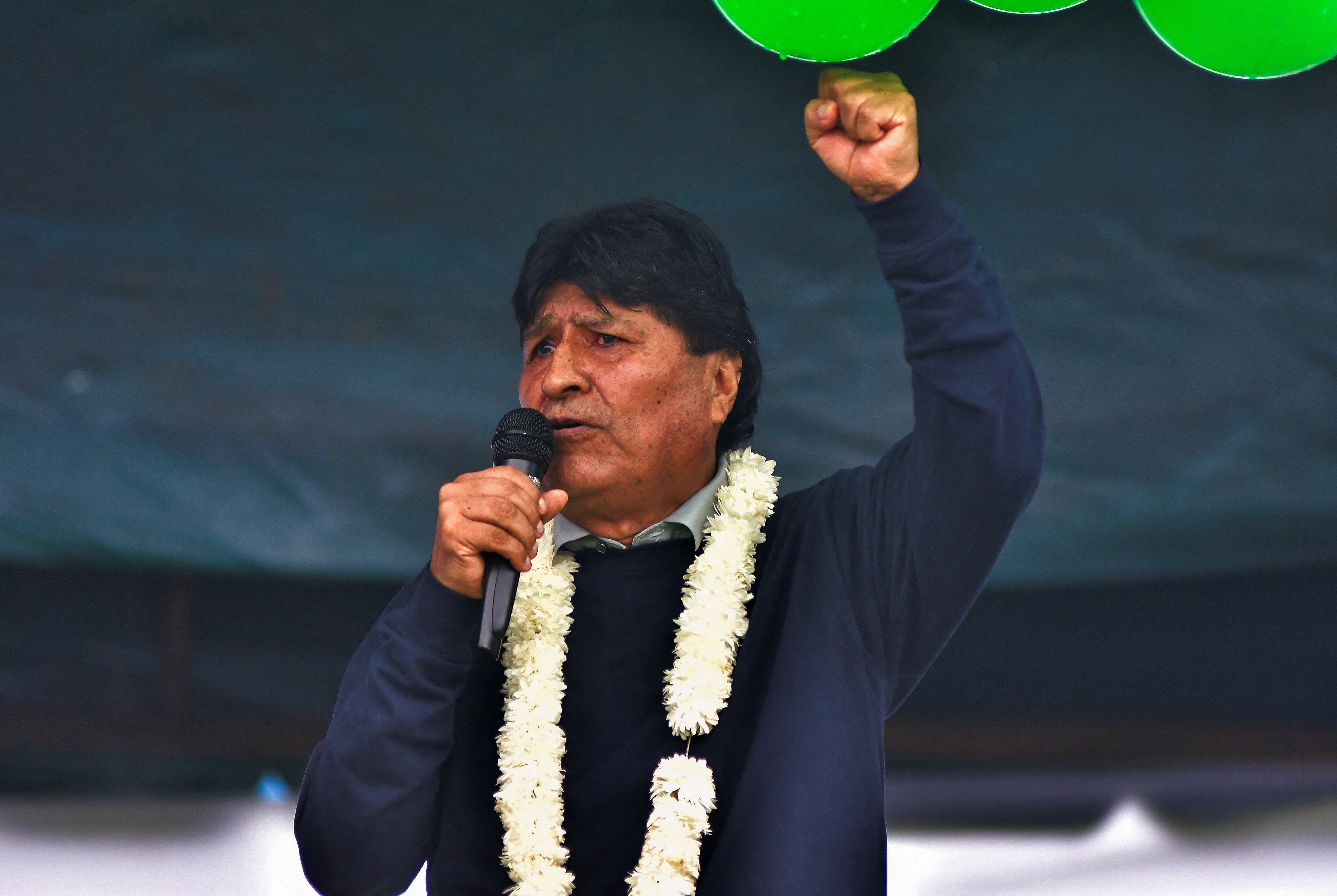
By unanimous decision of its nine members, the Constitutional Court of Bolivia confirmed the prohibition that Evo Morales is again president of the country that has already ruled three periods. Two previous constitutional sentences that spoke incidentally of the limits of the re -election have been ratified by a more specific ruling and backed by the Plenary Chamber of the Court, and that is why, according to the specialists, it has a greater legal force. The incident occurred a few days before the term for the registration of candidates for August elections ends.
The Constitutional Court responded to a requirement of two opposition deputies with a resolution that confirms that no Bolivian can occupy the presidency or vice presidency more than twice and can govern for a reckless maximum of ten years, regardless of whether it has been elected continuously or discontinuously. In this way, Bolivia has adopted a system analogous to the American, which breaks with the national tradition, which had always allowed discontinuous reelections. Some analysts have considered it a “custom -made” reform of Morales, which has governed almost 14 continuous years, between 2006 and 2019.
The sentence was made public the day after President Luis Arce announced that he will not be in the electoral race and asked to reunify the left around the “best positioned”, referring to the president of the Senate, Andrónico Rodríguez. With morals outside the race, Rodríguez has the opportunity to be the only leftist candidate in the elections, but it is not certain that he will. Those who until now had been close to Arce, who have control of the movement to socialism (MAS), the historical party of the Bolivian left, are disregarding the president’s message and shuffling other options in addition to Rodríguez. This, meanwhile, has said that the unit must occur between social organizations and not “with disconnected domes” of reality. Thus he intends to distance himself from the president, whose management of the economic crisis causes a strong citizen rejection. So that the registration of two or even three leftist candidates is possible.
The first time that the Constitutional Court indicated limits to the re -election that resulted in the disqualification of Evo Morales was in December 2023. Since then, the former president has expressed several times that he does not abide by this decision and considers it unconstitutional. Instead, he has organized several protests to get his right to be a candidate. The most recent of these will be May 16, when their supporters march from the countryside and enter La Paz, the headquarters of the Bolivian politics, to peacefully demand its registration. However, it does not have a legally registered party, which, added to the constitutional prohibition, closes its step. The Electoral Court has indicated on its claim that it will not act under pressure.
“Only the people can ask me to decline the candidacy. We have no personal ambitions. We are going to obey the mandate of the people to save, again, Bolivia.” Thus Morales responded to Arce’s challenge to follow his example and remove his presidential aspirations.
While this happens in Bolivia, in Argentina justice has admitted a demand for several civil organizations, including the Argentine Forum for Democracy, against former President Morales for crimes against humanity allegedly committed during its three governments. Argentina allows extraterritoriality when it comes to human rights causes. As has been known until now, the plaintiff lawyer, Tomás Farini Duggan, argues several cases of alleged judicial persecution against a set of Bolivian citizens and residents in Bolivia. The complaint was accepted by Judge María Eugenia Capuchetti and will be processed in the Federal Courts of Buenos Aires.
For more updates, visit our homepage: NewsTimesWire