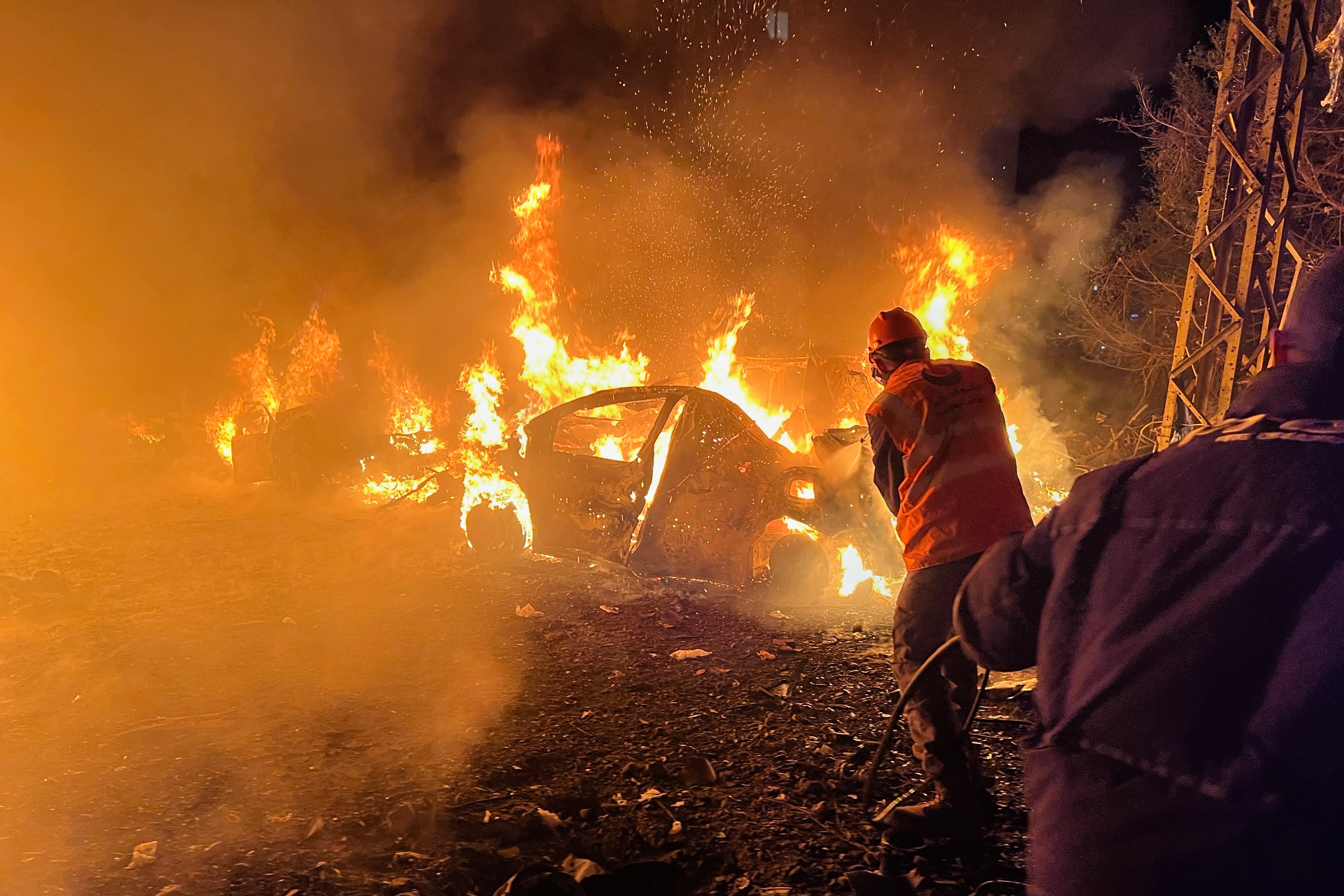
“Where citizens attack the army there will be aerial fumigation.” Gustavo Petro’s message this week, with a term that had already entered disused, was not any flying. In response to one of the recent assonates who hinder the operations of the Public Force, in which the extreme of trying to burn two military, the president of Colombia stated that, before what he considers a “mafia tactic”, the Constitutional Court “must reconsider its sentence”. Although it did not come into details and is very difficult to put into practice its proposal, it referred to the failure that prevents resuming air fumigation with glyphosate to eradicate illicit crops, a controversial anti -narcotics strategy that Petro fustigó in the past. It is not the first Manida idea that the left -wing president resorts to face the complex security crisis.
Air fumigation with glyphosate, a potentially carcinogenic product, has been suspended since 2015 before recommendations from the World Health Organization and a ruling of the Constitutional Court that appealed to the principle of caution. In another judgment of 2017, the High Court determined that, among other requirements, the authorities could only reactivate fumigations if they established with scientific research that these sprinkles do not produce damage to health or the environment. Before being president, Petro promised that in his period there would be no herbicide drop. However, his government has faced a recent controversy for the purchase of 22,000 liters of herbicide for terrestrial fumigation. Although the connoisseurs agree that it is almost impossible to again asperjar – the predecessor and political rival of Petro, Iván Duque, tried unsuccessfully during his period – that contradiction in the changes promised in politics against drugs caused a generalized confusion.
The bombings are another example. One of Iván Velásquez’s first ads, the Prime Minister of Defense of this Government, was to suspend the air attacks of illegal groups in which there may be minors, a brake that restricted them to the fullest, given that the recruitment of minors is a constant practice of the multiple structures that coexist in the country. In any case, they only returned to be on the table after an ambush of the Gulf clan killed four military in Segovia, in the northeast of Antioquia, in February 2024. And, then, President Petro completed last March his threat of bombing without contemplations to the largest drug trafficking band, and the largest illegal group, in that same region of Colombia. In this 2025, under the new Minister of Defense, Pedro Sánchez, a general retired from the aerospace force, the State has made at least four bombings against armed groups.
The appointment in February of Sánchez, the Prime Minister of Military Defense since the 1991 Constitution, could be considered another band. The Government started, under the baton of Velásquez, with the purpose of getting the National Police out of the orbit of the Ministry of Defense to strengthen its civil character – which, in addition to an old debate, was one of the recommendations of the Truth Commission, part of the broadest debate on a background reform to the security forces. That campaign promise was also bogged down. In the opposite direction, given the drift of their peace policy and the deterioration of a security for which there was no clear strategy, Petro decided to put a military in the head of the defense portfolio, something that their right -wing predecessors did not do. A pragmatic response that more than one observer considered a setback.
For Jairo Libreros, professor of National Security and Defense at the Externado University, in Bogotá, “the government of President Petro failed to build a road map or a coherent strategy in National Security and Defense. Therefore, he is subjected to political bands, that is, to discursive changes in statements on public policy decision making”. What Petro promised in the campaign does not sympathize with what he has formulated in the three years that he already has in the Casa de Nariño, says the expert. “Moreover, recent safety ads were not in their government plan and are contradictory to the actions that dissected the Ministries of Defense, Justice and Interior,” he adds in a rapid review of those bands.
To the announcement of aerial fumigation, bombings or military defense minister add another example. Petro said in campaign that he was going to guarantee the integrity of the command lines into the public force, he recalls. “But, as soon as he possession, he broke it by calling the positions of command to officers with less seniority in the forces and in the National Police.” That led to an exit in the first six months of approximately 75 colonels and generals. “And then, in a third act, he reimbursed some senior officers, as is the case of the Director of the Police and the Army Commander,” he recalls.
During the exercise of its first government, the left failed to develop a security doctrine, coincides Jorge Mantilla, a researcher specialized in the armed conflict. “Although the narrative exercise of government is marked by very clear ideological dyes in economics or in natural resources, in security ragatism prevails. But it is a pragmatism that is much closer to improvisation and confusion that making practical and fast decisions,” he warns. “This government leaves left without a clear security agenda. The political repercussions will be seen in the 2026 elections,” he concludes.
For more updates, visit our homepage: NewsTimesWire