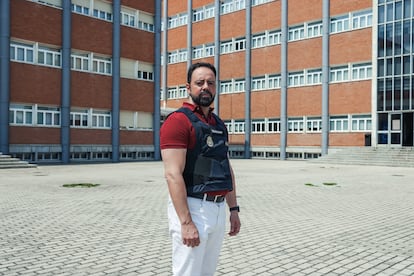
“How would you communicate with someone who is about to throw themselves with a cliff and turn out to be a deaf person?” The question, asked in an office of the Canillas police complex, in Madrid, seems like an exam. It is one of the situations that inspector César Martín, coordinator of the National Police Negotiators, during an interview on the way in which situations of maximum tension, such as the confinement of two men armed with members of his family occurred in Madrid on August 11 and ended up successfully solving successful. Martín, who prefers to sit in front of him, without occupying his place at the Office of the Office, speaks with a calm tone. “A negotiator is constantly evaluating the situation in which it is found and seeks the best way to solve it,” he explains.
Faced with a critical situation, as a case of ill -treatment in which there are retained victims, when a person with a mental illness threatens to harm, or even in a hostage robbery, the “negotiating team” of the police (because they sow they talk about their work as part of a gear), has the adrenaline at maximum, but must keep the mind cold and the ability to analyze. The negotiators of that network, composed of 53 agents throughout the national territory, have exceeded in their formation a series of fire tests in which vertigo is prohibited, creativity is hyperstimula and it is essential to “leave the egos aside.”
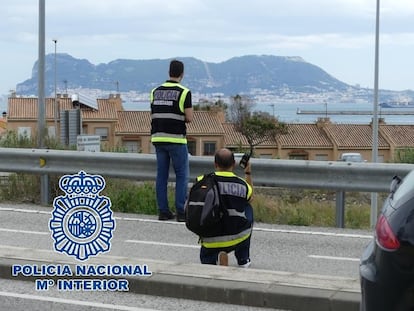
The exam question, the case of the person who could not listen to the policeman who tried to help him is a real case. The negotiator who went to this notice in Algeciras (Cádiz), was the chief inspector Joaquín Llanos. The agent, who has been doing these functions almost a decade, recalls that there was nearly an eleven building and tried to find a signs interpreter, although it was impossible. Llanos approached everything that could man, who was in front of a cliff in a work: “He was agitated, embedded, colored, with tense neck muscles.” He says he communicated with him as he could, vocalizing a lot, making gestures. “I don’t smoke and that day I smoked a pack with him,” he recalls. Every time a new cigar extended, one more step was approaching. “He made gestures that his heart had stolen, which was better on burst. He knew that the man worked with his partner in a vegetable position and was very affected by an infidelity. “I felt that nothing made sense,” he says. Until he offered him the cigar with which they could approach enough to get him out of that danger situation. They were two and a half hours together. “You have to disassemble that situation, that bottomless well in which they believe, from respect, validating their feelings and understanding that these people are frustrated and angry,” he says. “When everything ended I didn’t want me. The first thing he did was hug me,” he recalls.
“The negotiation is to create trust,” summarizes Inspector César Martín. “You have to convince the person to overcome the problem.” It is rare the week in which they do not reach the General Police Station of the Judicial Police, responsible for managing these situations, alerts of one or two incidents, although sometimes the negotiator is not necessary to intervene directly, to which the territorial units activate. It is only mobilized when the situation is limit. In these cases, the network is activated and supported between them or talk about possible strategies.
Isabel Espejo, Chief Inspector and negotiating in Malaga, also knows what it is to pull creativity. After not being able to connect with a person who wanted to commit suicide from an 16th floor of a Fuengirola hotel, it occurred to him to tell him that if he would like to leave him in silence. “Yes, please,” he told me, “he says. They were the first words he directed. And just around that pause, after an hour and a half of trying to approach, it was when he managed to leave the cornice. “Not because of much talk you are doing better,” says the inspector. When asked about a situation that has made special dent, he cites a case with fatal outcome. It was the night of June 24, San Juan, when a person with suicidal ideas threatened to throw himself from a window. The other partner who does the functions of negotiator in Malaga was in the place, while she was still on the phone. After 15 hours they failed to convince him. “It was painful. It is one of the first who have gone badly and that’s why we remember it,” he says.
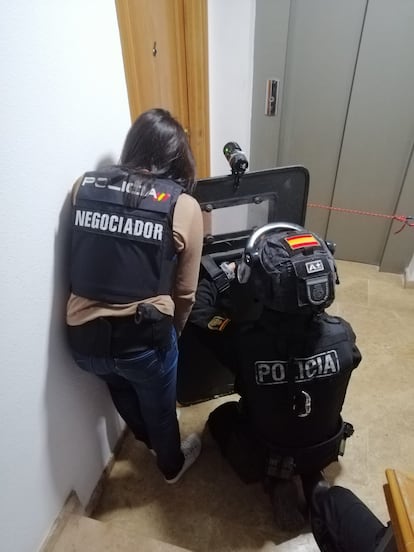
Negotiator’s work is not full time. Its agents are destined in other functions. The Coordinator of the Network, and also negotiator, also directs one of the two groups of kidnappings and extortion of the General Police Police Station, while those of Cádiz and Malaga are in charge of foreigners and borders in the line of conception and of the family and women’s unit (UFAM) in Malaga, respectively. The three are members of the first promotion of the negotiator specialization course, convened in 2016 by the National Police, and participate in the formations of the future colleagues in the network. Every time new agents are incorporated, which specialize after an exhaustive selection and a course, which has begun this September 8 will have its fourth edition in the Geo Barracks in Guadalajara. When it ends, the police force will have 23 new negotiators aimed at supplying the tasks of some colleagues who have promoted or changed destination. They will also serve to reinforce areas such as Málaga, Cádiz or Alicante.
In the selection process, for which it is necessary to have the category of inspector, they expose them to different tests, such as orienting in an uninhabited area, convincing someone to let them use their mobile or to take them to a certain point, as in a kind of search for treasure for police. All without the possibility of using money or own phone. There are also other tougher tests, in which they seek to raise their stress, which go through journeys in small and dark places or expose them to large heights. “We have had interventions in a crane, in Logroño, or on the roof of the Cathedral of Murcia,” justifies César Martín, to justify these requirements.
The National Police follows the FBI negotiation model, in which the negotiating team and tactical agents, who are responsible for high -risk operations, such as the GEO (Special Operations Group) or the GOES (special safety operating groups), work separately, even if they support and advise each other.
Before starting to negotiate, they collect all possible information and, although it seems a contradiction, they take their time to establish a strategy. “The pulsations rise, although it is also true that in tension, more ideas arise,” says Malaga’s negotiator. The main negotiator speaks directly with the person of the incident, while the secondary supports, informs and transmits what is happening to the command team. Always with the premise of self -protection, they can establish contact from behind a door, after a wall, face to face or by phone.
Most cases are usually related to gender violence or suicide attempts. They also intervene in kidnappings, much less frequent, but more complex. Many more variables come into play and can be extended over time, inspector Martín emphasizes. With account adjustments such as background or for drug games, agents find that there is no complaint or that the information they have not to be true. A few summers, Martín recalls, a man of Romanian origin denounced the police in his country that they had kidnapped his son for the theft of a drug shipment. In collaboration the Romanian agents, the Spanish agents managed to free him alive after a week of conversations. However, they had “great uncertainty” because the information took a long time to reach them and was partial. “There is a lot of tension, but then there is a lot of satisfaction,” summarizes.
Agents affect the need for “the egos” to be aside and triumph teamwork. We must not think about solving it alone, but attending to the situation and acting as planned, they affect. “And working in a network costs a lot.” That is why they highlight the importance of companions such as citizen security agents, who are the first to arrive at the scene in these cases, know the existence of these protocols and are activated if necessary.
The Cádiz negotiator, who defines himself as an agent “skin with skin”, defends the power that has to be close to people, whether they are judges, victims or investigated, in all circumstances. “It is very powerful, both in research and other tasks.” His partner of Malaga sets his usefulness in brawls or a demonstration and even in daily life. “By the time you argue with a child, with a relative. You have to stop and listen. It is not easy. There are people more easily, but trained, these capabilities improve. And the word is a possibility that does not remain,” he ends.
For more updates, visit our homepage: NewsTimesWire