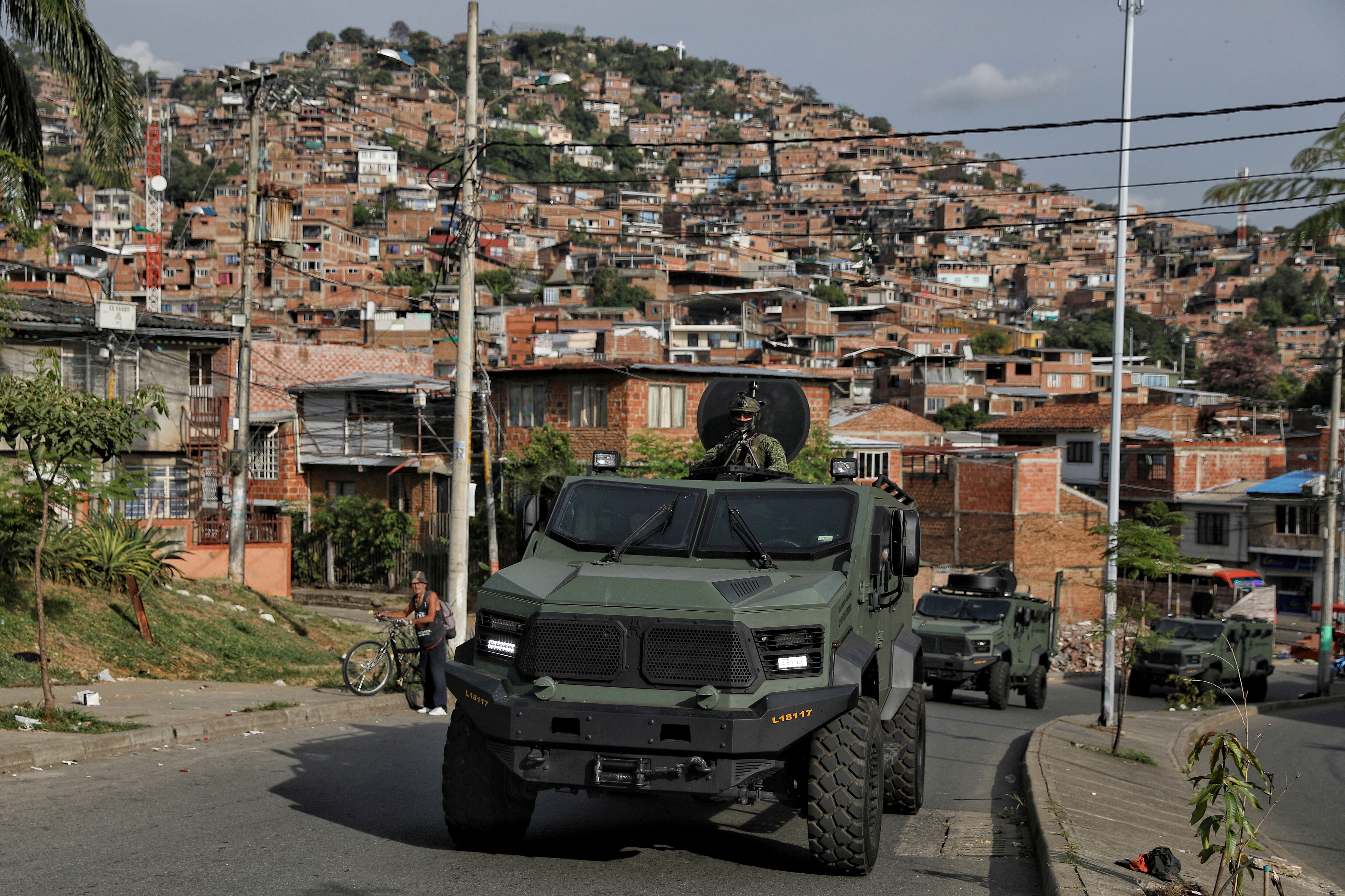
The relationship between Colombia and the United States has been full of turbulence since this year. Donald Trump’s return to the White House has meant a major challenge for Gustavo Petro’s government and his foreign policy, marked by cross -statements, commercial threats and even a brief diplomatic crisis. The tension rushed again this week for Washington’s decision to describe Colombia as an allied country in the fight against drugs. Although the resolution avoids the hardest sanctions and maintains cooperation, it represents a new blow to the already weakened bilateral relations.
Petro lashed out at the decision. “I do not threaten me, here I hope if you want. I do not accept threats, I do not accept missiles, I do not accept murders, I accept intelligence. They come here to speak intelligence,” said the Colombian president on Wednesday in a televised speech addressing Trump. The US administration has not hidden its animosity by the Colombian leader, which qualifies as “erratic” and “not being a good ally”, in the words of the Secretary of State, Marco Rubio.
Coca eradication efforts by Colombian authorities were not enough in the eyes of the White House and that is why he decided to withdraw the certification from the country as an ally in the matter. Washington suggests that the culprit of Colombia’s “breach of its drug control obligations” has been “political leadership”, not to mention Petro by own name, but pointing it directly.
The decision also occurs at a complex geopolitical moment in the region. The United States has attacked four vessels in the Caribbean Sea that left from Venezuela and allegedly loaded with drugs. Trump has accused the Venezuelan Nicolás Maduro from directing the Los Soles poster, a criminal structure. Although Petro has denied that this structure exists, the Colombian Senate approved this week that declares it as a “terrorist organization”, online to the requests of the United States and the European Union.
Manuel González, an international analyst and professor at the Javeriana University, argues that the US resolution is a conditional registration. ” “Trump implies that cooperation is maintained for national security interests and that the rejection is aimed at the president (Petro) but not to local rulers or public force.” For the expert, the American naval deployment is a justification: “Trump’s administration considers that countries like Colombia are not doing their homework and that is why they believe they are obliged to move on to action.”
Controversies from day one
From Trump’s return to power, a turbulent relationship was already anticipated. Petro pointed out to be xenophobic and racist for his immigration policies, the first of many clashes. In January, when the United States began to suffer from migrants to their countries of origin, the Colombian president prevented the landing of two flights with deported Colombians because, he considered, they were being mistreated. The answer was immediate: Trump threatened to impose 25% tariffs on Colombia. In a few hours, Petro reculled and accepted the return of migrants.
Mario Osorio, researcher at the Center for Economic and Policy Research, a Think Tank Liberal with headquarters in Washington, ensures that this was the first example of Trump’s way of operating. “He loves Matoneo. It is one of his tools to make politics, thanks to the power he holds,” he says in a phone call. “Many of the decisions that this administration has made have been more political than techniques, as happened with tariffs,” he adds.
Colombia ended with a 10%tax, the lowest level imposed by the United States to the rest of the world. But the commercial struggle did not end there. The search to diversify Colombian exports has been another stumbling block with Washington. Petro joined the new Silk route, the megaprogram of Chinese infrastructure investments with which the Asian country seeks to expand its global influence.
The reprisal of the United States was not late. He strongly opposed recent projects and upcoming disbursements “by the Inter -American Development Bank (IDB)” for state companies and controlled by the Chinese government “in Colombia. In addition, several officials threatened to prioritize the purchase of coffee and flowers – two of the most exported products to the US – from other countries, such as Ecuador.
The inflammatory statements of both leaders have thrown more firewood on the fire. In July, the United States called for consultations to the ambassador commissioned in Bogotá after the “unfounded statements from the highest levels of Colombia’s government.” The decision was made after Petro reacts to audios revealed by the country in which former chancellor Álvaro Leyva is heard ensuring that he has met with congressmen close to Marco Rubio to seek the support of the United States for a coup d’etat against him.
Although Petro also called consultations with his ambassador, Daniel García-Peña, a few days later he sent him back to Washington with apologies to Rubio and the US government, because he said they had no “participation in a coup d’etat or in any attempt to destabilize”.
For analyst González, “the relationship with the United States has not been the best and is like a snowball” that continues to grow. To the tariffs and the diplomatic crisis then the attacks on the Judiciary were added. After the conviction of former president Álvaro Uribe in July, Rubio said without evidence that justice was “instrumentalized” and that the sentence sat a “worrying precedent.” “The type of decisions Trump makes have a more political than technical halo and that is why many worry about a retaliation similar to that of Brazil, when a government was punished that clearly for Washington was no longer an ally,” González argues.
Trump, electoral figure
The Colombian policy is already marked by the electoral cycle next year, which begins in March and will end up in June with the presidential elections. David Varela, professor at the Javeriana University and Doctor of International Affairs of the Johns Hopkins University, states that Trump’s figure inevitably will appear in the campaign.
“Leaders as Trump attract attention and occupy the headlines every day, that ends up influencing political discourse beyond their borders, either so that it is taken as an example for some who want to emulate it or as an ideal for others that they must overcome,” he says.
Experts agree that, as has happened with recent elections worldwide, Trump’s figure will have some impact on Colombian elections. But it is still very soon to predict how. “We do not know if it will have an effect like that of Ecuador (where Daniel Noboa won, wrapped by Trump) or like Canada’s (where Mark Carney won with an anti-trump speech),” González reflects. The relationships, although maltrechas, summarizes Varela, have never been on the verge of a diplomatic rupture. “It has been more noise than something else,” he says.
For more updates, visit our homepage: NewsTimesWire