The United States Supreme Court today celebrates a hearing to deal with what is probably the greatest controversy unleashed by Donald Trump’s executive orders: the right to birth by birth. On his first day as president, the tycoon ordered that the right to nationality be eliminated to children born in the United States whose parents were undocumented migrants, a guarantee that includes the Constitution since 1868. The High Court does not have to pronounce directly on whether Trump’s decree is or not constitutional, but will decide whether the three judicial failures that considered the illegal executive order can be applied to the entire national territory.
The Trump administration asked the Supreme to address the issue with urgency after federal judges of Maryland, Massachusetts and Washington block the application of the order and failed that the president cannot change or limit the Constitution with a decree.
The government asks the judges to limit the application of judicial decisions to the parties that filed the lawsuit, arguing that the lower courts cannot issue failures that stop a national presidential order. The administration states that federal judges can only give a sentence on the rights of litigants in the case they analyze. They ensure that this appeal has been used by the Courts in “epidemic proportions” since the beginning of its second government, which has prevented the Executive Power from “exercising its constitutional functions.”
The plaintiffs argue that there is no reason for the Supreme Court to rule on whether universal judicial orders are always appropriate. The relevant, they say, is to define that these failures are appropriate in this case.
It is not clear when the high court will make a decision, although it is likely to do so before the summer break, which usually begins at the end of June.
Although it is not the reason for the hearing, the Court’s decision will determine whether or not the Constitution grants citizens to all those born in US territory. If the Supreme Court gives Trump reason, citizen restrictions by birth could go into force in at least 27 states.
The parties differ in the interpretation of the fourteenth amendment, which specifies that “all persons born or naturalized in the United States, and subject to their jurisdiction, are citizens of the United States and the state in which they reside.” That guarantee, which was established in 1868, has only traditionally excluded the children of foreign diplomats and the children of foreign enemies during a hostile occupation.
Trump defends, however, that the expression “subject to her jurisdiction” leaves out the children of undocumented migrants. The president argues that children born in the United States of non -citizens must loyalty to another country.
The first judge who spoke was the magistrate John Couchnour, of Maryland, who described the executive order as “blatantly unconstitutional.”
Massive opposition
The tycoon fulfilled his electoral promise and the same day of the inauguration of his second term signed the executive order that withdrew the right to citizens to children whose parents do not have permanent legal status. Trump and his supporters argue that there should be more strict standards to become an American citizen, what he called “an invaluable and deep gift” in the executive order.
The reactions soon produced. They were enough for a few minutes for the American union for civil liberties (ACLU) to file the first demand. Several states, civil organizations, and pregnant women have challenged the order in 10 different demands. Although Trump had declared numerous occasions that he would, jurist experts questioned that the president dared to challenge that right contemplated in the Constitution for more than 150 years. In 1868, 28 of the then 37 US states ratified the fourteenth amendment so that citizens did not refuse to the ex -liberated exchanges, of African descent, or their children.
The Supreme Court has already rejected the argument defended by Trump in the Wong Kim Ark case of 1898. The authorities prevented the entry of the plaintiff, born in the United States but of Chinese parents, for applying legislation that prohibited the entry of the citizens of the Asian country. The supreme ruled that Wong was a citizen, since he was born in American territory.
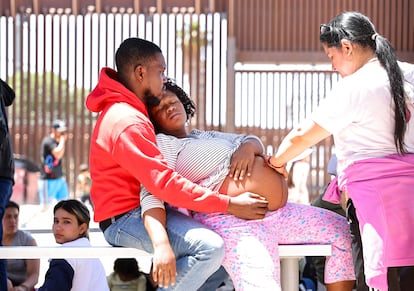
If the president’s executive order entered into force, hundreds of thousands of babies would live illegally in the country, being able to be subject to the massive deportations of the anti -immigration crusade of the tycoon. In addition, they would become stateless, because those who fled from countries without diplomatic ties such as Venezuela do not even have a consulate to register.
A recent study of Think Tank Migration Policy Institute shows that putting an end to citizens by birth would increase the undocumented population by 2.7 million by 2045 and in 5.4 million by 2075. Every year, some 255,000 children born on US land would begin their life without citizenship due to the legal status of their parents, the investigation shows.
“This creation of a class of residents born in the United States from the rights that citizens give to their neighbors, classmates and work colleagues could sow the seeds of a significant disruption in economic mobility and social cohesion in the coming years and decades,” writes the authors of the analysis.
For more updates, visit our homepage: NewsTimesWire