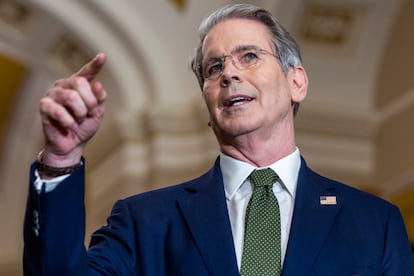
The United States Secretary of the United States, Scott Besent, issued a message on Monday of an unusual forcefulness in the support of the Argentine government: he said that his country is willing to do whatever it is necessary to help Javier Milei stabilize the economy of his country.
Besent’s statement occurred at a crucial moment. The Central Bank of the Argentine Republic (BCRA) has been losing part of its very scarce reserves to defend a price of the dollar that the financial market has considered very cheap. That deterioration of the amount of dollars held by the BCRA lit alarms between the holders of Argentine debt titles, which began selling those papers. The risk index arrived last week at an alarming level of 1500 points. The bondholders assumed that Milei’s government was walking towards him default. In this context, Besent’s words worked as a providential lifeguard. Even when the modality that will adopt that aid is still ignored.
The Secretary of the Treasury said that this Tuesday Donald Trump and himself would be seen with Milei in Manhattan, within the framework of the United Nations General Assembly. And he stressed that Argentina is a systemic ally of the United States. These statements help to understand the meaning of Besent’s financial announcement.
First, Milei plays a relevant role in Trump’s policy towards Latin America. Not only because he said aligned with the Republican leader before he returned to the White House. It is also relevant that the region is colored today with an anti -American tone. Brazil, Mexico, Colombia, Venezuela, Chile and Uruguay are administered by different variants of the left opposite to Washington. Milei is Trump’s only friend in South America and is in a casual way. The Argentine president has no qualms about stating that his alignment with the White House is automatic.
The second indication that Besent’s words cover is that Argentina’s rescue is a Trump decision. Therefore, the relevance of Manhattan’s meeting. This customization of the United States foreign policy is not novel. Trump announced at the end of July that the import tariffs would increase to Brazilian products in retaliation for the judicial decision to submit to his friend Jair Bolsonaro, charged with instigating a coup on January 8, 2023. Lula da Silva officials tried to modify that decision with innumerable efforts to the American bureaucracy. In all cases they bounced against the same warning: “This can only be modified in the Oval Hall of the White House.” In other words, it was a punishment inflicted by an imperial president.
It is curious: a leader like Trump, who usually can have retired to his country of unnecessary international conflicts, intervenes in the domestic policy of other nations to complicate or repair it, depending on whether it is friends or enemies. Rarely, economic policy was subordinated so much to a geopolitical strategy elaborated by a single person.
The help promised to Milei by the Secretary of the Treasury is surprising. In principle, for the emphasis of that statement, “we will do whatever it is necessary,” it is suspected that the aid will not be less than 10,000 million dollars. That hypothesis, very reasonable, clears any presumption of cessation of payments. It is more than eliminating a traumatic episode of the horizon.
The increase in the financial risk of Argentina made it anticipate that the Milei government could no longer renegotiate its debt in the market. It means that it should accumulate the dollars necessary to meet maturities of around 20,000 million dollars during next year. The acquisition of those dollars would mean an increase in the price of the American currency, with its inevitable derivations: less consumption of all goods manufactured with imported inputs or pieces, which would become more expensive. That is: the lack of dollars would entail a political discomfort due to the fall in the level of economic activity.
This medium -term consequence is accidental with respect to short -term clouds. The fear that the BCRA cannot defend a preferred price of the dollar had been promoting a run against weight. It is the worst scenario to face the elections for the renewal of the National Congress that will be held on October 26. It means that, with its statement on Monday, Trump’s government became the main electoral ally of Milei.
This support has few background. Bill Clinton could be remembered to Mexican President Ernesto Zedillo in January 1995, when he ordered an help pack of 40,000 million dollars, 20,000 of which left the American Treasury stabilization fund. During the 2001 crisis, George W. Bush’s government gave Jorge Batlle’s Uruguay an immediate help of 1500 million dollars to avoid a financial collapse similar to the one in Argentina.
Milei predilection is explained for an additional reason for the alignment of the Argentine government with Washington. On September 7, in a local election in the province of Buenos Aires, there was a forceful triumph of Peronism, headed by Cristina Kirchner. That result installed on the horizon the possibility of a return of Kirchnerism for the presidential 2027. For Washington, Kirchnerism and China are the same thing.
For this reason it is speculated that at Trump’s, Besent and Milei meeting this Tuesday will not be discussed only about economics. A strategic issue for Washington will also be mentioned: the possibility that North American mining companies access rare earth reserves in northern Argentina. They are an essential input for the production of high technology for mass or military consumption. The possession of these minerals is a main reason for the increasingly uncompromising competition between the United States and China. It should not surprise that it is the most important price of Milei’s rescue.
For more updates, visit our homepage: NewsTimesWire