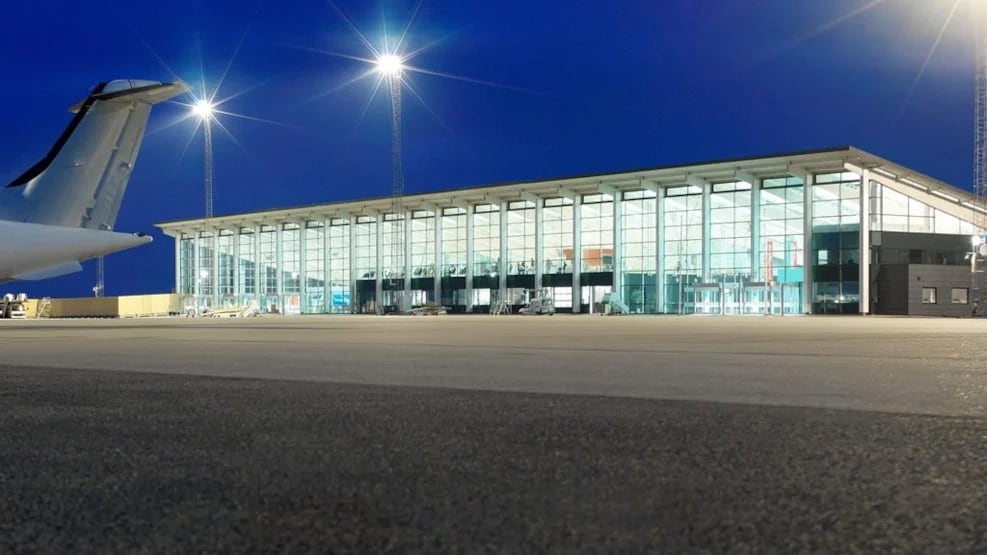
The Aalborg airport, in Northern Denmark, has closed this Wednesday for the presence of drones in the airspace, as the Fumtradar flight monitoring service advanced and confirmed the police. The incident occurs when Denmark and Norway investigate similar events that occurred on Monday. According to a police statement, drones were also stubborn in the Airports of Esbjerg, Snderborg and the Skrydstrup air base, although they did not have to be closed.
This is the second sighting of this type in three days in the Nordic country. The Copenhagen airport, the eldest of Denmark, closed for four hours Monday night due to the presence of this type of aircraft that caused delays and flight cancellations. The Oslo airfield, in Norway, lived a similar incident the same night.
The disturbances at Aalborg airport, according to the Danish National Police, also affected the Army because there is a military base. According to Flightradar, three civil arrival flights of SAS, Norwegian and KLM companies have been redirected, and an arrival flight and two departure have been canceled.
“Drones have been observed near the Aalborg airport and the airspace has been closed. The police are in the place and is investigating the matter,” said the northern Jutland police in the social network X. The National Police has reported that the drones have followed the same pattern as the incident on Monday.
In a press conference at midnight, the Regional Police said that more than one drone had been seen flying over the infrastructure. “We evaluate that there is no danger to residents or for the airport,” he said.
According to the police, the drones were first sighted around 9.44 on Wednesday, peninsular time, and the press conference time, 12.05, remained in airspace. The police in northern Jutland said that he could not specify the type of drones or if they were the same that flew over the Copenhagen airport on Monday. “It’s too early to say what is the goal of drones and who is behind,” said a police officer.
The Danish Prime Minister, Mette Frederiksen, described what happened on Monday as “the most serious attack on Danish critical infrastructure to date.” “Obviously, we do not rule out any option as to who is behind this,” Frederiksen said. “And it is clear that this fits with the developments we have recently observed with other drones attacks, airspace rapes, and hacker attacks on European airports,” added the leader.
The Norwegian and Danish authorities are in close contact for the incidents that occurred on Monday, but their investigation has not yet established any connection, according to the Norwegian Foreign Minister of Foreign Affairs.
The Russian government denied Tuesday that Moscow was behind the incident. “Periodically making unfounded accusations lead, frankly speaking, that the new statements are not taken seriously,” Dmitri Peskov, spokesman for the Russian presidency, told a press conference.
Berlin, Brussels and Heathrow (London) airports suffered cyber attacks on Friday night in the software From Collins Aerospace, used by all these airfields for flight billing, shipping and luggage management. Computer problems in these services caused dozens of cancellations and delays, which in the case of the Belgian capital have felt several days.
The National Agency against the Crime of the United Kingdom (NCA) arrested a suspect of being involved in these incidents on Wednesday. Continuous research and the British authorities have not indicated neither the reasons for cyber attack nor the concrete details of its execution.
These unidentified authorship events, which are investigated as hybrid attacks, occur while NATO elevates the voice in front of Russia after the incursion into the airspace of several of its member states of drones and fighters. First were Romania and especially Poland, two weeks ago. In the Polish case, almost twenty Russian drones invaded their territory and the alliance responded for the first time with the demolition by fighters of their allies of those aircraft. Romania also saw a Russian drone cross through his sky.
Last week three fighters remained for 12 minutes in Estonia’s airspace. It has also been seen in the Baltic, on an oil platform, a Russian spy plane. Both Warsovia and Tallin activated article 4 of NATO, which launches consultations within the alliance when a member feels that their territorial integrity, their political independence or security are threatened. The Alliance has warned Moscow that he will not hesitate to use “all force” to protect the allies.
For more updates, visit our homepage: NewsTimesWire