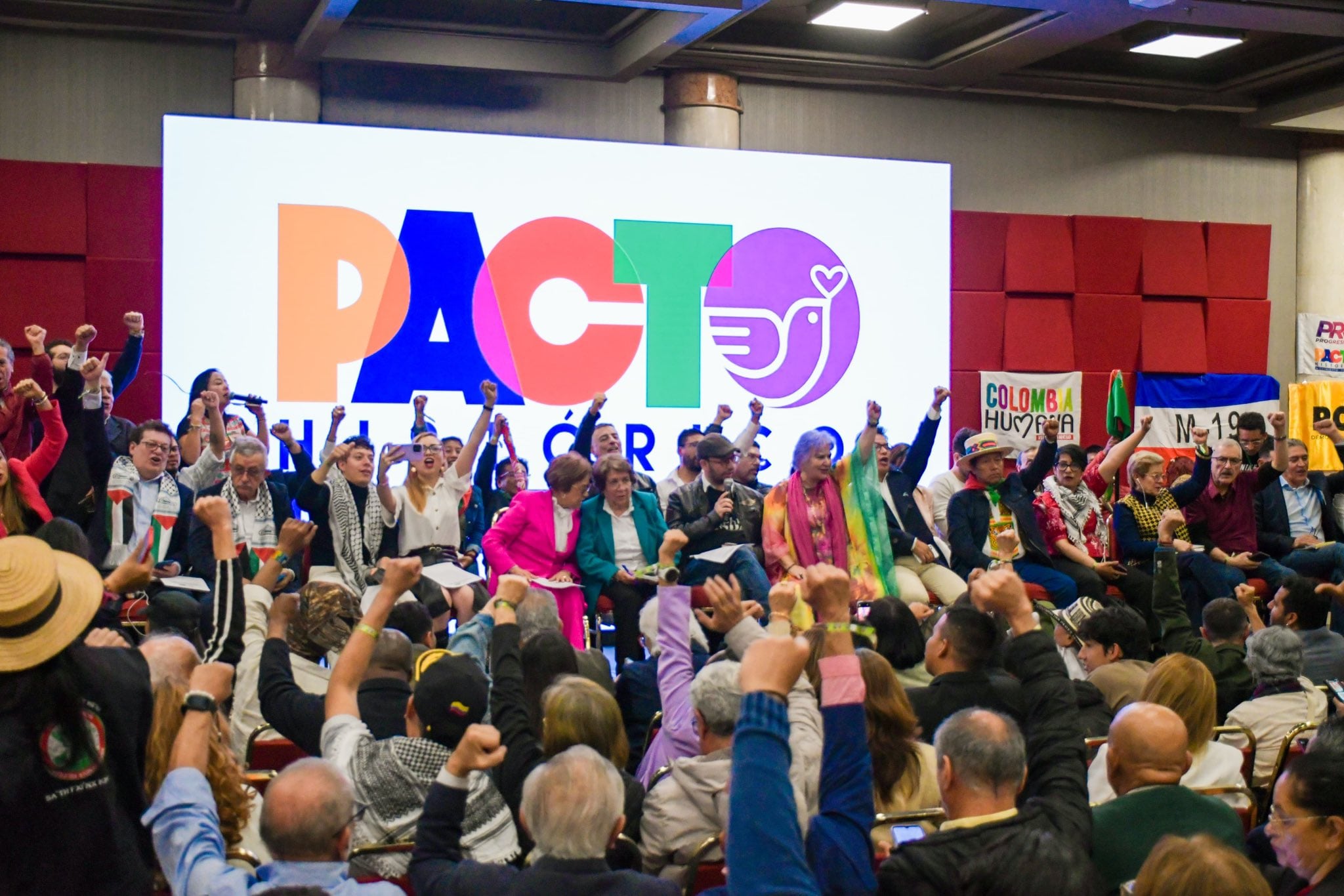
The historical pact has announced by surprise this Thursday that you give up a popular consultation on October 26 to choose its presidential candidate. The coalition of progressive forces that supports Gustavo Petro’s government has said in a statement that the political committee will now be responsible for defining a new mechanism that “guarantees a single candidacy in the name of the historical pact in this electoral contest.” It also postpones the main definitions to give priority to the so -called interparty consultation, which is held next March on the same date of the legislative elections.
“Regarding the selection of presidential candidacy, and considering the lack of legal certainties that guarantee the participation of the candidacy chosen in a consultation of the Broad Front in March together with other leaderships and allied sectors, we have resolved to prioritize said consultation as the final space that ensures the choice of the winning option for the presidential elections of May,” says the statement.
The original road map that had been proposed by the historical pact went to make a consultation at the polls on October 26 to choose both a presidential candidacy and its lists to the Senate. A kind of primaries. The winner of that first consultation (partisanist, in the Colombian electoral jargon) would be measured in March of the next year in another consultation (interparty), as part of the broader coalition that they call Broad Front. That plan is the one that has brought this Thursday to overcome the labyrinth of resolutions of the National Electoral Council that has hindered the promised unit of the Colombian left.
The opaque organism in charge of regulating political parties and elections half passed last week the fusion of the historical pact, a coalition of progressive forces of all kinds that wanted to reach the polls as a unified party. While authorizing the conditioned confluence of the Democratic Pole, the Communist Party and the Patriotic Union, left the Human Colombia out so much, the party of the president and several of the candidates, such as progressive, the movement of Senator María José Pizarro, another of the candidates to succeed him. That decision left the partisan consultation that all these forces had already agreed.
Earlier this Thursday, the Superior Court of Bogotá had launched a lifeguard to the parties and movements by enabling the registration of all the candidates for the consultation of October 26, a provisional measure in response to a guardianship of former senator Gustavo Bolívar and the former health minister Carolina Corcho, two other candidates. The Court considered that the resolution of the CNE could generate irremediable damage by restricting political participation in equal terms, but its ruling did not modify the decision of the historical pact to rethink its electoral route.
The now suspended partisan consultation had postulated a dozen candidates. Among them were Senators Pizarro, Iván Cepeda and Gloria Flórez, former senator Bolívar, or former minister Susana Muhamad (environment), Gloria Inés Ramírez (work) and cork itself (health). The list was completed by the former mayor of Medellín Daniel Quintero – the one that wakes up among the progressive sectors -, the Afro -descendant leader Ali Bantú and the former head of presidential dispatch Alfredo Saade.
“Current candidates may continue, if they decide, in their aspiration to represent the historical pact in the Broad Front consultation, presenting its programmatic proposal and accompanying the process for the Congress of the Republic,” concludes the statement signed by the National Political Committee. Waiting for new definitions, Petro himself has requested to shorten that list of applicants.
For more updates, visit our homepage: NewsTimesWire