The United States has announced the first reprisals against Colombia for its adhesion to the new Silk route, the China Investment and Infrastructure Megogram, with which the Asian country seeks to expand its global influence. The Western Hemisphere Affairs Office has stated this Thursday in X that the US “will strongly oppose recent and upcoming projects” by the Inter -American Development Bank (IDB) and other financial institutions “for state companies and controlled by the Chinese government” in the South American country. According to this office, part of the State Department, these projects “endanger the security of the region.”
US will strongly oppose recent projects and upcoming disbursements by @el_bid and other international financial institutions for state companies and controlled by the Chinese government in Colombia (as in other countries in the region where the …
– Bureau of Western Hemisphere Affairs (@whaasstsecty) May 15, 2025
Although the message does not explicitly mention it, the Bogotá Metro, the project with the greatest investment in the South American country, is the first one that is sights. The IDB approved at the end of 2023 a credit line of 415 million dollars, money to finance the construction of tunnels, stations and the adaptation of urban public spaces for line 2, whose elaboration is in charge of a consortium in which the state company China CRRC is located. Metro line 1, scheduled to open in 2028, also received support from the IDB and the International Bank for Reconstruction and Development (BIRF) and the European Investment Bank (BEI).
The measure will not only affect Colombia, but also “other countries in the region where the initiative of the Strip and the route has projects,” says the message, among which are Chile, Argentina, Uruguay, Ecuador, Peru and Brazil. “North American taxpayers should not be used in any way by international organizations to subsidize Chinese companies in our hemisphere,” the office added.
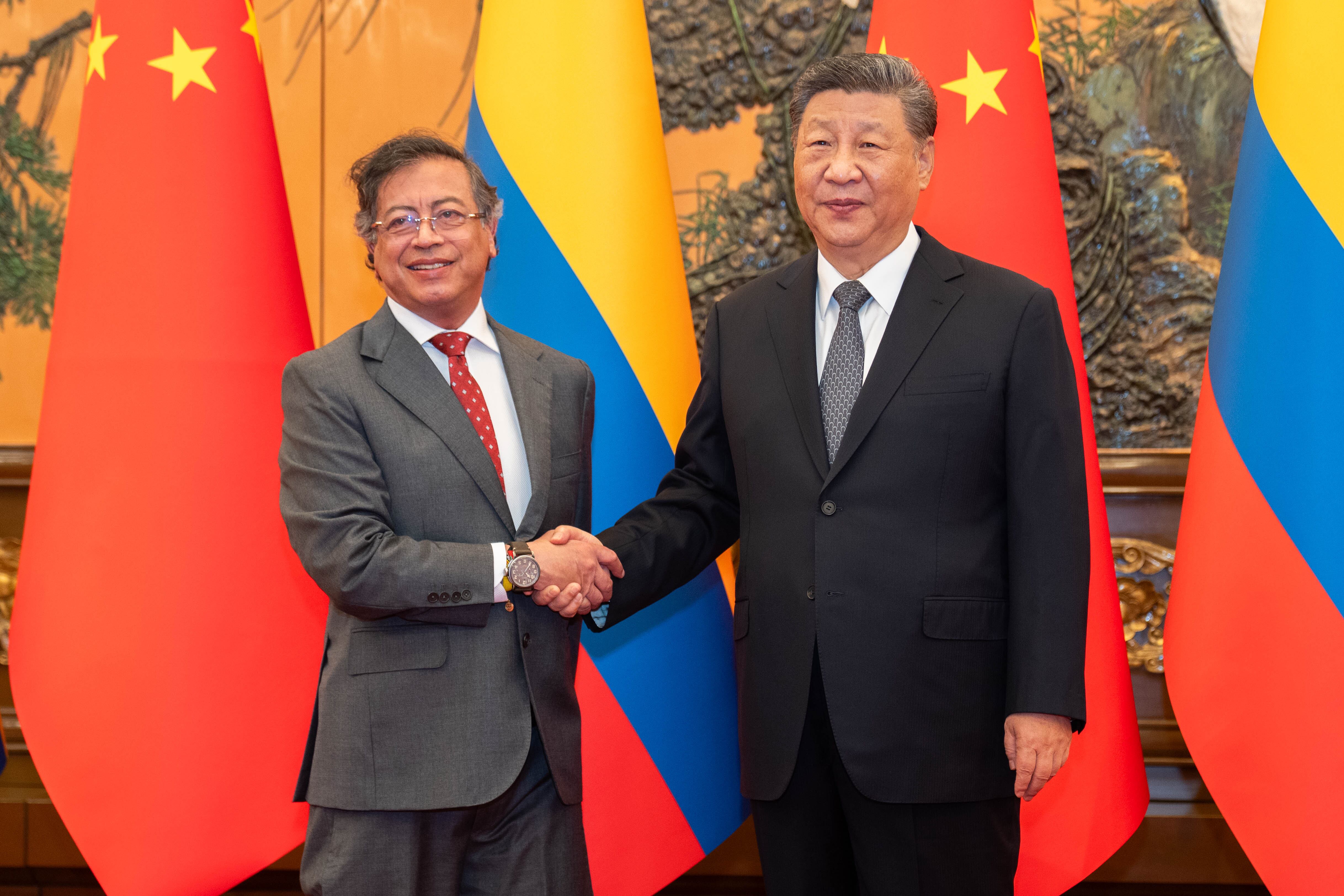
The president of Colombia, Gustavo Petro, traveled to Beijing this week for the meeting of Foreign Ministers of China and the Community of States of Latin America and the Caribbean (CELAC) and to meet his Chinese counterpart, Xi Jinping, and specify the adhesion of the South American country to the Asian initiative. Petro said on Wednesday that this seeks to “finish the commercial deficit with China”, which amounts to 14,000 million dollars annually. “I look for a central Colombia in the world, as its geographical position deserves and its people,” he said in X.
In Beijing’s appointment, Xi promised a new credit line for more than 9,000 million dollars for the region and promised to strengthen ties with Latin America “in the face of geopolitical turbulence” and “the regular countercurrent of unilateralism and protectionism” promulgated by the American Donald Trump.
In any case, the cooperation plan signed both countries is not a treaty, nor a “document with legal obligations,” the Colombian Foreign Ministry confirmed. Although the agreed is not yet binding, the pact contemplates development in projects in areas such as energy transition, agribusiness, mobility and artificial intelligence. “This is a historical step that can define Colombia’s course in the 21st century,” said the Foreign Ministry.
The special envoy for Trump’s Latin America, the Cuban American Mauricio Claver-Carone, had already expressed the disagreement of the United States with any pact that Colombia reached with China. The diplomat said last week that “the approach of President Petro with China is a great opportunity for Ecuador’s roses and coffee in Central America”, alluding to the fact that the main products that Colombia exports to its partner of the North will be in danger of the relationship with the Asian giant.
News flash. There will be update shortly …
For more updates, visit our homepage: NewsTimesWire