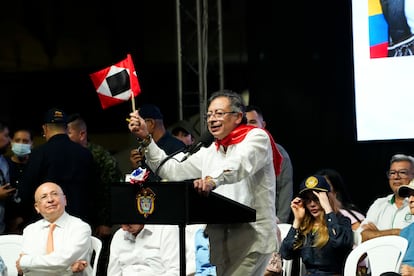
In his last speech as head of state before the United Nations General Assembly, last week, Gustavo Petro made a dramatic emphasis to point out the small badge he carried in his left pocket of his white guayabera. “Either greed or life. Or local and global barbaric or democracy. O Freedom or Death, as Bolívar said, and raised his flag: red, black and also white,” said the president of Colombia from the lectern. “Freedom, red. Death, black. White, possible peace. It is a world revolution of peoples what is needed to positively overcome the climatic crisis and not let it reach a global collapse. It is a revolution of the United Peoples, of civilizations that have to dialog Gaza
It is not the first time that Petro exalts the flag of the so -called “Death War”, despite the flood of criticism that awakens his recurring discursive violence. He did it for the first time last May, the International Labor Day. In his speech of that day of mobilizations, from the Plaza de Bolívar, Petro wielded the sword of the Liberator, a historical relic that had promised to “unveil” as a symbol of popular power. In several passages, he redoubled his attacks against Congress, whose building gives to the square and was covered by a black protective mesh that insistently resembled a “shroud”. In that same intervention he claimed another bolivar symbol, less known. It was then that he first raised the “flag of freedom or death”, as he usually qualifies. The same that looks at the presidential desktop in photos published by Petro himself on his social networks. And whose use begins to replicate the most strident official candidates, such as the former medellin mayor Daniel Quintero.
Although Bolívar – in its different facets – has been a cult figure for both the conservative sectors and for part of the left, various experts warn that choosing that symbol in particular glorifies violence at a very delicate time, with a budding campaign. And they warn the risks of the president of the president in a country that has just suffered the return of political violence that was believed to be overcome, with the murder of the senator and opposition candidate Miguel Uribe Turbay – who died in August in the clinic where for two months he was between life and death since a hitman shot him in the head during a rally.
“Its use of the” War to Death “flag of Bolívar is unacceptable,” wrote constitutionalist Rodrigo Uprimny in a column in which Petro’s speech calls the UN as a lost opportunity. “Many things in Bolívar deserve to be claimed, but the” death war “is not one of them. It was the worst moment of his heroic career, because he raised in 1813 killing every Spanish, although he had not committed any crime or support the realistic troops,” he says. “Bolívar himself abandoned that strategy and agreed years later the regularization of war with Pablo Morillo, in order to avoid those atrocities. Surprising then that Petro, who claims to direct the government of life, claim the atrocious” war to death “of Bolivar.”
The president, ten months after finishing his four -year period, has staged all kinds of symbolic gestures since the ceremony itself in which he took possession on August 7, 2022, when his first order as president was to bring the same sword of Bolivar, among many other examples. The guerrillas to which he belonged in his youth, the M-19, had a Bolivarian character. And also on more than one occasion he has exalted the figure of José María Melo, a relatively forgotten president who fought with Bolívar and then in the ranks of Benito Juárez. Petro has become a state issue of repatriating his remains from Mexico. Experts have warned again and again the lack of rigor in that militant interpretation of history, which usually omit or blur important nuances.
The death war, specifically, refers to a period of extreme violence in the Venezuelan War of Independence. Its origin was a decree that Bolívar issued on June 15, 1813 in Trujillo (Venezuela), which warned that Europeans who did not support the cause of independence would be passed through weapons. “Spaniards and Canaries, counting on death, even being indifferent, if you do not actively obsess in the gift of the freedom of America. Americans, have life, even when you are guilty,” concluded that proclamation.
The stories speak of mutilations of corpses, massive executions of prisoners or massacres of innermes. The excesses, side and side, of Republicans and realistic, without barracks for the defeated, led to a very large radicalization, with dyes at times of a racial confrontation between black and mulatto communities against the Creole elites of Caracas – the so -called Mantuans. “The death war favored the appearance of guerrillas, looting to properties, population displacement and many summary executions of part and part,” says historian Arnovy Fajardo, professor at the Externado University of Colombia. Officially the war to death remained until 1820, when the independentistas had achieved definitive victories in what was the new Granada. Then Bolívar met with Morillo and sealed an agreement to regularize the war.
“It is one of the manifestations of the resurgence of violence in the War of Independence, where each side sought to express themselves with an increasing sevice against the enemy and its supporters,” says historian Felipe Arias. The black, red and white flag, specifically, “is a very ephemeral symbol of use that will not transcend time like many other symbols of the war of independence, but being connected to the figure of Bolívar certain contemporary claims of the Bolivarian cult will start using it,” adds the author of Another history of Colombia? Since 1814 the tricolor, yellow, blue and red, which end up being the colors, with minimal variations, of the flags of Colombia, Venezuela and Ecuador that they did last.
For more updates, visit our homepage: NewsTimesWire