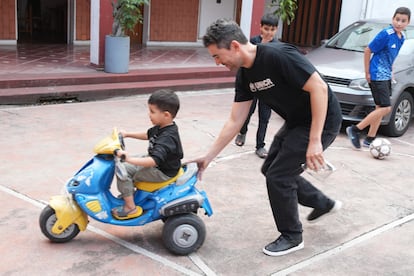
In a hostel of Mexico City I met four Palestinian families who, after having lost everything in one of the most devastating conflicts of our time, have found refuge in our country. Their stories come as bursts: the life they left behind, their love stories, the horrors of the armed attack that disproportionately affects the most vulnerable people, the lost earth, the flavors that they miss – it seems that the meatballs are always better at home -, the things that can no longer be recovered. Houses, jobs, streets that had name and are now rubble.
In his words, beauty and frustration coexist. His eyes, loaded with emotions so intense that one barely dares to look at them too long, they seem to sustain a difficult language to decipher. At some point, a voice asks the impossible question to answer:
“Who is going to return my land, my companies?”
After my endless silence, he tells me:
“I didn’t do anything.” I only worked to keep my family. It even helped humanitarian causes.
That last comment crosses my soul. While I port my acnur shirt, I can’t help thinking that, in this changing and capricious world, we could all be refugees at some point.
The questions are thrown into the air with the innocence of those who seek explanation, but land in me with the weight of a trial. As if someone, for having witnessed, could offer justice.
Working as a goodwill ambassador to ACNUR is an experience as bright as painful. The exercise of listening and containing hundreds of stories, of empathizing with such heartbreaking emotions, forces to learn to smile even when, inside, the heart drowns.
And yet, life insists. Children play. One teaches me his scars and smiles timidly; I smile back while pushing it on a toy motorcycle in the patio. Another, with a ball in my hands, looks at me and pronounces, proud, one of the few words that already dominates in Spanish:
“Do you know?”
I would like to tell him yes, but I don’t want a bad impression of Mexican football.
Then the collective question arises, what do we do? How can we help?
We are flooded with news, videos and images that become increasingly immune to suffering. The skin becomes thick, even if one does not want. A very sad survival mechanism.
What do we do?
Take action.
In addition to talking, having awkward conversations, of using our networks to denounce injustices, we can do something very concrete:help those who help.
To those who have been holding the unsustainable years: managing shelters, understanding migratory flows, supporting refugees, providing legal advice, food, a roof; Looking for, day after day, how to reintegrate them to society. To ours.
In this shelter there are also refugees from Honduras, from Haiti, from Cuba, Venezuela and Afghanistan. All with love and loss stories that cross in the same patio, in the same kitchen. The food depends on the goodwill of different organizations and civil society.
If you are interested in helping them, go to: https://www.casarefugiados.org/sumate
ACNUR, the UN Agency for Refugees, protects people forced to flee due to conflicts and persecutions. You can join in https://bit.ly/luisgerardoacnur
Shadi, one of the Palestinian refugees, has a cafeteria in Jilotepec, State of Mexico. He and his family have coffee with the inherited tradition. He gives me a bag, proud, and asks me to smell it. The aromas can make us cry for many reasons, right? The memories of childhood, some old love or – as in this case – the ghost of a cafeteria in Gaza that no longer exists.
We can also help Shadi. Your coffee is calledCafé Abu El Araband never a coffee will make you feel something like that. You find it on Instagram.
These four families, eighteen people from Palestine, begin their new life in our city. Thanks to the support of these organizations they now prepare for their Spanish classes, to gradually look for the labor market, our customs. You have to say it, they don’t look happy; There is a lot of pain in the looks. But there is also hope. Despite their circumstances, they know they are fortunate, that the only alarm they could hear here would be the seismic. The pumps are over.
Shadi gives me a metal chain with a Palestine flag. He puts it on the neck. I give him a hug and I can only tell him:
“Good luck, dear Shadi.” We continue.
For more updates, visit our homepage: NewsTimesWire