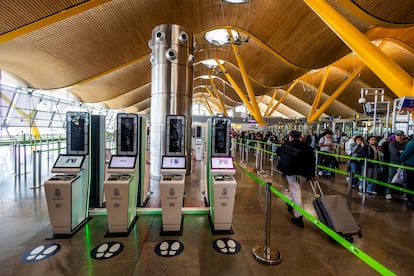
A flight that will arrive early next Sunday at the Madrid-Barajas-Adolfo Suárez airport will be the first to test in Spain the new European automatic border control system that registers the face and fingerprints of non-EU travelers in a large database that will be managed by the European Commission and which EU countries will be able to access in real time.
The Entry and Exit System, called EES for its acronym in English (Entry-Exit System), will be implemented throughout Europe progressively in the coming months and is expected to be fully operational on April 10. This collection of information from citizens arriving from outside the Schengen Area seeks to meet security and migration objectives in border management and the prevention of cross-border crime, which will serve to combat terrorism crimes, organized crime or irregular immigration.
Three days before the premiere, a group of National Police officers and personnel from the Ministry of the Interior showed this Thursday to a group of media how the automatic border posts, which they call kiosks, work. 48 of these machines were already ready to scan travelers’ passports and check their biometric data (such as their facial image and the prints of four fingers on their right hand, all except the thumb).
Juan Manuel Valle, chief inspector of the Central Border Unit, explained that once travelers register for the first time, the process will be much faster. “The format is very intuitive to cause minimal disruption,” he detailed. Through a screen, the kiosk asks the traveler for the same documents or asks the same questions that a National Police agent could ask them, such as whether they have a hotel reservation, means of livelihood or length of stay. There will be police officers and assistants in the area who will help people who have to use them, explained one of the National Police agents.
After registering their data at the kiosk, non-EU travelers must go through a type of turnstile, which they call the “ABC gate,” which scans their passports again and registers their face again to check if it is the same person. This double check is intended to prevent passports from being exchanged and another person using the document, Interior sources explain. If the agent supervising the process has not seen any inconvenience, he or she allows departure from the airport. In case there is a problem, the traveler must go to a manual checkpoint (PCM), where the agents are located.
The system will be implemented first in airports, then at land borders and finally in ports. Spain, like the rest of the countries, has a series of objectives that it must meet as the months go by. “It is likely that not all travelers’ biometric data will be collected or that their information will not be recorded in the system, because it will come into operation gradually,” explain sources from the Ministry of the Interior.
Passports will continue to be stamped until April, but when the EES is fully operational, this will stop. “It is a process that consumes a lot of time, does not provide reliable data on border crossings and does not allow the systematic detection of people who have exceeded the maximum duration of their authorized stay,” they add from Fernando Grande-Marlaska’s department.
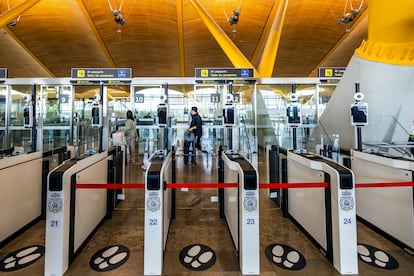
The EES will register travelers from non-EU third countries each time they cross an external border of one of the 29 European countries that are part of the Schengen Area to stay for a maximum of 90 days in any 180-day period and this data, including rejections, will be available for consultation by European law enforcement agencies. If the traveler requires an entry visa, the system will only store their passport data and facial image, because their fingerprints were already recorded when they applied for the visa. If you don’t need it, it will also collect your fingerprints.
The European Commission presented its smart borders proposal in April 2016 and it was approved in July 2017. The EES Regulation, together with a specific amendment to the Schengen Borders Code, entered into force on 29 December 2017.
The Interior has invested 83 million euros to adapt all Spanish border posts to the technical requirements of the EES, which continue to be the responsibility of the National Police, while the Civil Guard retains its tax protection missions.
The land and air borders are already prepared, according to the ministry, while in the case of the ports, some tenders are pending from the port authorities.
Interior emphasizes that the technology used by the EES meets all the requirements of the EU General Data Protection Regulation and “guarantees the protection of people’s fundamental rights.” The data will only be kept in the system “for as long as necessary” and “for the purposes for which it was collected,” they add.
For more updates, visit our homepage: NewsTimesWire