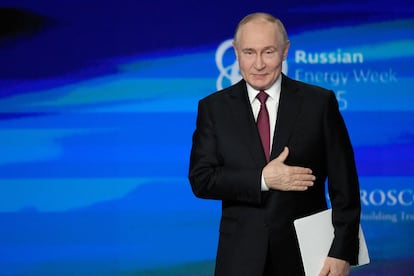
The president of the United States, Donald Trump, announced this Thursday after a “long and productive” phone call with his Russian counterpart, Vladimir Putin, that both have committed to meeting in “an agreed place, Budapest (Hungary), to see” if they can “end (the) ignominious war between Russia and Ukraine.”
Trump spoke with Putin a day before Ukrainian Volodymyr Zelensky’s visit to the White House this Friday. Trump announced the call on his social network, Truth. In that same forum he gave details about the fruit of that talk. In an appearance in the Oval Office with the press, he announced hours later that this meeting in Budapest will take place “probably in the next two weeks.” “So it will be quick.” He did not specify, however, whether Zelensky’s participation is expected.
In Truth, he had said that Putin had congratulated him “and the United States for the great achievement of peace in the Middle East.” “I firmly believe that this success will contribute to our negotiations to end the war with Russia and Ukraine,” Trump wrote. “We also spent considerable time talking about trade between Russia and the United States once the war with Ukraine is over. At the end of the call, we agreed that our high-level advisors will meet next week. The initial US meetings will be led by Secretary of State Marco Rubio, along with others to be appointed soon. The location of the meeting (with Rubio) is to be determined,” he clarified.
Later, before the press, he spoke about his participation alongside the Vice President’s Secretary of State, JD Vance, and Trump’s top negotiator, Steve Witkoff. “I have ended eight wars. This will be the ninth,” he promised. Not all conflicts with which his Administration is presumed to have ended did he play a crucial role and even fewer remain to be resolved.
“I think today’s phone conversation (with Putin) was a big step forward,” Trump had written in Truth. In it, the Russian president warned the American against a hypothetical delivery of precision missiles to kyiv, according to Moscow.
“Putin told Trump that the Tomahawks will not change the situation on the battlefield, but they will harm Russian-American relations and the agreement on Ukraine,” the Russian leader’s adviser Yuri Ushakov said after the call. Trump told reporters at the White House that he had told his counterpart to prepare for the sale of “a couple thousand” of those missiles to Ukraine. “I told you so,” the Republican repeated three times. Afterwards, he seemed less ready to provide such military aid to kyiv. “We also need Tomahawks in the United States.”
Ushakov described the talk as “extremely frank and confidential,” as well as “very substantial.” Along the way, Putin, always according to Moscow, also tried to convince Trump again that Russia “retains the strategic initiative” despite the fact that its summer offensive has not achieved any substantial progress at the cost of numerous casualties. Ushakov assured that the idea of meeting in Budapest was the Russian president’s. The Hungarian Prime Minister, Viktor Orbán, declared himself “ready” to receive the two presidents, with whom he aligns himself; “This is great news for the peace-loving peoples of the world,” he wrote on the social network X.
The meeting in Washington with Zelensky – in which, Trump advanced, they will discuss this Thursday’s conversation with Putin “and many other topics” – is for a “working lunch” in which, as planned, both leaders will discuss the possibility of a new shipment of weapons for the defense of kyiv. Trump and Zelensky spoke by phone twice last weekend. Throughout this week, a Ukrainian delegation led by the Prime Minister, Yulia Svyrydenko, and the head of the Presidential Office, Andrii Yermak, has held preparatory meetings at different levels in the US capital, among others, with Rubio.
“The leadership of the United States and, personally, of President Donald Trump have made peace in the Middle East possible. This is the vision that the world, and Ukraine in particular, needs today,” Yermak said on his social networks.
Trump stated last Sunday during his trip to the Middle East to attend the signing of the first phase of the peace plan between Israel and Hamas in Gaza, that he had informed Zelensky that he was ready for a new ultimatum to Putin: either Russia commits to serious peace talks or Ukraine will receive powerful Tomahawk missiles from the United States. “(Ukraine) would like to have them. To be honest, I might have to talk to Russia about the Tomahawks. Do they want to have (that type of) missiles heading towards their country? I don’t think so,” he told reporters accompanying him aboard the presidential plane.
Putin has not at any time shown concern about this supposed delivery of Tomahawk to Ukraine. Not only that: the president did not respond this week with an escalation and limited himself to saying that Russia will need “more anti-aircraft systems.”
The idea that Trump is ready to continue with Ukraine, after the diplomatic achievement, still uncertain, last week with Gaza, is gaining strength these days in Washington. The president of the United States won the election with, among other things, the promise that he would end the Russian invasion on his first day in the Oval Office. 269 days have passed and the war is far from easing in intensity as it heads into its fourth winter.
Trump has issued several ultimatums to Putin in these nine months with the announcement of more sanctions that later never materialized. Both leaders met in Alaska on August 15, in a meeting from which the Russian president emerged stronger.
In Russian propaganda, a good thermometer of the Kremlin’s plans, it was suggested two days ago that the delivery of Tomahawk will only be a theatrical act agreed upon by the two leaders in Alaska. “This way one of the two parties will come out to make some concession and give an opportunity to start negotiations again,” said former Ukrainian politician exiled in Russia Spiridon Kilinkarov on Rossiya 1.
At that summit in Anchorage, the American president not only removed his counterpart from the international isolation in which he found himself and forgot the threats of imposing new taxes on Russia to force a change of mind from the Kremlin; He also accepted Putin’s main demands to start talking about the end of the war. In total, Russia has occupied about 20% of the neighboring country.
Afterwards, the Republican tried a new strategy with also few results: putting pressure on Moscow through third countries, mainly China and India, which still buy oil from Russia. The Republican also maneuvered to get NATO to stop buying crude oil from that country.
Last Friday, in another demonstration of Washington’s unpredictable swings on this matter, the first lady, Melania Trump, assured that she maintains an “open channel of communication” with Putin from Alaska. The goal: to repatriate Ukrainian children forcibly transferred to Russia. Some, the first lady said, have already been returned. “In fact, eight children have been reunited with their families in the last 24 hours,” he added. This Thursday, Trump wrote in Truth that his wife’s gesture had also been part of the conversation with Putin.
intense week
The announcement of the call between Trump and Putin comes in an intense week in the White House’s foreign policy in which the American has continued to pressure the Nicolás Maduro regime with the fifth extrajudicial operation against an alleged drug boat in international waters of the Caribbean. In that action, the US Army killed the six crew members without prior trial and without providing evidence about their identity or the cargo they were carrying. Then came confirmation that the Republican has authorized the CIA to carry out covert actions in Venezuela.
Trump has also threatened Spain with tariffs for not raising defense spending to 5% of GDP, as the US leader has asked of NATO partners. He did so within the framework of a visit by Argentine President Javier Milei during which Washington sealed its commitment to giving Buenos Aires a boost of oxygen by granting a swap of foreign currency for 20,000 million dollars to shore up the economy of the South American country. In an attempt to interfere in the internal politics of another country, the Republican made this aid conditional on Argentines voting for Milei in the elections on October 26.
For more updates, visit our homepage: NewsTimesWire