Kepa Junkera, a legend of Basque music, had a stroke rob him of his speech in 2017. He was 52 years old when the blood stopped supplying his brain. Indescribable tragedy for any mortal, but especially for those who express themselves with the echo of their voice. It took seven years for the unthinkable: a radio station in Bilbao interviewed him with the help of artificial intelligence. “Although it is not my voice, they are thoughts,” said Junkera.
One of the architects of the miracle was Ana Ormaechea, digital director of the PRISA Group radio stations. The method: voice cloning, a low-cost tool that already existed on the market. They selected old interviews of the musician and technology did its thing. “Let’s stop demonizing artificial intelligence. This is a clear example that everything depends on the use,” Ormaechea said this Thursday during one of the panels at the International Language Congress of Arequipa (CILE).
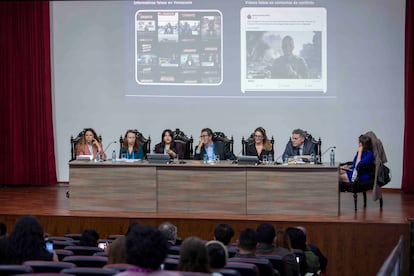
In the Arequipay theater of the Municipal Palace, a group of specialists met to discuss digital journalism and misinformation in this era marked by digital tools that allow us to see a UFO crashing into the White House, the emblematic Hollywood sign on fire or Milei kissing the flag of the United States in front of Donald Trump. Three events that have not happened, but that have been propagated as real in recent times.
The table was moderated by Julián Quirós, director of the newspaper ABC; Sonia Pérez, press officer of the Cervantes Institute, and Olivia Piquero, director of Communication of the Royal Spanish Academy (RAE). The shortlist of speakers was completed by Angélica Rodríguez, coordinator of Efe Verifica in Latin America; Natalia Blanc, editor of the newspaper’s culture section The Nation and Ramón Salaverría, professor of Journalism at the University of Navarra and pioneer of digital journalism in Spain.
Although there is more talk about its dangers and threats, everyone agrees that AI is a gateway to infinite possibilities. But it all depends on the prism through which you see it. Ormaechea, who is far from being apocalyptic, is in favor of the media becoming the great filters of information based on craft, transparency and reputation. “The media must be certifiers of reality. Contrary to what some may think, it is a good time to assert who we are.”
Argentine Natalia Blanc comes from the analog world but her thinking is similar: the backbone of journalism will not change no matter how much generative AI we use. Blanc played a peculiar game: he confronted the Decalogue of the journalist by Tomás Eloy Martínez with the AI. He asked him to outline each of his precepts in his own way. While the author of Santa Evita wrote that “the only asset of the journalist is his good name”, the machine replied: “credibility is the most powerful algorithm.” “Each post, thread, note or audio builds or erodes your authority.”
Angélica Rodríguez narrated her data verification work. And he shared a dilemma: turn to AI detection tools to verify its falsehood or manipulation. In other words, AI is the poison, but at the same time the cure. The drawback is accuracy. Its detection analysis cannot yet be fully trusted, but it is supportive. The biggest lies, he explained, occur during electoral times, where the unscrupulous let their imagination fly to undermine the reputation of their adversaries. “We have not stopped trusting in traditional journalism to find the truth. Human value will continue to be at the center of journalistic work.”
Ramón Salaverría, for his part, emphasized that journalistic organizations must understand the current moment. “I understand that in the midst of the financial difficulties that the media are going through, it is difficult to escape the temptations of anything goes. Because artificial intelligence, which has entered through the back door, without transparency, allows things to be done with less effort and at a lower cost.” That is why he stressed that those in charge of the media must establish firm principles so that journalists make responsible and transparent use of technologies. “Citizens can forgive mistakes, but never lies.”
For more updates, visit our homepage: NewsTimesWire