EL PAÍS offers the América Futura section openly for its daily and global information contribution on sustainable development. If you want to support our journalism, subscribe here.
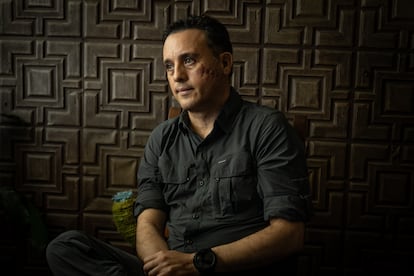
There is no movie that has done more damage to the reputation of an animal than Shark by Steven Spielberg. It premiered in the summer of 1975, but the fear it instilled in people is still latent 50 years later. For marine biologist Mauricio Hoyos, however, it had the opposite effect. “It made me fall in love with the white shark and dedicate my life to working with these incredible animals,” acknowledges the Mexican, who receives América Futura at his mother’s house in Mexico City, where he is recovering from the serious accident he suffered a few weeks ago in Costa Rican waters.
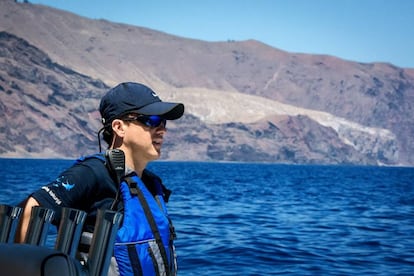
Hoyos, who normally resides in La Paz on Mexico’s Baja California peninsula, had traveled to the Coco Islands as part of the One Ocean Worldwide Coalition for the conservation of the oceans and their biodiversity. The objective of the expedition was to implant markers in hammerhead sharks to follow their local movements and migrations, map the coordinates of their habitat and be able to monitor their populations, drastically reduced around the world in recent decades. A fundamental activity for its protection and that is part of the routine of the biologist, who has carried out some 2,000 markings throughout his career.
Armed with his hawaiiana fishing harpoon with a special tip for it, had just installed a transmitter on an almost four-meter female of the Galapagos species and was preparing to collect its data on a tablet when it received a bite that almost cost it its life. According to him, that specimen had caught his attention due to its size, “so when I saw it swimming towards the bottom I went after it. I oriented myself towards it and shot it at the base of the dorsal fin, where it has the thickest muscle layer and you don’t hurt it as much.” But the animal reacted to the puncture, turned around and then everything happened. “I saw her turn towards me out of the corner of my eye and my immediate reaction was to lower my head. Suddenly, my head was inside her mouth. It was incredible, I felt the pressure of the bite, how my skull cracked!” he says.
On the left side of his face, the striking scars of the accident are drawn: marks from the 29 teeth that the shark stuck into him. “One inch up and it takes away your eye; one inch down and goodbye to your neck,” the surgeon told Hoyos. “It was a defensive bite. If it had been an attack, I wouldn’t be here,” he explains, who has dedicated 30 of his 48 years to studying the behavior and reproduction of these fish, which are among the largest and most endangered in the world.
“He spared my life”
Contrary to what most believe, experts have been showing for years that they only tend to attack as a self-defense reflex. “My head was inside her mouth, I was the most vulnerable animal at that moment, and she did nothing but mark the bite and let me go,” says the biologist. As he explains, when sharks want to kill their prey, they turn their heads sharply. “His teeth are designed to sever. First they bite and then they shake their head to the sides. He could have killed me instantly and he didn’t. He spared my life.”
From that moment on, time began to run in slow motion. In the attack, the animal broke the hoses of the equipment that supply the air, which came out at full pressure. “What scared her,” says Hoyos, who never lost calm about the situation. “I was aware that I was in danger, but I knew what I had to do,” he says. His knowledge of shark behavior, knowing that the animal did not want to attack him, and more than three decades of experience as a diver were key factors in his survival.
Normally, the marine biologist does not usually dive deeper than 20 meters. But they had asked him not to dial while there were tourist activities. “The only time it was possible was at 12, when the animals swim very deep, 40 meters,” he says. The scientist only planned to stay a few minutes at that sea level. But that was the moment the incident occurred. The hose through which he was breathing no longer gave him air supply, so the scientist ran to grab the octopusthe team’s emergency tube. And it began to ascend slowly. “At these depths, you cannot hold your breath when you go up, because when the pressure drops, the gases expand and the lungs or pleura can explode,” he says. Between the water that had entered her visor and the amount of blood, she could barely see when the midday light appeared like a glare and, with it, the enormous shadow of the female that had bitten her. “She surrounded me twice, but she didn’t do anything to me. That’s why, I insist, if it had been an attack, she would have followed me and finished me off. She had the strength and the power,” he emphasizes.
On the surface, the captain of the boat was waiting for him, who quickly helped him get settled and remove his equipment. “When he saw me, he stayed for about 10 seconds without saying anything about the impact. I imagined that I had lost my face, it felt torn,” says the biologist, while putting a hand to his stitched left ear. After removing the visor, blood began to gush out. “They say that when sharks smell a drop of blood, they go into a feeding frenzy, that they go crazy. I did not stop bleeding from 40 meters to the surface and that female did not follow me to eat me. Because we are not part of the menu of the marine ecosystem, our blood has other components that the prey on which they usually feed do not have,” says Hoyos, a great connoisseur of their behavior. fish.
The accident he just suffered is the first incident he has had with one of them. “Between biopsies and marking, I have used the marking tool thousands and thousands of times and with various species: white sharks, which can reach 5 meters, with silver tips, and even bull sharks, which have the strongest bite of all compared to their size. You shoot all of them and they go away,” he highlights. The only ones that have ever reacted, he says, are those from the Galapagos, “although they have never bitten me. They are very large, and dominant animals.” And what they usually do, he explains, “is lower their fins and hunch over to show that they are not happy with your presence.”
That was precisely the reaction that that female had towards the other diver who accompanied Hoyos that morning, and who was able to observe the entire scene. “After biting me, he went towards him, made a threatening gesture and left,” says the scientist, very grateful for the “quick and excellent” medical attention he received from the Costa Rican authorities. And also proud of being able to complete his mission.
“The immune system of the oceans”
The transmitters that he managed to place that day send ultrasonic signals to be detected by receivers installed along the Eastern Tropical Pacific to the United States. “Every time the shark passes by the place within a range of 500 meters, its signal is detected. So, we know when they are there and when they leave,” details the biologist, who spends his time traveling from country to country to dive among them.
“These animals are highly migratory and, although we have marine protected areas, they do not respect the borders made by human beings. Therefore, we want to protect them not only in isolated nations, but internationally.” As an example, he emotionally recounts the case of the longest movement he has monitored: that of a Galapagos shark that made a journey of up to 2,200 kilometers. “It was marked in the Revillagigedo archipelago in Mexico, the largest protected natural area in North America, and moved to Clipperton, France, and from there it moved to the waters of Ecuador,” he points out.
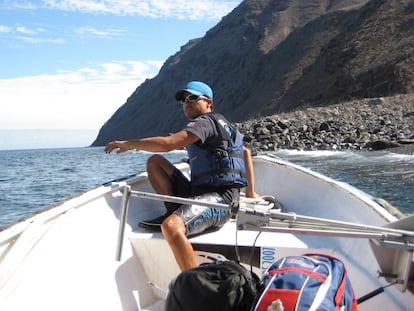
Placing these devices “is essential to determine underwater corridors between protected areas,” explains Hoyos, one of the founders of the Pelagios Kakunha organization. Created in 2010 with his colleague James Ketchum, the main objective of this association is to generate information about migratory sharks and give the Mexican Government the tools to protect these animals, which play a fundamental role in their ecosystems. “They are like the immune system of the oceans, they feed on dead, sick and old organisms precisely to maintain this health in the ecosystem. It is very important to protect them.”
Hollywood told a story about these animals, the scientist points out, “when there was no information and technology. Now that there is, I want to show the other side of sharks. We must put an end to the myth that they are killers, when we kill hundreds of thousands of sharks a day and very few human beings die each year due to incidents with them. Of the 286 attacks reported between 1876 and 2010 by white sharks, only 10% were fatal,” says the biologist, eager to fully recover and be able to return to the next expedition.
As he concludes, these animals have been in the oceans for 450 million years, an environment that we invade. “Sharks are a reminder that we are not the only species on the planet nor the most important. And as part of a whole, we must respect that balance.”
For more updates, visit our homepage: NewsTimesWire