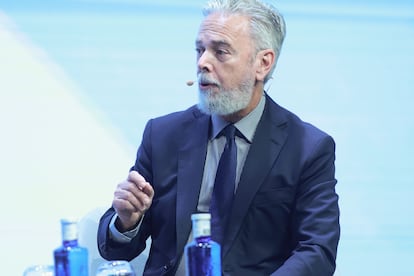
It is impossible to discuss the future of the planet without talking about Brazil. Either because of its continental size, or because 20% of the oxygen produced on the planet lives in its lands. To delve deeper into the internal and diplomatic challenges of the Latin American country, the former director of EL PAÍS, Javier Moreno, and the former Brazilian Foreign Minister, Antonio Patriota, current ambassador to the United Kingdom, participated this Monday in the World In Progress (WIP) forum, an initiative of the PRISA Group that held its second edition at the Palau de Congresos in Barcelona. “We remain very vigilant against those who threaten the institutions and upcoming elections,” stated the Brazilian diplomat.
The ambassador has defended that Brazil, since its independence, has invested in consolidating professional and high-level diplomacy and, despite the military dictatorship and the attacks by the government of former president Jair Bolsonaro, it remains outstanding. The discussion has addressed topics such as the relevance and influence of Brazil in a world marked by conflicts, and Patriota has used the space to reinforce the strength of the Brazilian Ministry of Foreign Affairs, known as Itamaraty, as an institution in the current political context of the country.
The former president was sentenced to 27 years in prison last September and is awaiting a possible amnesty that, according to Antonio Patriota, will hardly come. “We are seeing massive demonstrations throughout the country and recent polls that indicate that the Brazilian electorate would not tolerate a president granting an amnesty to Bolsonaro,” said the diplomat.
However, the historic diplomatic relationship between Brazil and the United States is experiencing an unprecedented level of hostility after the announcement of the new tariffs, a real blow to Brazilian diplomacy. From Washington, Eduardo Bolsonaro —son of the former Brazilian president—, mentioned by Antonio Patriota as having been proposed by his father as a possible ambassador during his mandate, maintained direct contacts with US authorities to promote the increase in tariffs as a form of financial pressure on the Government of Luiz Inácio Lula da Silva. Since then, Brazilian diplomacy has intensified its efforts to reestablish dialogue with the new republican administration.
When asked about the risk of Bolsonaro returning, Patriota recalled that between 60% and 70% of the population rejects the amnesty proposal for the former authoritarian leader and considered that the far-right government was “like an antidote.” “It was a nightmare in many aspects, but perhaps it has inoculated Brazilian society with greater awareness about the defense of democracy,” he stressed.
The Latin American country, in addition to the challenges it faces in its democracy, also seeks prominence in global discussions. Next November it will host the 30th Conference of the Parties (COP30). The Belém summit, in a perfect symbolic setting for the Amazon, comes at a time of high expectations for Brazil as a protagonist of the global climate discussion, with the urgency that the issue requires.
The WIP global discussion forum, which is celebrating its second edition in Barcelona, has the presence of business, political and intellectual leaders to debate the great contemporary challenges: artificial intelligence, sustainability, geopolitics and the future of multilateralism. Among the personalities who will pass through the Palau de Congresos in Barcelona are King Felipe VI, several ministers of the Spanish Government and the president of the Generalitat, Salvador Illa. The two Nobel Peace Prize winners, María Corina Machado and Juan Manuel Santos, also participate, as well as ambassadors, former Latin American and European presidents, and directors of large Spanish companies.
For more updates, visit our homepage: NewsTimesWire