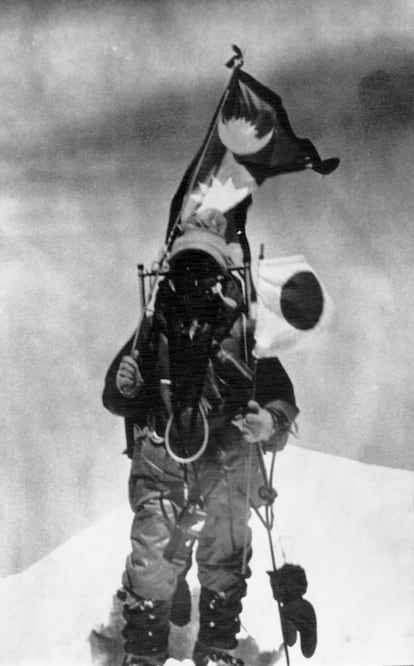
If everyone remembers with extraordinary astonishment on May 23, 1953 as the date of the first ascent to Everest, it would be convenient to remember with identical or greater stupor and rejoiced on May 16, 1975. That day, Junko Tabei, tiny Japanese climbing (1 meter and 48 centimeters) sneaked into the top of the world, premiering there the feminine presence. For many, it was the second conquest of Everest. The avalanches that suffered from the way to the top, the cold or uncertainty of a top without tame, barely eroded their determination. His true fight had to do with invisible walls, incomprehension walls, machismo towers. The official records indicate it as a ‘housewife’, but it was much more: it was the pink that opened the doors of equality in the highest mountains on the earth. The photos of the time show a fibrous body, a too large piolet, a light being and in appearance too fragile to withstand the rigors of the wind, the hypoxia, the cruelty of the high peaks. His image refers to that of a brittle bird transported by the whim of the wind to an unexpected and dangerous place. But the images of half a century also collect her smiling, happy, demonstrating that she was there because she wanted, because she should.
The date on which Edurne passed, 15 years ago, in the first woman to climb the 14 Ochomiles From the planet: The Guipuzcoana closed a dream that Junko Tabei could never consider, even if a seed for the future contradicting both macho and skeptics.
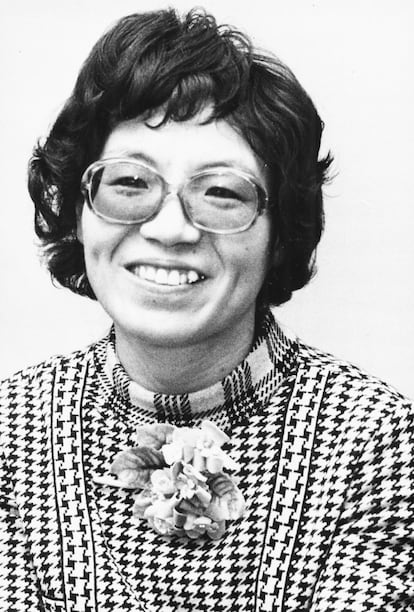
Like so many others before her, Tabei was fascinated by mountaineering not so much for her direct practice and by the evocative power of literature. Graduated in English literature in 1962 by the University for women of Japan (where he created the Ladies Climbing Club Only so that they would not accuse her of joining male clubs looking for a husband), she soaked from the great classic mountain stories that caught an engine that would never go out. Junko did not stay in Everest, he always contemplated this peak as a springboard from which to strengthen his alpinistic career claiming a preferential place for women in the scene.
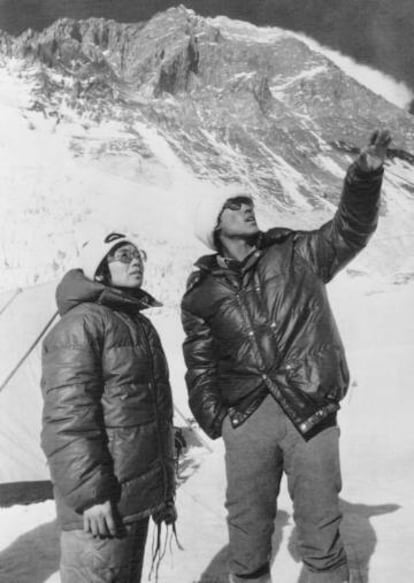
He climbed tops from all continents, returned to the Ochomiles (successes in Shisha Pangma and Cho Oyu), climbed sevenmiles in the Pamir and reached great notoriety as a lecturer in his country. Victim of a cancer in 2016, Tabei never stopped climbing, or military in favor of the presence of women in any social spheres or favor of the environment, demonstrating that genuine passion for climbing does not understand sexes. According to his biographers, to approach Everest, Tabei decided to launch the idea of organizing an expedition exclusively for women who was born more as a toast to the sun than as a solid project. However, against all forecast, Japanese television and a prestigious newspaper decided to finance the bet. At the beginning of May 1975, fifteen Japanese women and nine porters of the Sherpa ethnic group reached the base camp of the southern or Nepali slope, willing to follow in the footsteps of Edmund Hillary and Tenzing Norgay. Days later, while they rested at 6,300 meters, an avalanche swept the countryside and Tabei was rescued unconscious. Fifteen days later, he reached the top accompanied by Sherpa Ang Tsering: he never hid the fundamental role of his string partner.
However, his example and his effort was not always easy to imitate: the figures at the top of the planet continue to reveal a huge imbalance between the male and female peaks. According to Himalayan Database, until December 2024, 7,269 people had put their feet on the top of Everest, of which only 870 were women. This spring, 372 men and 84 women are looking for their place in the tail to boast to the roof of the planet, a figure that triples the statistics of the year 2000, just the year in which the unstoppable massification that now knows the mountain exploded.
Tabei was the first great model to imitate in the highest peaks, as were later the British Alison Hargreaves, the Polish Wanda Rutkiewicz, the French Chantal Mauduit and, more recently, Nives Meroi, Gerlinde Kaltenbrunner, Edurne passed and Lhakpa Sherpa, who exhibits ten ascents to Everest. The female referents exist, the information flows in any sense and is available to (almost) the entire population, many psychological barriers have collapsed and if macho attitudes have not totally disappeared, if they have been answered by many men.
The gap open by Junko Tabei half a century ago seems distant enough in time to have generated a much more natural and generous female presence of women in the high mountain. Surely, Tabei could identify today with great ease those seemingly invisible limitations that slow the parity in the skirts of Everest. They would be the same that prevent female performance in all areas of the consumer society. But it could also conclude that many women, with the wind in favor, do not see grace to climb neither big nor small mountains.
For more updates, visit our homepage: NewsTimesWire