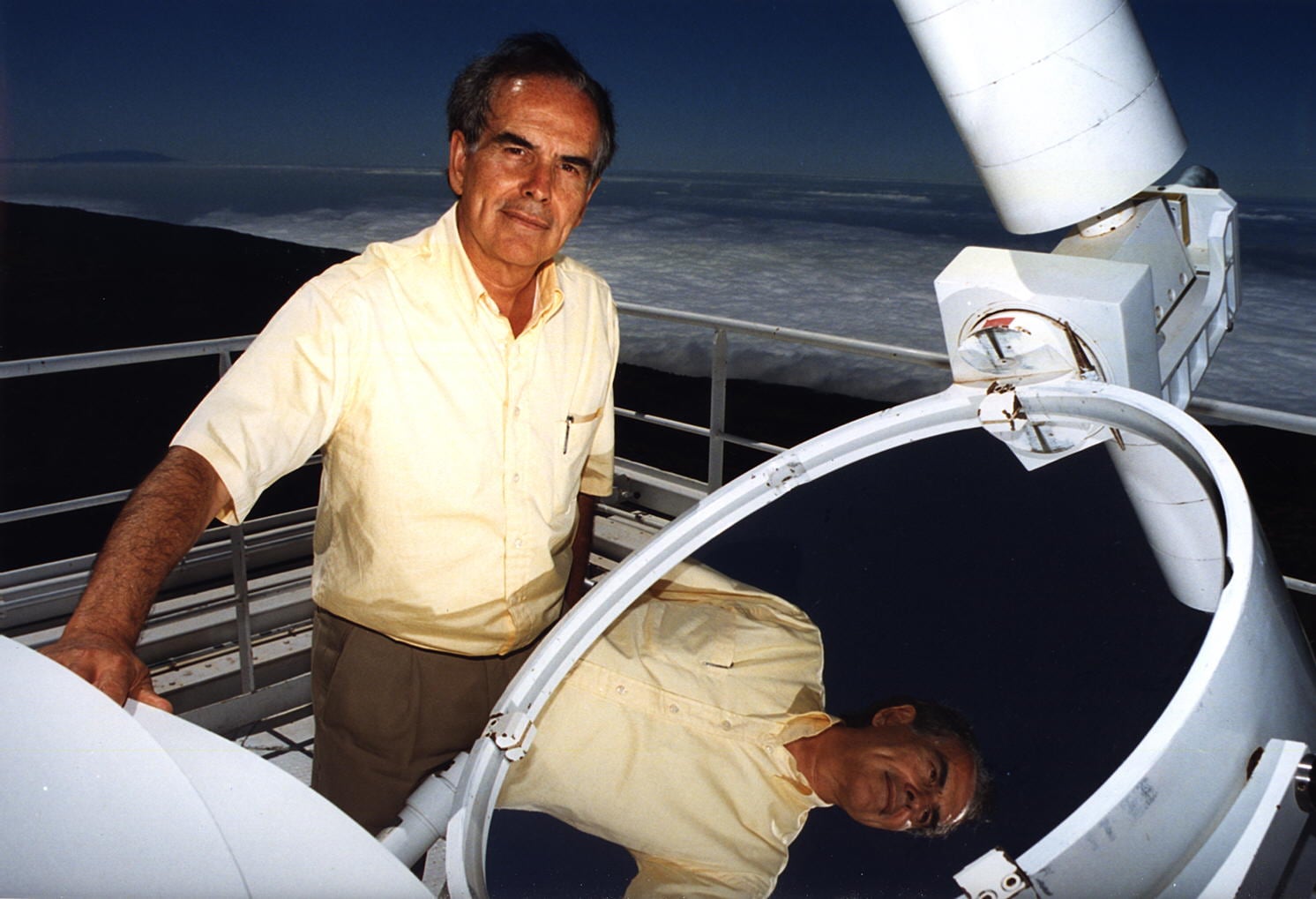
The astrophysicist Francisco Sánchez, former director and founder of the Institute of Astrophysics of the Canary Islands (IAC), died this Tuesday in Madrid at the age of 89, as reported by the research institution.
Born in Toledo in 1936, Sánchez was one of the pioneers and promoters of Astrophysics in Spain since, in 1961, he traveled for the first time to Tenerife and began the first studies of the astronomical quality of the Canary Islands sky, where he was one of the promoters of the construction and commissioning of the Gran Telescopio de Canarias, the largest telescope in the visible and infrared range in the world launched in 2009 and located in Roque de los Muchachos (La Palma).
“With his tenacity, Francisco Sánchez managed to create one of the most cutting-edge research centers in Europe and two of the best astrophysical observatories in the world: the Teide Observatory, in Tenerife, and the Roque de los Muchachos Observatory, in La Palma,” the IAC highlighted in a statement.
We regret to announce the death of Francisco Sánchez, founding director of the IAC.
The man who dreamed of stars and made Astrophysics possible in Spain, turning the Canary Islands Observatories into world references.
Ad astra, dear Pacohttps://t.co/NMsGvAEyUu pic.twitter.com/3fyOhts5oH
— IAC Astrofisica (@IAC_Astrofisica) October 21, 2025
The director of the Institute, Valentín Martínez Pillet, has highlighted the legacy of Professor Sánchez, which he described as “incalculable”. “He was a man who paved the way for Spanish Astrophysics with vision, courage and indisputable leadership. He not only founded the IAC, but also laid the foundations for an entire discipline in our country. Thanks to his efforts, Spain is today a recognized power in astrophysics research. His figure, as a pioneer and teacher, will be an eternal inspiration for future generations,” highlighted Martínez Pillet.
The Ministry of Science, Innovation and Universities have expressed their regret over the death. “It is with great sadness that we say goodbye to Francisco Sánchez, founder and first director of the IAC.” “Thanks to his vision, astrophysics in Spain took a decisive leap towards international excellence,” the department headed by Diana Morant noted in its X account. “All our love to his family, friends and the IAC.”
Sánchez traveled to Tenerife in 1961 with the firm conviction that the Canarian skies were exceptional for astronomical observation and in 1964 he got the University of Bordeaux to install the first professional telescope at the Teide Observatory.
“An international agreement that laid the foundations for all subsequent agreements that allowed the installation of international telescopes in exchange for 20% of the observation time for Spanish science,” details the IAC. With Francisco Sánchez, the first astrophysics research group in the country was also born, the Upper Atmosphere and Interplanetary Environment, and the first doctoral theses were carried out.
In 1965 he joined the University of La Laguna (ULL) as an assistant professor of Physics at the Teide Observatory and in 1969 he presented his doctoral thesis, which was the first on Astrophysics read in Spain. From there a long career began and in 1970 the first position of professor of Astrophysics in a Spanish university was created at the ULL, occupied by Francisco Sánchez, who was also the first professor of the subject in Spain in 1974. In 1973 he promoted the creation of the University Institute of Astrophysics at the ULL, precursor of the current IAC.
Likewise, in La Palma, between 1976 and 1978, work was carried out on the access road to Roque de los Muchachos, which led to the beginning of the current Roque de los Muchachos Observatory. In 1988, he also promoted the Law for the Protection of the Astronomical Quality of the IAC Observatories, known as the Law of the Sky, making the Canary Islands the first autonomous community that limited the levels of artificial lighting to avoid light pollution of the sky.
In 2007 Francisco Sánchez participated in the International Starlight Conference of La Palma from which “the declaration in defense of the night sky and the right to starlight” emerged, and promoted the creation of the Starlight Foundation with the aim of disseminating the principles of the La Palma Declaration. In 2013, Francisco Sánchez left the direction of the IAC and, among other activities, dedicated himself to participating in conferences and writing. In fact, in 2019 he published the book “Soñando estrellas”, an autobiographical story about his passion for the universe and his commitment to Spanish astrophysics.
Among other distinctions, Francisco Sánchez was the Canary Islands Research Award and a member of the Royal Society of Friends of the Country since 1985 and of the Canarian Academy of Sciences since 1987. He was vice president of the European Astronomical Society, belonged to the Science, Technology and Innovation Advisory Council and to the Science and Society Area Committee of the Ibero-American Science and Technology for Development Program.
For more updates, visit our homepage: NewsTimesWire