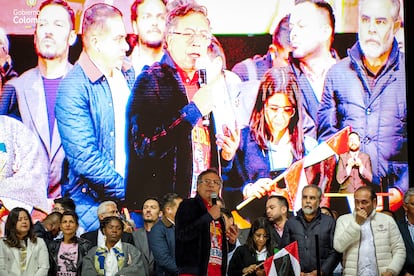
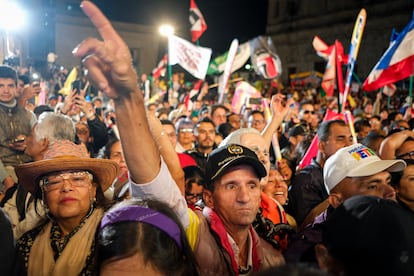
“The United States Government has decided to choose the mafia as its ally in Colombia,” Gustavo Petro said late this Friday afternoon, a few hours after the United States Government included him on the so-called Clinton list, alleging links between the Colombian president and drug trafficking. “We are not kneeling, we are not going to take a step back,” he insisted to the cheers of thousands of followers who filled the Plaza de Bolívar, as he had summoned them days before to demonstrate in favor of his proposal for a Constituent Assembly. The meeting, adorned with posters in defense of the “constituent power” that the left-wing leader has defended, ended up becoming a great platform for him to respond to the accusations of Donald Trump’s Executive from the street, the place where he moves most comfortably and naturally.
The call took place in a context of high political tension. Petro chose a Friday afternoon, two days before the popular consultation by which Petrism will define its candidates for the presidency and Congress for the elections of the next semester, and at the end of a week in which it maintained a crisis with the United States and its bases suffered the emotional defeat of the acquittal, in the second instance, of its nemesis, former president Álvaro Uribe Vélez. For this reason, the sit-in was expected since Petro launched the call, after learning of Uribe’s exoneration in a criminal process that has kept Colombia in suspense for more than a decade. And the decision of the North American Government, announced at the beginning of the same afternoon, increased expectations.
For this reason, about two hours before the president appeared on stage, thousands of his followers were filling the central square. Heliodoro Africano, a 67-year-old retired teacher, says he has come to show “total support” for the government’s social reforms, which “Congress is destroying.” He is especially concerned about the pension, whose fate is being decided right now in the Constitutional Court. He adds that it is also an unrestricted support for Petro, “the only president who has not knelt down to the North American Government.” “Not even Lula (president of Brazil) has been so forward,” he highlights.
Trump’s attack against Petro is also rejected by Sergio Suárez, a 50-year-old businessman who attended the demonstration. “The president of the United States wants to be king of the world and do what he says, I think that is not right,” he defends. And he has also come because he agrees with the proposal of the Constituent Assembly. “It would be a way to reshuffle and try to make the changes that until now have not been possible because legal obstacles always appear.”
Among the thousands of people who have filled the square, in which a huge flag of the M-19 – the guerrilla to which President Petro belonged – has been displayed, there are students, pensioners, workers, batucadas and indigenous delegations that have arrived from different parts of the country. Henny Gutiérrez, 49 years old, has come from Puerto Carreño (Vichada), where she is the governor of a council. He had to travel first by boat to Puerto Gaitán (Meta) and from there to Bogotá by land, a journey that totaled more than 10 hours. “We have to support the processes that President Petro is leading, it is the only option for indigenous peoples.”
Two huge screens located in the square have projected the president’s walk from the Nariño Palace to the stage. He has done so surrounded by Vice President Francia Márquez, the director of the Administrative Department of the Presidency, Angie Rodríguez; the advisor Víctor de Currea Lugo and the Minister of the Interior, Armando Benedetti. Your closest circle. Already on the stage, the rest of the cabinet joined
“Trump does not even know clearly where Colombia is, nor who raised the coca crops and who has stopped them,” questioned the president, dressed in a red-bottomed shirt that reads “the people are sovereign. National constituent assembly.” And he continued: “Mr. Trump attacks the Colombian leader who has most opposed drug trafficking thirsting for political power and blood in Colombia,” he said in what he promised would be his last mention of the North American president during his term.
In any case, Petro linked the decision in Washington with Colombian politics. “In Mexico and Brazil everyone, from the richest to the poorest, closed ranks around their president. Here it happened the other way around, here groups of lying businessmen and lying politicians motivated the North American extreme right to take sanctions on Colombia and its president.” And, without mentioning it, he charged against former President Uribe, leader of the Colombian right: “His ally is a former president who grew up among the mafia of Pablo Escobar’s Ochoa cartel, which promoted the legalization of armed drug trafficking organizations.”
Later he indicated what he believes is the basis of the sanction. “My last speech at the United Nations made a difference that day, and that’s why they punished me,” he said, referring to his recent intervention in the General Assembly, in which he attacked Trump and proposed a special force “to stop the genocide in Palestine.” Faced with the sanction, Petro said that it is a punishment that he makes fun of, since it prevents him from doing business, but he does not do business. “We do not respond to Mr. Trump by kneeling, but by standing firm and taking to the streets to defend the rights of the people, of democracy,” he said, “in defense of Colombia, which is being attacked by the forces of greed, by the forces of tyranny, by the forces of the mafia.”
From that point, that of the exercise of sovereignty, the president tied his statements to Sunday’s consultation. “I know that we are approaching an election for the Congress of the Republic. I myself, on Sunday, will vote in the Historical Pact consultation,” he explained, and clarified, “I’ll see for whom, or I can tell.” He then pointed out that his constituent project, which will go through the collection of 2.5 million signatures, is not designed to reach the current congress, but rather the one elected in March. For this reason, he says, the campaigns will be divided “between those who support the people being able to become constituents again, and those who oppose them.” He explained that the constituent will only seek to ensure that the social reforms are approved by direct decision of the people, instead of the long legislative process, and that their intention is that in parallel to the current electoral period, a popular campaign will be developed to promote the constituent.
“I have summoned you here, then, to summon all of Colombia to the constituent power, not to make little articles in favor of me,” he concluded, before announcing that he would like to be a member of that constituent, “if you decide.” He thus launched not a campaign for his presidential re-election, something prohibited in the country and which the opposition has agitated like a ghost, but rather a path to promote the constituent assembly and, then, be one of those who write a renewed constitution.
For more updates, visit our homepage: NewsTimesWire