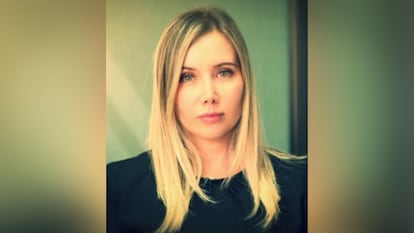
The Colombian Foreign Ministry described this week the country’s adhesion to the new Silk route, the China Investment and Infrastructure Megogram, such as “the most important commercial news of the last 25 years.” In Beijing, however, President Gustavo Petro was not accompanied by a property minister. Next to him was Cielo Rusinque, the superintendent of industry and commerce that has been exercised since March as interim. The trip to the Asian giant was his last commission, because the president must take possession of Diana Morales on his return to Bogotá, already announced as the new chief of the portfolio.
Petro will also now designate a new Minister of Justice, as Ángela María Buitrago released on Thursday her irrevocable resignation, motivated by “attempts to interferes” in his management. He pointed out, specifically, his colea of Interior, Armando Benedetti, and the director of the Administrative Department of the Presidency of the Republic (Dapre), Angie Rodríguez. The friendly fire never ceases in the government. With a cabinet turned into a roller coaster, the president, with almost three years in power, has entrusted the remainder of his mandate to mainly novice and loyal ministers.
No one is immovable for Petro. He has never hesitated to do without whoever is needed, and precedes the reputation of cutting heads without contemplation since he was mayor of Bogotá, between 2012 and 2015. After the departure of Susana Muhamad from the Environment portfolio, in March, no minister of the original cabinet survives him. The long crisis does not find a definitive outcome. The chaotic first Council of Television Ministers of February, full of reproaches and accusations for the return of Benedetti to the center of presidential power. “As a feminist and as a woman, I can not sit at this cabinet table, of our progressive project, with Armando Benedetti,” Muhamad said. The brand new policy minister, very resisted on the left, remained a sphinx before the cameras. Now is the strategist of the popular consultation that the government insists, despite the fact that Congress revived the labor reform.
The instability of the cabinet is not a surprise, since it had already happened in its mayor’s office, the Yann Basset analyst endorses. “Petro is someone who values above all personal loyalty, has a very caudillesco style, and this makes anything that moves away from his official line ends up being interpreted as a gesture of disloyalty. Hence the tendency to change all the time,” says the professor of political science at the University of the Rosario. There are also other more institutional factors that have accentuated that tendency, he adds: “It has to do with the passage of a coalition government to a minority, which is increasingly the sun behind it. As we approach the elections, many begin to leave because they aspire to be candidates, because they want to distance themselves from the government or simply because Petro tries to quadrate supports for the campaign, which brings their own instability.
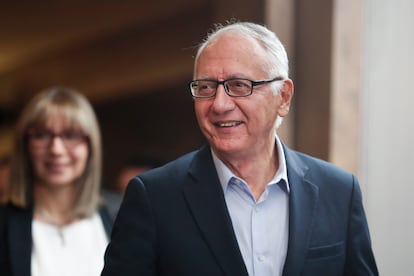
The diagnosis is known. Petro trusts a very small circle of collaborators and speaks little with his ministers. He has brought to the extreme the idea that they are fuses, to the point that he has named more than fifty. So far from 2025, adds changes in 14 of the 19 portfolios. Guillermo Alfonso Jaramillo, the Minister of Health, is the one who has been in the government, together with that of Science, Yesenia Olaya. They are the only ones that accumulate more than a year of continuity.

After so many ministerial remasses, and many other changes to droppers, Benedetti and Jaramillo have remained as the heavyweights of the current cabinet, in tune with Angie Rodríguez, the director of the DaPre, who was previously a collaborator of the Minister of Health. This was illustrated by Petro’s false departure at the time of delegating his duties while he was in China. At first, he signed a decree in which he made that wink to Benedetti, but then revealed and left the commission to Jaramillo, as he has done in most of the occasions he has left the country. They are, by far, the two most veteran politicians. The others tend to be rookies and young people. “The new ones have less experience and political weight, we are exhausting stocks. Finally, what is valued for what remains of mandate is the closeness with the president, and not much more,” says Basset.
Jaramillo, a surgeon who represents the traditional left, has been a congressman, mayor of Ibagué and governor of Tolima twice, and Secretary of Health of Bogotá during the Mayor’s Office of Petro. The government continues to move forward a health reform, despite being the most unpopular of its great social reforms. That insistence cracked the legislative majorities with which Petro started his mandate. Jaramillo arrived at the portfolio in April 2023, replacing Carolina Cork, to which they devoured criticism for uncompromising. In his most recent controversy, the minister said during a public hearing that the Government is “maintaining the EPS (health providing entities) in intensive care to approve the reform.”
An Argentine phrase says that he first governs with those who helped win the campaign, then with friends, then with the best of them and in the end the only ones left are the accomplices, recalls Sergio Guzmán, director of the consultant Colombia Risk Analysis. “Well, we are now in the complicit cabinet,” says this analyst. “We are in the Leales Cabinet, which seem to be willing to give everything for the project regardless of whether they are investigated or charged by something later. The best case is that of the Minister of Health, which seems to be willing to be willing to die in order to pass the reform,” he concludes.
For more updates, visit our homepage: NewsTimesWire