The crisis of political instability that France is going through has deprived the world of an image as symbolic as it is exceptional: the bosses protesting in the street. Businessmen were willing to demonstrate in protest against the so-called Zucman tax, a new tax that has crept into the budget debate and has already caused the first frictions between the left and the right. It is a tax on large assets – more than 100 million euros – whose design has been inspired by the proposal launched in 2024 by the renowned French economist Gabriel Zucman.
The mobilization of the employers was canceled as it coincided with the days in which the country looked into the abyss of a government vacuum, but the matter has continued to be discussed in the National Assembly, where the socialists demand that the wealth of the rich be taxed as a condition to keep the Government afloat. The episode reflects a debate that is intensifying in Europe and that seeks to get the ultra-rich to contribute more to tax systems that, with a thousand holes and loopholes, seem designed to suit them.
“Europe cannot build a sustainable tax system if its richest citizens contribute less, in relative terms, than ordinary workers,” maintains Giulia Varaschin, political advisor at the EU Fiscal Observatory, which Zucman himself directs. The tax, he adds, would increase income by about 20 billion euros annually in France alone and “would realign the tax system with the constitutional and moral foundations that everyone contributes according to their means.”
The reply comes from Cristina Enache, an economist at the Tax Foundation Europe, who assures that these figures reduce salaries and investment and destroy jobs, in addition to having a “very limited” redistributive impact and generating capital flight towards more lax jurisdictions in fiscal terms.
Something is wrong in the tax system. There is a deep gap between the economic and financial muscle of billionaires and the real weight of their taxes in the public coffers. A study from the University of California at Berkeley, recently published by the United States National Bureau of Economic Research (NBER), has analyzed with administrative data how the 400 richest Americans are taxed. In this academic work a well-known signature appears again, that of Zucman himself. And it shows data that is as revealing as it is uncomfortable: the average effective rate of these large fortunes is 23.8%, well below the 30% that the average population supports, and the 45% that falls on the most qualified workers.
The document points out that what is happening in the United States is not an exception, but part of a trend that can be extended to regions such as Europe. In France, the Netherlands, Sweden and Norway, the ultra-rich – in the analysis they looked at those with more than 1 billion euros – support effective rates that are sometimes lower than 20%.
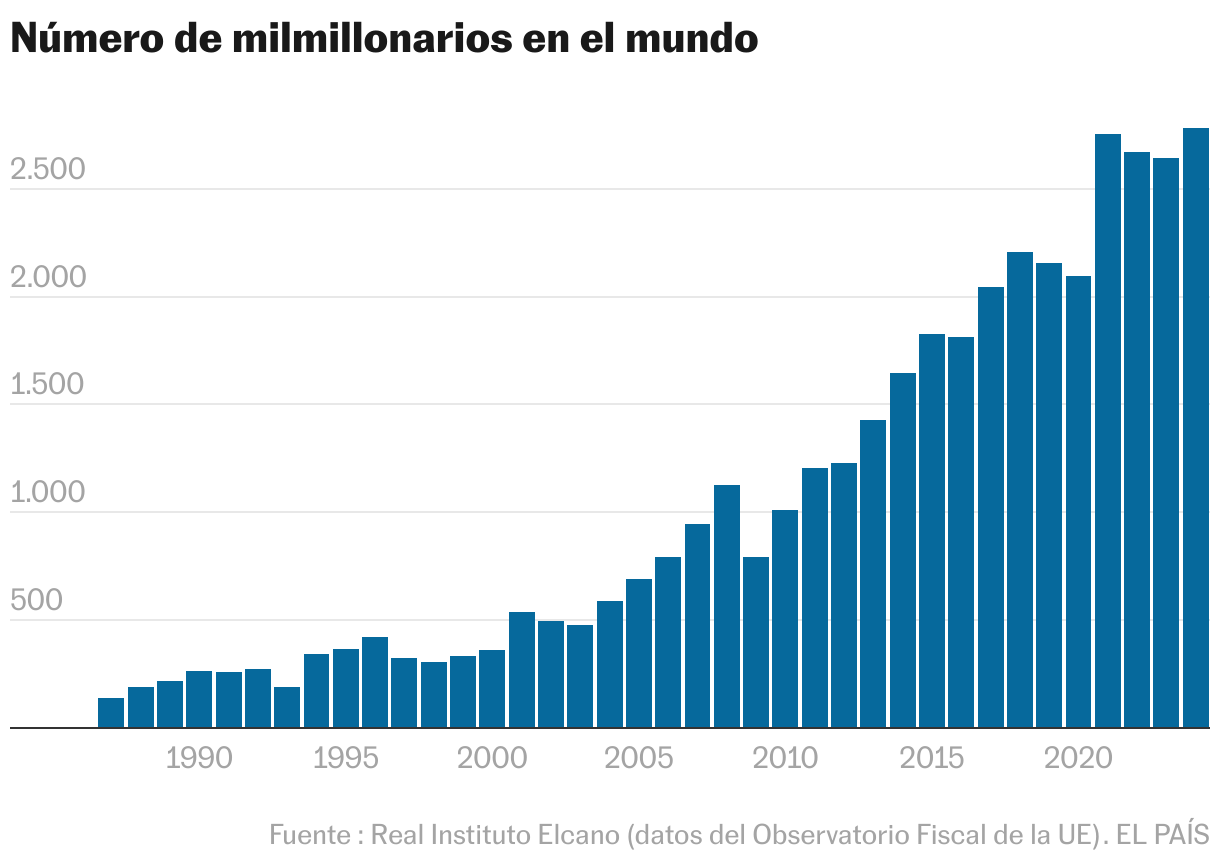
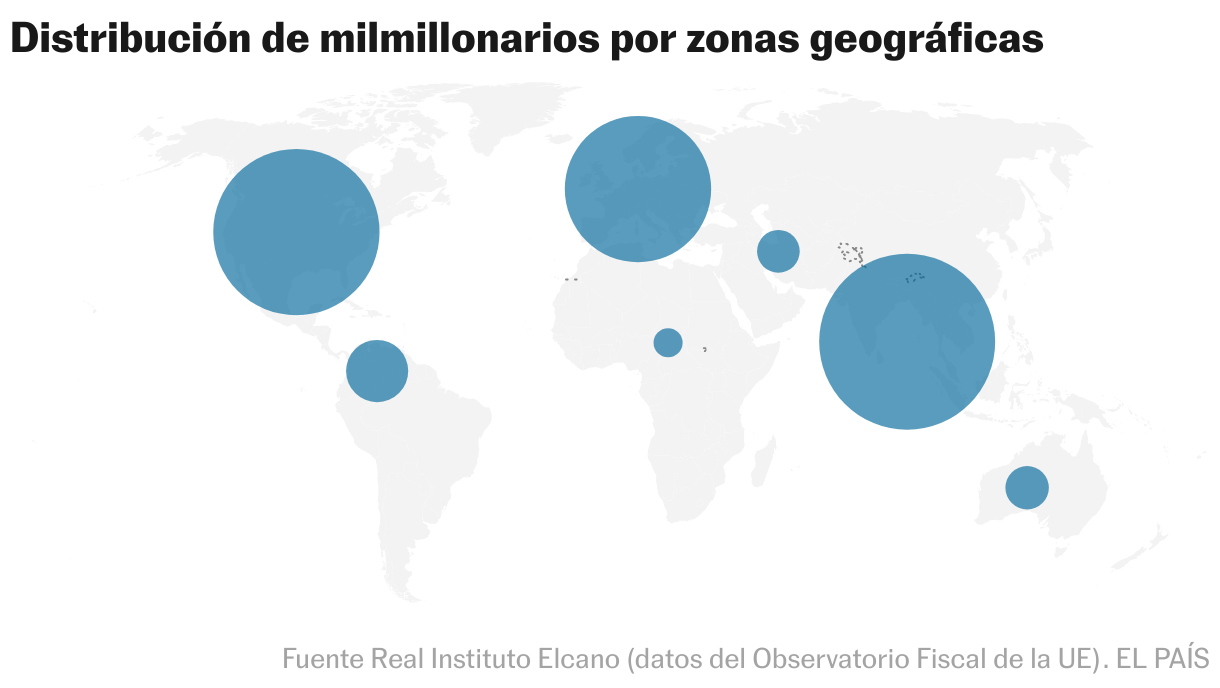
The report does not offer figures for Spain, which does not stand out for being one of the jurisdictions with the most billionaires – just over 30, out of a universe of almost 2,800 worldwide. However, the data available at the national level reflect a similar picture. Several academic studies from institutions such as Fedea or the Institute of Fiscal Studies show that the wealthiest 1% of the country – which includes the very large fortunes and the rich of lesser magnitude – bear an average effective rate on total taxes that is lower than that of the poorest segments of the population.
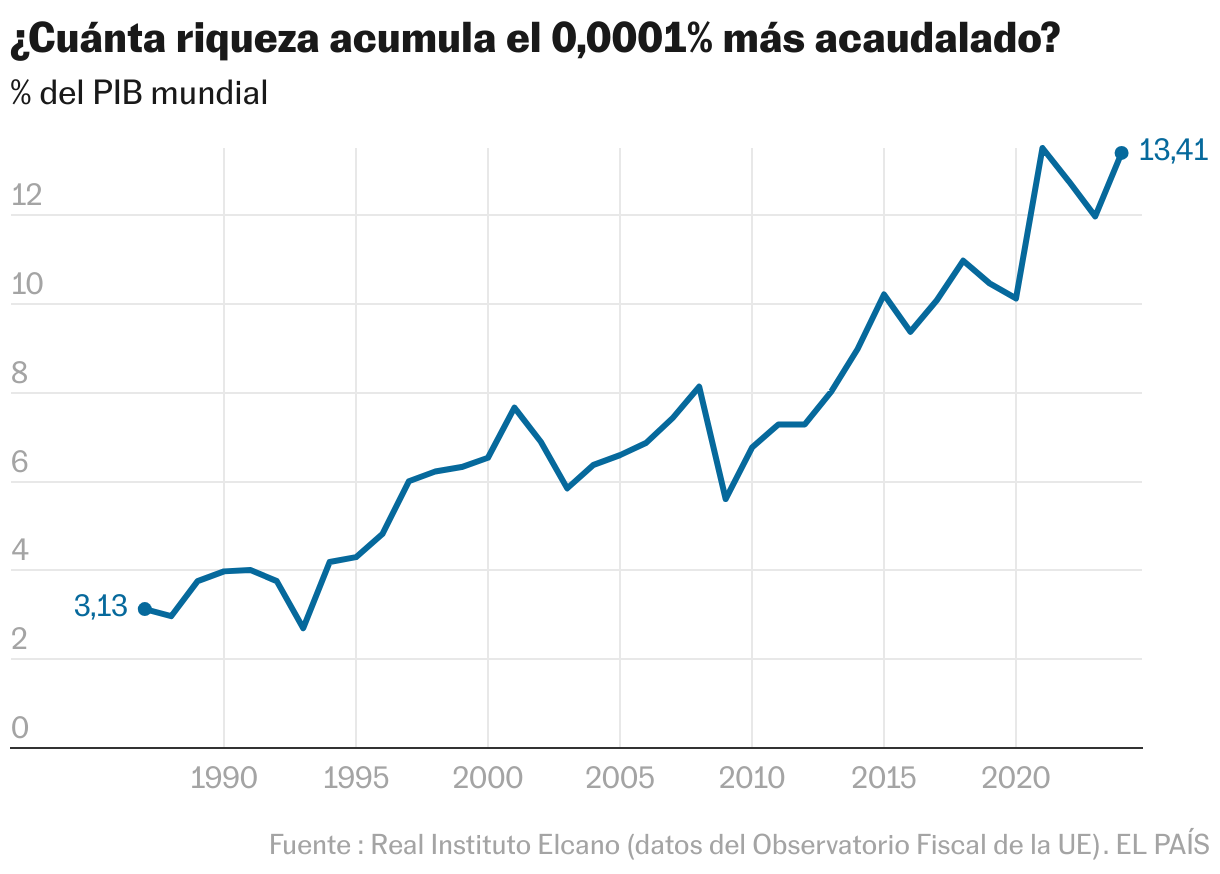
For this reason, the group of economists headed by Zucman demands the implementation of a rate for a group that does not stop growing in number and accumulated wealth, and that already accumulates 13.5% of the world’s GDP, according to data from the EU Fiscal Observatory. If the tax on the rich prospered and they paid at least 2% of their wealth every year – which together is close to 14 trillion dollars – the countries would have about 250 billion dollars (about 215 billion euros) in additional income.
Although with an effective tax much lower than 2%, Spain already has the wealth tax – in the communities that have it subsidized, the one on large fortunes operates. In the Norwegian elections, held in September, the discussion of property taxation was present. The United Kingdom is also maintaining its debates and other countries, taking advantage of recent discussions within the G-20, have put the issue on the table. In France they have gone a little further and the Ecologists and the left-wing coalition have landed a proposal that would affect almost 2,000 high taxpayers. Bernard Arnault, president of the luxury group LVMH, has declared that these ideas are typical of “far-left militants” eager to “destroy the liberal economy.” For Varaschin, without these corrections “it becomes difficult to ask the rest of society to assume heavier burdens through higher taxes and welfare cuts.”
Opposite recipes
The phenomenon of low taxation of the wealthiest does not respond so much to evasion or fraud practices as to the structure that governs all of these countries. The common denominator is that taxes are designed around work and traditional ways of obtaining income, which is why they are less effective when it comes to taxing wealth from business, financial and investor vehicles (shares, dividends, interest, capital gains…), which are what make large fortunes fat. How to deal with this situation – and the appropriateness of doing so – is what divides experts.
Some believe that it is difficult to specify the assets subject to the tax and that these taxes would cause massive relocation, penalizing investment and, therefore, employment. Others argue that a coordinated response between several countries, together with an armored and well-structured design, can capture that wealth and help governments reduce inequalities and clean up their public accounts.
The schemes by which tax systems are governed, believes José María Durán, professor at the University of Barcelona and researcher at the Barcelona Institute of Economics, are what make it difficult to effectively apply taxes of this type. “The problem is not so much the idea of taxing the richest, but how to do it without creating distortions or duplications,” he points out. Durán is cautious in the face of the enthusiasm that the Zucman rate in certain political sectors. “In taxes, the details are essential,” he remembers. “We know what wealth taxation is, but we must specify what is taxed and what is not, in addition to the exemptions contemplated, such as those for family businesses. All of this conditions the final effect of the tax.”
Durán insists on aspects such as the valuation of assets. “A listed stock is not the same as one that is not, nor a new property versus an old one, nor using the market price or another indicator.” The researcher also points out that wealth, unlike income, “is taxed regardless of whether there are profits or losses in a year,” which can be “very distorting.” It also raises questions about what to do with family businesses and assets spread across several countries. “Without cooperation between tax administrations, everything will go away. Those who have more also have more capacity to relocate,” he warns.
The researcher brings to the fore the small group of millionaires – especially Americans and Europeans – who have publicly shown themselves in favor of the tax, but believes that “they are very few” and that most of them would make a move not to pay.
There are those who are more blunt. Gregorio Ordóñez, director of the Institute of Economic Studies – the study center of the Spanish employers’ association – assures that property taxation “is the figure that generates the most distortion in terms of economic activity and relocation.” Remember that many European countries have been eliminating it over the years “precisely for that reason.” On the one hand, he says, it reduces savings and investment by increasing the cost of capital. On the other hand, “modern economic systems are interdependent: if you penalize some, you end up affecting everyone.”
In his opinion, it is unfair to include productive assets (companies) in this debate, since capital is already taxed “directly and indirectly, through personal income tax, corporate tax or local taxes.” And he adds that, if only a few countries apply the tax, the others would become poles of attraction for large fortunes. “Experience shows that taxing these profiles does not have positive effects. They relocate, and the incentives to continue creating wealth are reduced,” concludes Ordóñez.
Enache also believes this: “A wealth tax reduces salaries, destroys jobs and reduces income.” stocks of capital. All income groups are harmed due to lower economic activity.” Furthermore, he adds, a global or European agreement “is highly unlikely,” as a critical number of countries would have to sign it, including Switzerland, “making this proposal unviable.”
Excluding professional assets, however, would neutralize the effects of the reform, Varaschin maintains. These represent around 90% of the wealth of billionaires, so their exclusion would open a “huge loophole, encouraging the reclassification of assets and reducing potential income by up to 40 times.” The analyst also does not believe in the resulting disincentives for business activity. In fact, “a fair tax system, together with strong public services and investment in research, provides a better basis for innovation than a low-tax environment marked by instability,” he concludes.
For more updates, visit our homepage: NewsTimesWire