
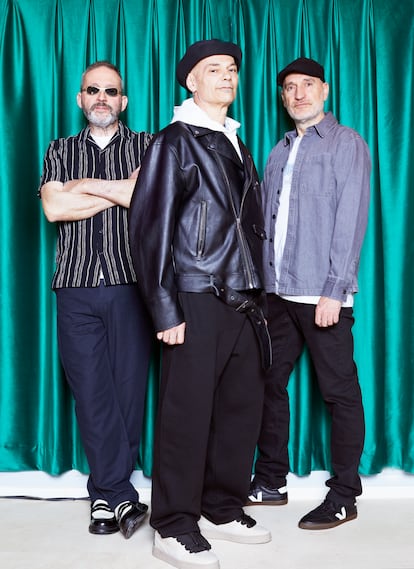
The path of time does not seem to have made an impact on Celtas Cortos. The group that all of Spain remembers every April 20 (the song of the same title has around 60 million views on Instagram) is still alive and well after four decades and two million records sold. They are going to celebrate now with a new compilation, 40 years telling stories, and a commemorative tour that, in 2026, will visit large pavilions in ten cities. We have spoken with its three oldest members: Jesús Cifuentes (voice and guitar), Alberto García (violin and trombone) and Goyo Yeves (sax and whistle).
Is it more difficult to sell new music to your fans than to re-send them what they already know?
Jesús: Totally, at least in our case. The whole explosion that we experienced in the nineties, which was the moment of greatest boom and popularity that we had, seems to mark the backpack that will accompany you for the rest of your life. We have continued working to this day and releasing new music, and it is much more difficult to make it known with the intensity that we would like.
His first album, Emergency exit (1989) was very anomalous for the time. It was an instrumental folk album, a genre that was still associated with the Transition and a certain dandruff, but it sold 60,000 copies. To what do you attribute that success?
Goyo: It’s true that we came from folk, but we were already mixing it with electric guitars. They began to label us as folk-rock, and perhaps that is what attracted the most attention, because, at least in Spain, that fusion was not practiced as much then. Another factor is that we played a lot, and live we were already very explosive. The people who saw us did not forget.
Jesús: We are children of Gwendal, Milladoiro, Oskorri, of traditional Castilian music and of Basque radical rock. So we became a hybrid that was looked at with a certain disdain from the orthodoxies, both folk and rock. But, positively, we can say that we have contributed to putting traditional music on stage and to making miscegenation today something understood, respected and seen naturally.
At that time they were signed by Paco Martín, a king of the industry who had just discovered Men G. What did he see in you?
Alberto: I know that answer because I heard him tell it himself not long ago. He saw, above all, that we filled a space, which was that of the revelry on stage, the madness, even despite not having lyrics. He was also the one who suggested Jesus write and sing.
Jesús: I don’t remember that that way. I already had that desire and that need in a very clear way.
Between 1992 and 1996 they did about 150 concerts a year. Did they burn?
Alberto: Man, the kilometers certainly didn’t pass in vain. There were times when we literally didn’t know where we were, even because of the physical distance, because one day we were playing in Badajoz, the next day in Tarragona and the next in Bilbao. But they are things that all musicians have experienced in some way, you are working on the road and that is how it is.
Jesús: You also had the stupidity of being in your early twenties, that you don’t know who you’re harvesting for. And the post-concert, which was much more serious than the concert. This type of thing that makes you get on a cloud that is shaped like a bus, and that makes you not know where you are going to fall. Then we rushed.
Alberto: Yes, there was overload. I remember some moment of absolute suffocation calling home and saying: “I can’t handle this.”
Goyo: At that time we would arrive at a place, we would make a stop and we would all go to the restroom and the green telephone at the bar, and we would have to wait for one to finish before the other would go, call home and say: “We’re fine, how’s everything going there?” In short, experiences that now seem very old to us.
Jesús: We always had to tell Goyo: “Finish it!”, because he could spend an hour and a half talking.
It was a very sudden success. How did you keep your feet on the ground?
Goyo: Although sometimes we have combined many nights with days, some more than others, the good thing is that we have always had very good communication between us. And, above all, I think we have known how to accept certain personal needs of others at some point above this maelstrom. We have handled it well because we are friends, we always have been from the beginning, and that is something that differentiates us from many others. We are not a band that has been built artificially, and all that has made us still here after 40 years.
Jesús: And also the awareness that this is a fortunate job, and we have wanted to safeguard it from our own foolishness. I think that working class consciousness has helped us a little to have…
Goyo: …not to become idiots. To respect the common good that we shared, because we know that making a living as a musician in Spain is truly a fortune that very few of us enjoy.
His war cry when saying goodbye to the concerts was “See you in the bars.” Did they always keep their promise?
Jesús: In the nineties I would say 90% of the nights. In other words, nonsense. I am amazed today that we have survived with such fortune.
Goyo: Then came another decade in which the “see you in the parks” thing arose.
In 1996, Celtas Cortos was the group that gave the most concerts in Spain. It was the same year that José María Aznar obtained the presidency of the Government. He may have been the only adopted Pucelano who competed in popularity with you.
Jesús: Well, we better leave Aznar to the people of Madrid. He was associated with Valladolid for a time because he boasted of being close to the town, of going to the golden mile of Ribera, and playing mus with the countrymen. In any case, at that time, and given our ideological color, which has always been progressive, we were faced with a series of issues that had to do with who had been in government and could make the decision to take you to play in their city or not.
And did they also suffer that bill on a personal level? Jesus, for example, came from a military family and sang in favor of insubordination.
Jesús: Of course that generated its moments of controversy, but I have to say that my father landed in the worthy body because, in his generational time, it was a way for him to prosper. I clearly identify him as just another worker, who found it necessary to leave his small Castilian town to look for beans and found his bones there. Then, in my family, the military cast is broad and powerful, I am not going to go into this in depth, but there comes a time when you already know that your conversations do not have to go through that, because we have opposing positions and we are not going to reach an agreement.
Anyway, you have not suffered the level veto of other groups like, say, Soziedad Alkoholika. Maybe because they were always massive, transversal and liked. They will even have many right-wing followers.
Alberto: It’s true what we said about the party group, something that everyone feels in the same vein, being able to enjoy a relaxed moment with music, with dancing, with lack of inhibition.
Jesus: Our flag has a more pronounced color than another, but it is wrapped in a more or less loving and kind paper. So it is true that even people on the right have shared that time with us in the same way, but I don’t think we are the only ones to whom that has happened.
And they continue to be very media-friendly. They have the privilege of having a loudspeaker to say things that many others cannot.
Jesús: Yes, well, we have always done the exercise of words in an absolutely free way. For me, putting words to a song is a challenge, it’s the most fucking complicated and what costs me the most. I do it with great awareness that what I want to express has a content, a direction, and a real emotion, that it serves a purpose in the sense that it is revulsive or transformative and that it is also a hug, something that invites. So, that charge of positivity, even if you are talking about hard situations or fucking social realities, is perhaps launched from the naiveté or humility of a chronicler. The key is also a bit there, because it is something very close, we are not expressing ourselves from any elevated pulpit, but from the sidewalk that all citizens pass through every day.
you have been very aware of the situation in Palestine for years. In that sense, would they sing “calm down, majete, in your chair” to many guild mates?
Jesús: This conversation already has a certain recurrence. I think there is a lack of coherence and that we have also arrived late in positioning, and in many other things. The corporation of famous musicians is very far away now. Music has stopped serving as a socially transformative element, and I don’t know when that bond was broken, to be honest. There are sectors that do it with more intensity, such aship hopbut the bulk does not position itself, it does not want to get wet. I don’t know if it is because of a fear of what social networks may say, of the consequences that you may suffer from this or simply because these are more anodyne generations. The truth is that the profile of youth is oscillating towards the extreme right in a dangerous way and that, in my opinion, is a lack of judgment that has not been well managed.
Within the music industry, have you had many personal ideological conflicts when facing certain dynamics? For example, this new tour is done with the multinational Live Nation.
Alberto: Sometimes the possibility has arisen that a sponsor was behind us with a banner, and we have always considered, in a fairly collective manner, this type of thing. What happens is that, also, sometimes, life presents you with situations that are shaped like a passing train and you don’t know what destination you are really going to reach, but you have the feeling that you have to take it.
Goyo: The fact that we are now with Live Nation behind us, which represents the great machinery of entertainment at an international level, the first thing that has made me feel is that you have given them some reason to pay attention to you, right? So, that perhaps overshadows everything. And you are also putting yourself at the service of people who dedicate themselves to something that you also dedicate yourself to, which is music, entertainment. And it is clear that, if you want to be consistent with all your ideas, you probably cannot buy a car, a telephone, or a certain brand of clothing. But we do raise those doubts, of course. And we also have to say that, on this tour, the price is going to be the same for all tickets: 38 euros, which becomes 42 with this management fee, which is something that nobody understands. Still, they may be the cheapest Live Nation has ever seen.
40 years telling stories It is published on November 21. Tour dates can be consult on its official website.
For more updates, visit our homepage: NewsTimesWire