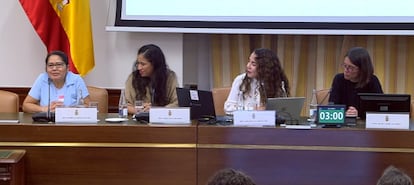
Three women illustrated this Monday in Congress with their own misadventures the difficulties in accessing asylum in Spain, the appointments that do not arrive and the procedures that are prolonged, endangering lives held with pins. María Galiego Calate, who arrived from Guatemala in 2019, lowered her voice to tell of the day when she and her children no longer had anything to eat. In Spain, she was surprised by the pandemic and went to work in the most dangerous area for contagion, a nursing home, but a denied asylum left her without a job. Today she is about to receive her DNI, but she still does not smile at all, because she is missing her children’s ID, who in these years reached the age of majority and no longer have the mother’s shelter for this process. “We don’t want aid, we want to work and pay taxes,” he says.
Galiego Calate lost his father in the Guatemalan genocide that began in 1960 and lasted 36 years. His mother, Ana Calate, was a pioneer in the long search for those missing and won a harsh sentence against her country in international courts for military excesses. That triumph has haunted the family ever since. But it is not only political violence, but also the many that affect women in dictatorships that force them to leave their countries and seek refuge in others. It was also told by the Nicaraguan Nora Rugama and the Cuban Marta Ramírez, all of them under the umbrella of the Guatemalan Women’s Association, which has accompanied their cases in the fight with the Spanish Administration.
Adilia de las Mercedes, jurist specialized in Human Rights of the aforementioned organization, presented a report titled Without appointments there are no rights for the deputies who wanted to come and listen to it. The document recalls that Spain is, after Germany, the country that receives the most asylum applications, reaching 167,366 last year, due to the political crises in the Latin American region and some armed conflicts in other places. In 2024, despite international law and signed treaties, Spain only granted the requested protection in 13% of cases, while in the European Union the average was 51.4%, according to the report. In the courts those who request refuge do not have any better luck either: last year 4.5% of cases were won through administrative litigation, far, again, from the European average, which amounts to 27.1%.
The painful procedures and non-compliance with the law, De las Mercedes denounced, lead to suffocating situations for women who had already suffered denigrating experiences in their countries due to their gender that are not foreign to any dictatorship, neither right nor left, as Nora Rugama and Marta Ramírez have shown. The first, Nicaraguan, was dedicated to the protection and therapy of women who survived sexual violence in childhood, a thorny issue under the dictatorial regime of Daniel Ortega and Rosario Murillo. Murillo’s daughter, Zoilamérica, accused her stepfather of raping her. She is now exiled in Costa Rica and the case was falsely closed with the mother’s acquiescence.
“I was studying in Spain and I didn’t know I was a refugee until I read the international statutes and knew that I had to ask for asylum because I fulfilled the aforementioned well-founded fear of the possibility of being persecuted,” said Rugama, 40 years old. The women who accompanied her in her human rights work in Nicaragua in the Aguas Bravas organization are suffering the same persecution. The obstacles to obtaining asylum prevented him from accessing housing and this Monday he denounced the gibberish of the applications: “Appointments should not be the monopoly of the mafias,” he said. De las Mercedes also pointed out that accompanying the Administration in one of these cases “of medium complexity takes between 100 and 125 hours of work”, a time that many of them do not have. The presence of a woman from El Salvador who could not attend because missing work would have caused her greater problems was also expected at the Congress.
But the parliamentary headquarters did have the presence of the Cuban Marta Ramírez, who has suffered the rigors of another of the dictatorships that “betrayed the principles that inspired the revolutions that preceded them.” Ramírez is a journalist and activist for women’s rights and “feminism is considered in Cuba something petty bourgeois and unnecessary, because it is taken for granted that everyone has guaranteed rights, but femicides occur there like anywhere else,” she said. She left with her daughter to make the reverse trip that her grandparents made, Spanish exiles from the Civil War and Francoism. Her difficulties with the asylum have caused her difficulties in accessing the health system, which her daughter needed, suffering from complicated health problems.
Alluding to those round-trip exiles that Ramírez’s experience exemplifies, lawyer De las Mercedes pointed out that “no one is ever safe from having to abandon their land” and that “a shortage of resources cannot be argued for not granting the right to asylum to which these people are entitled, some of whom have spent up to 15 months without even access to an appointment to start the process.” De las Mercedes demanded in Congress “from what is called the most progressive Government in the world” reasonable deadlines, not exceeding 15 days, to formalize an appointment, that telematic and telephone channels be implemented for this and that the sex and training of those who interview these women be taken into account, because they are regularly re-victimized. “Now we miss those lines of people who waited all night years ago to request asylum, at least they had a chance come morning. Today it is more difficult,” he said.
For more updates, visit our homepage: NewsTimesWire