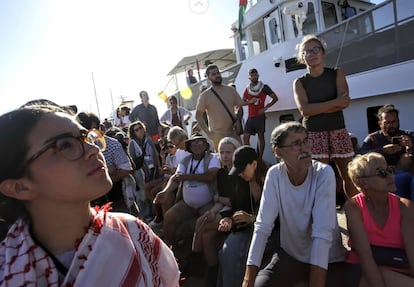
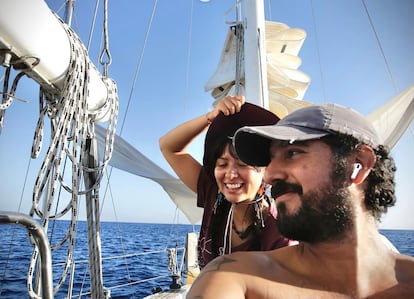
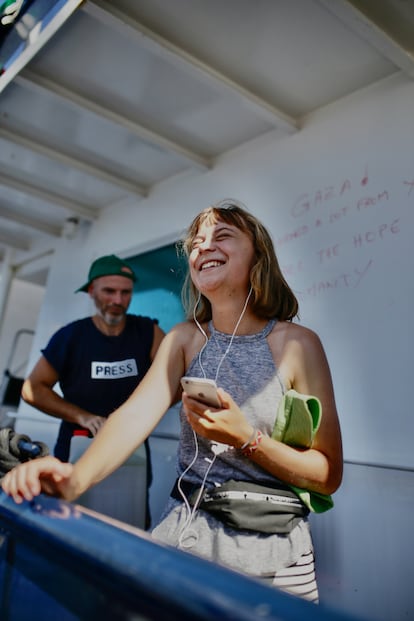
We sailed for thirty-two days towards Gaza. The objective was clear and twofold: to open a humanitarian corridor and bring the eyes of the world to Gaza, breaking the information siege that Israel has imposed for years. There were nine people on the HIO ship, including the only two Colombians who were still on the mission, Manu and Luna. Mexico and Colombia were represented on my boat.
We were part of the Global Sumud Flotilla, an international civil coalition made up of doctors, artists, activists, sailors… Ordinary people. Under collective leadership with figures such as Greta Thunberg, Thiago Ávila and Mandla Mandela, we sought to peacefully challenge the blockade declared illegal by international organizations.
About 150 nautical miles from Gaza we knew that we were entering the area where other flotillas had been intercepted. We slept little. The atmosphere was dense, the night guards increasingly tense. On October 1, Israeli ships appeared on radar. Within an hour we were surrounded.
The Israelis started with the largest ships. First they intercepted the Alma, where Greta and Mandela’s grandson were traveling. We were 51 vessels and we noticed at least three interception teams operating in parallel. On the HIO, our captain, a stubborn Irishman, was beside himself. I think he couldn’t accept that we wouldn’t reach Gaza; Denial consumed him and he accelerated the ship, ignoring protocols. From my position I saw the flashes of machine guns and lasers aimed at us. I yelled at him to stop. The boarding was imminent. We activated the protocol as best we could: hide documents, get rid of phones, prepare for the kidnapping.
The transfer to the port took fifteen hours. They kept us on the deck, in a space so narrow that it was impossible to sleep. With dawn, the heat became unbearable. The faces of my companions showed exhaustion and sadness. The captain, with a vacant look, looked like a broken man. We all shared the same feeling, that of having failed. Why, even for a moment, we thought we could do it.
We arrived at the port of Ashdod at sunset. When we set foot on land, the Israeli police were violent, they subdued the flotilla with keys and it was clear that their intention was to humiliate us. They threw us to the ground, put some of us on our knees and shouted “terrorists” at us. Itamar Ben-Gvir, Minister of National Security, appeared between cameras with his communications equipment. His presence was a political spectacle.
Ben-Gvir walked among us looking for his image of victory. I was a few meters away; I could see him smiling as an assistant recorded him with shaking hands. He yelled at us that we were “Israeli baby killers” and that they would take us to a terrorist prison. It was a grotesque speech, made for the networks. But he found no fear. We shout “Free Palestine” in his face, we call him a psychopath, a murderer. In the video he posted afterwards, he cut that moment.
The repression intensified. They tied our hands behind our backs and forced me to kneel again on the stone floor. Time became a blur. I estimate that I was like this for about seven hours, twisting, looking for a less painful position. Around me, some were collapsing from exhaustion. They wanted to break us. They processed us little by little and tried to get us to sign documents in Hebrew admitting to a crime for trying to enter Israel “illegally.” We refuse. We do not recognize the legality of the blockade or the occupation.
In the end they blindfolded us and put us on trucks separated by gender. It was the last time I saw Luna, Manuela and Lorenzo D’Agostino, the Italian journalist with whom I shared the journey. We spent six hours locked up, with the air conditioning on maximum, shivering from the cold. At dawn we learned that we were being taken to Ktzi’ot, a high-security prison in the Negev desert. Built during the first Intifada, Ktzi’ot is one of the largest prisons in Israel. Tens of thousands of Palestinians have passed through their cells, many without charge or trial. Human rights organizations have documented torture, beatings, and deaths in custody; In the last year, the UN has reported at least 75 deaths.
Ktzi’ot rises in the middle of the Negev desert, and the heat there becomes unbearable. It is a single-story complex divided into several pavilions; I knew numbers 9 and 10. Each cell contains six metal bunk beds, gray and cold, and a bathroom without a drain. They put us around 14 per cell. In the central hallway that separates the 16 cells of the pavilion, they placed two monitors on which images from October 7 were repeated over and over again. From the speakers, at a very loud volume, the screams emanating from the videos were mixed with gloomy music, creating an atmosphere calculated to break the mind. On every wall, Israeli flags were seen. With toothpaste, some comrades wrote “Free Gaza” on the cell doors.
They kept us incommunicado from the first moment, moving from cell to cell. Only on the second day were we able to speak briefly with the Mexican ambassador to Israel, the first voice from abroad that we heard since the interception. Still, we knew we wouldn’t suffer what many Palestinians face in there. We were protected by international scrutiny and the guards knew it.
I remember Thiago Ávila shouting from his cell so that the entire pavilion could hear him: “We are non-violent, but we are not going to submit! We are not afraid of them!” That spirit became a collective pulse. The challenge had its price: little food and no medicine for those who needed it. But none of that mattered, least of all for the comrades who began a hunger strike since the interception.
My cellmate, Takis Politis, a Greek in his 60s, was also on strike. He had been part of the first flotillas that set sail from Greece and in 2008 he managed to reach Gaza with the Free Gaza Movement, in one of the few missions that broke the blockade. His serenity gave us strength. It was living proof that the impossible, once, was possible.
On the second day, Thiago returned from speaking with his consul and shouted: “Italy is on fire!” Outside there were protests, governments pressing for our release. If we did not open the humanitarian corridor, we had at least turned the eyes of the world back to Gaza.
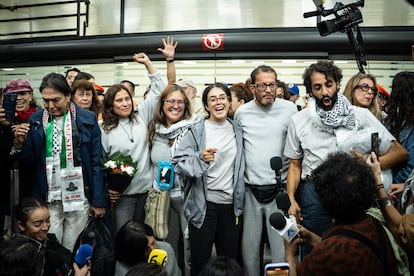
Days later we saw ambassador Mauricio Escanero, who acted with enormous dignity. I had direct instructions from the president and the chancellor to get us out as soon as possible. Thanks to international pressure, our deportation process to Jordan began.
For me, the purpose of joining this mission went beyond the ship or the blockade. It was the fight to restore dignity and agency to the Palestinian people. For years, Israel has not only tried to destroy them with bombs and sieges, but also through control of the narrative, imposing a narrative that dehumanizes them.
My work as a documentary filmmaker and photographer, since my years with UNRWA and other UN agencies in the Middle East, has always had the same axis, which is to accompany the Palestinian communities, listen to their voices and help them tell their stories. That is what some call the Digital Intifada, a counternarrative that seeks to break the media siege and show the humanity that persists even under siege.
Today, as Gaza resists beneath the ruins, the world begins to look again. But it’s not enough to look. The urgent thing now is to stop the genocide, repair Gaza and restore life to a devastated land. Every destroyed hospital, school and home must be rebuilt; Every wound, physical or moral, needs justice.
And that justice cannot remain suspended in the air. The architects of this massacre, Benjamin Netanyahu, Bezalel Smotrich and Itamar Ben Gvir, among others, have been explicit in their intentions to ethnically cleanse Gaza, erase its Palestinian population and transform that devastated territory into a real estate bonanza. Those who have ordered, financed and justified this extermination must be brought before international courts.
When they took us out to be deported to Jordan, they put me in a truck with metal cells. We were four people in a tiny space. At my side was Mandla Mandela, Nelson Mandela’s grandson. Behind the bars, the guards watched us silently. He looked them in the face and said, “Remember my face, because I am coming back.” One scoffed: “You’re wasting your time.” Mandela responded without hesitation: “I have all the time in the world for this.”
His words were suspended in the air. I thought of those who have resisted since the Nakba, of generations who have lived under siege and yet have not stopped rising. I understood that that phrase did not speak only about him, but about the Palestinians, who have sustained this struggle long before we were born.
Because Palestine has never stopped returning: in memory, in the streets, in every attempt to rebuild what others destroy.
Time, although the powerful believe that it belongs to them, remains on the side of those who resist. I would sail again in the flotilla as many times as necessary. There is no greater honor than having been part of this fight.
For more updates, visit our homepage: NewsTimesWire