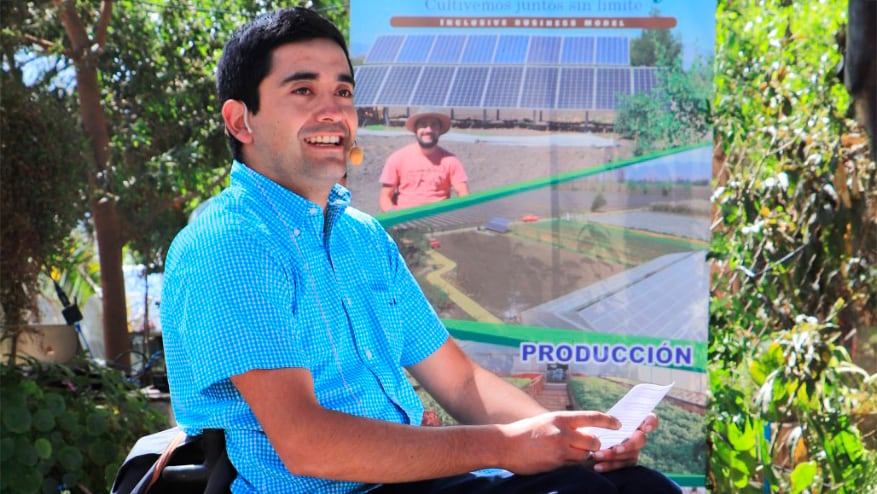
Chilean Alfredo Carrasco grew surrounded by peach trees and cherry trees, under the patient look of his father, a farmer dedicated to fruit growing. As a child, he cultivated a deep bond with the Earth, which reconciled with his other passion, the decrease by bicycle, which led him to compete since the age of 15 and study agricultural technology at 19. But in February 2017, when he was 21, during a competition in Viña del Mar, a poorly calculated jump made him fall head. He fractured three vertebrae and was paraplegic. A month earlier, his sister had died from a cerebral aneurysm. “It was a black year beginning,” recalls Carrasco, 29, in his wheelchair from his home in Fifth of Tilcoco. “It changed the way I saw life, work, everything. To my close ones, too.”
He spent two years in rehabilitation to recover his autonomy. He finished his studies to be agricultural technician and began to explore a way to return to the field. “I was in an impetuous search for how to approach agriculture again, because I knew that, as I had worked before, it was no longer possible. I didn’t want to go to an office. I wanted to continue in the field. I had to find the way.”
He nominated the Innovative Youth Fund of the Foundation for Agrarian Innovation (FIA), which supports ventures with social impact. This is how his company was born Farmhability In 2019. It began as an inclusive greenhouse where Carrasco could produce and sell vegetables autonomously, but the project grew beyond its initial objectives. Today is a training, training and visibility platform that promotes the labor inclusion of people with disabilities in rural contexts. “We become the first inclusive field in Chile,” says Carrasco, who now dreams of turning his company into a foundation. “We want to deliver concrete tools so that more people can develop labor in rural areas.”
Transmit hope
As Farmhability grew, Carrasco understood that his experience was not an isolated case “neither in the region, in the country, nor in the world.” He understood it by interviewing more than 400 people with disabilities during the execution of the FIA project and discovering a reality crossed by isolation, overprotection and geographical barriers. “They did not have an occupation, they were demotivated in their homes, with depression, with mothers who have to take care of their care,” he says. “They are families with less income, resources and access to opportunities.”
If that added the lack of inclusive working conditions in rural areas, the panorama became even more complex. Agriculture is one of the sectors with the greatest job accident in Chile. According to data from the Social Security Superintendence (SUSESO), the Fishing and Fisheries item in Chile registered a rate of 3.5 occupational accidents in 2023 per 100 protected workers, above the national average.
That awareness marked the course of his project. “I saw that I could convey hope,” he says. “I knew we were opening a new path in agriculture, in inclusion. And, since then, we have not stopped.”
Carrasco likes to say that Farmhability “is a company with a unique inclusive business model in Chile”, which integrates infrastructure, business, education and tourism. In fifth of Tilcoco, it has 2.5 hectares of agricultural production, a thousand square meters of adapted hydroponic greenhouses and a packaging room designed to mainly incorporate people with reduced mobility. There are vegetables such as hydroponic lettuce, broccoli and cauliflower, which are sold in Cugat supermarkets, which works in the country with farmers directly.
But the project did not remain alone in food production. In alliance with INACAP, a technical technical training institution, developed an adapted agricultural vehicle prototype, based on a four -time, which allows people with disabilities to perform open -field work. The impact, says Carrasco, is also educational. Pharmacyity gives workshops and educational activities to know the field, domestic and hydroponic agriculture. Together with other ventures, he promoted the first Rural Tourism Cooperative in the O’Higgins region.
The recognitions have been multiple. In 2021, the Inter -American Institute for Cooperation for Agriculture (IICA) highlighted the project. In 2023, Carrasco participated in the Inter -American Board of Ministers of Agriculture in Costa Rica, being the first farmer in 80 years to sit at that table. The following year, it was part of the first leadership meeting of rurality, with representatives from 28 countries.
More interested disabled people
Although he acknowledges that there have been advances, Carrasco still sees very few people with disabilities in the rural world. Therefore, your message is also an invitation: to become visible. “Through our own presence in public space we can also push changes, showing that we are capable and that we want to contribute to the development of the country.”
– What does inclusion in the rural world mean for you? How do you live in Chile?
– While I recognize that there are important efforts from the State, municipalities and schools, I feel that accompaniment ends when people graduate from the school system. There begins the real problem. Many times there is fear of losing benefits, such as disability pension, trying to professionalize or want to work. And, on the other hand, labor opportunities are missing. From the private world, it is believed that it is very difficult to incorporate a person with disabilities in their work team, when small adaptations are often required. It is not about inventing jobs for people with disabilities. It’s about giving them the possibility of working.
– How has the agricultural community reacted to this new look that is promoting?
– We have had a very good acceptance, both from the private and public world. The idea still impacts that a person in a wheelchair can generate agriculture, but I would like to see more disabled people interested in training around the agricultural issue. There is fear, and also the lack of spaces such as Farmhability limits access to these work instances.
– What structural changes are needed to make the field more inclusive and accessible?
– There are two possible paths. One is to strengthen the law that in Chile forces companies with more than 100 workers to include at least one person with disabilities. In practice, it is something that is not so effective. That law should be more rigorous and also allow, with less number of people, one with disabilities be included. The other way is to encourage: that the State supports companies to make the necessary improvements, not only in infrastructure, but also in training: teach employers and equipment how to generate an inclusive and friendly work environment.
– What does the agricultural sector win with this inclusion?
– Win in many ways. On the one hand, you have a labor that can develop any work, within its capabilities. Sometimes, you can develop even better than a person who does not have a disability because the commitment she acquires with work is much greater. There is an intrinsic value, which is not seen, emotional too, and, on the other hand, there is something perhaps close to consciousness, to know that you are contributing to dignify that person, to give value.
For more updates, visit our homepage: NewsTimesWire
https://elpais.com/america-futura/2025-07-25/alfredo-carrasco-el-agricultor-paraplejico-que-transformo-su-rehabilitacion-en-una-revolucion-agricola.html