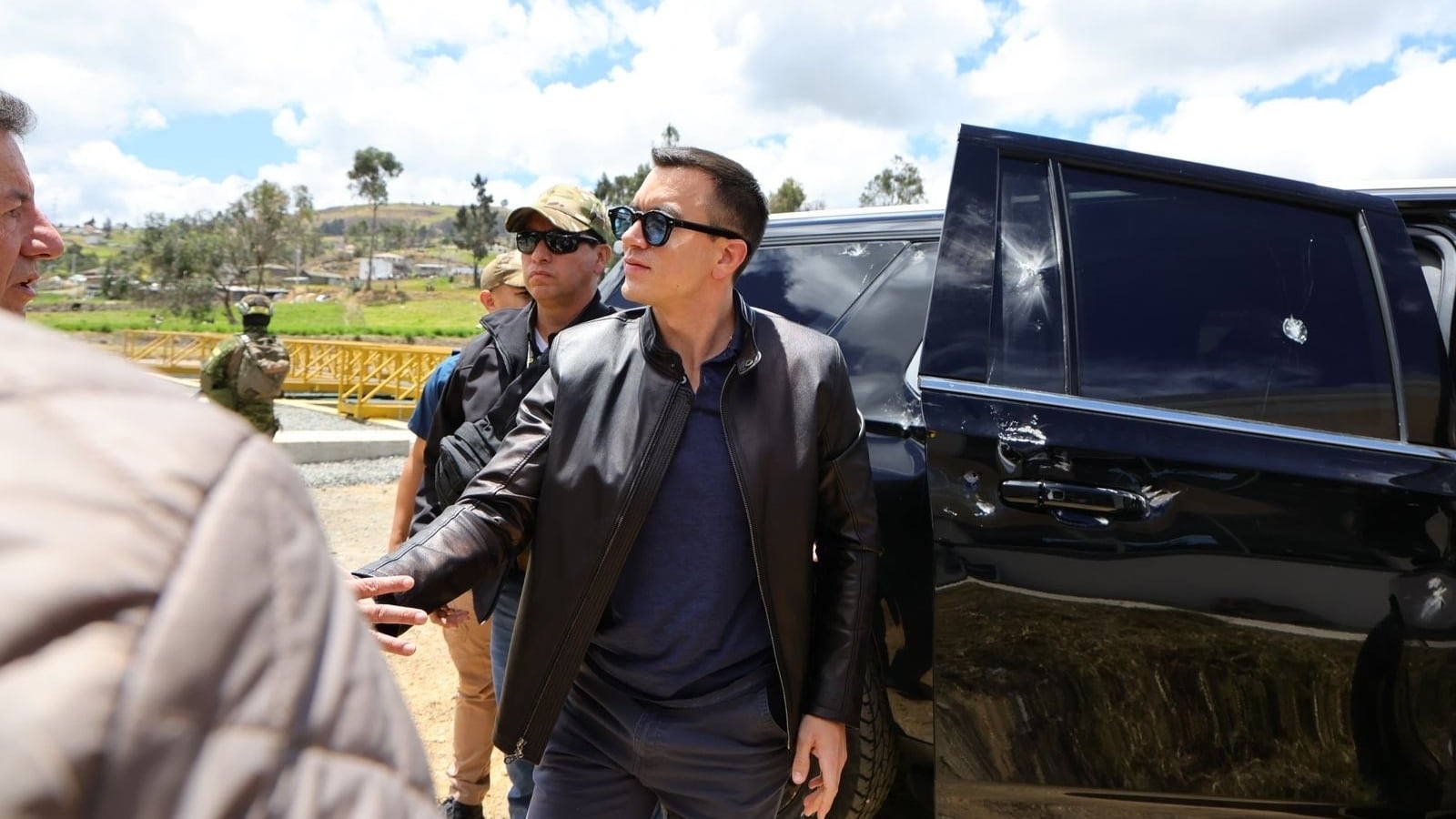
The Government of Ecuador has filed a complaint this Tuesday with the Prosecutor’s Office for an alleged assassination attempt on the country’s president, Daniel Noboa, after the caravan in which he was traveling to reach an event in the south of the country was attacked by alleged protesters. The Minister of Environment and Energy, Inés Manzano, explained that the president was arriving at an event held in the municipality of El Tambo, in the Andean province of Cañar, when “500 people appeared” and “they were throwing stones.” “There are also signs of a bullet in the president’s car,” he added. The politician was unharmed, he participated in the planned event, and subsequently, the minister said, he continued to fulfill his agenda “normally.” However, he has indicated that what happened will not “remain unpunished.”
In videos circulating on social networks you can see the moment when supposed protesters throw some stones at the presidential motorcade. From the Communication Secretariat of the Presidency they point out that the vehicle in which the president was traveling “is being analyzed by (the) Criminalistics brigade.” The head of Environment and Energy has also indicated that the security forces were able to arrest five people who were at the demonstrations and that they will be reported for the crime of terrorism. “We are not going to allow this. Ecuador says: ‘Yes to peace, yes to work’, and these types of demonstrations that are not peaceful are not what we need at a time of progress and development,” he mentioned.
The reported attack occurred during the sixteenth day of protests called by the Confederation of Indigenous Nationalities of Ecuador (Conaie), the country’s largest social organization, after Noboa eliminated the diesel subsidy. However, Manzano stressed that they knew that “the ancestral indigenous communities are not involved in this,” but rather that it was “certain criminal cells” that were “causing these acts of terrorism.” For its part, Conaie has denounced on its social network account The trigger for the indigenous protests was the elimination, on September 12, of the diesel subsidy, which raised the price per gallon (3.78 liters) of that fuel from $1.80 to $2.80.
For more updates, visit our homepage: NewsTimesWire