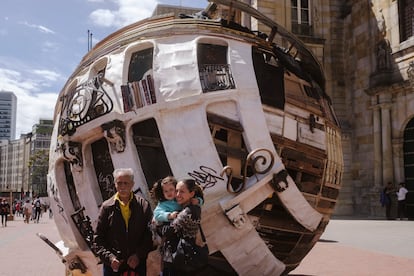
Are you happy? Bogotá is asking him. A capital that is usually associated with its stagnant traffic and its torrential rains, looks better these days. The capital of Colombia has released its first international biennial this week, with the participation of 200 artists and an ambitious project as a flag: “Tests on happiness.” It refers, for example, to the enjoyment of dance as a pillar of joy, or the toxicity of self -help manuals to be happy. The sculptures, paintings or performances are not only in iconic institutions in the center of the Andean capital, but in streets and parks, where passersby distressed by the haste of everyday life have begun to stop. Angie and Soraya left work early on Thursday, and stopped their passage when they ran into a house floating in the air. It was there, sustained with a crane, showing a tangled complex of roots at its base, in the middle of the Plaza de Lourdes, north of the city.
“If you ask me,” says Angie, who effectively asked how she interprets the work, “I believe that the artist means that he is worth dreaming, to heaven, that dreams have no limits.” Having your own house is undoubtedly a dream for millions of Bogota, but the mayor’s office performed the work on the other hand, that of the uprooting of those who are forced to leave their home, either for violence or by gentrification. For Leandro Erlich, the Argentine who created the installation, also has to do with the ignored and mistreated nature. “I was thinking that he looked half and a half of the center of Bogotá,” says a university student while watching the sunset light highlights the contrast of red bricks with the green of the hills of Bogotá, a usual color palette for the capital.
The conversation about making an international biennial of this size in the Colombian capital began several decades ago. In 1988 a first effort was organized, but with a very different claim: the Museum of Modern Art of Bogotá presented the works of 47 artists to commemorate the 450 years of the city’s foundation. It was a smaller event, “inside doors.” Now, the first official biennial is more than “Outside doors.”
“What I like most is people’s interaction with art in public space,” says graffiti artist Cristian Manzo, who works in the logistics team. The inauguration had the temporary installation of 15,000 flowers on the environmental axis, a brick channel in the center of the city, which reflects the now underground passage of the San Francisco River. “The environmental axis was a place of passage and that day (opening) was a meeting place,” adds Manzo. That weekend a sphere was also installed in the Parque de los Novia, to the West, which, in the words of a group of children of three and five years, “looks like a dinosaur egg.” Is called Seed, it is of the Colombian Vanessa Sandoval, and in her center she keeps a native tree.
The Biennial was done in record time for this type of event. The Mayor’s Office of Carlos Fernando Galán assigned the resources since his term began, in January 2024, and in less than two years a curatorial committee was formed, directors and a technical team of the Ministry of Culture, Recreation and Sports were delegated to think about the structure, theme, scale, places and the call. The Secretariat assigned 7.5 billion pesos (almost 2 million dollars) and 3,000 million more were managed through 65 public and private sponsors and allies, and international cooperation.
That budget and vision, says María Wills, curator of the Biennial, allowed to do something very different and ambitious: “Here new work was commissioned with fees and production money for artists, which allows us to consolidate a healthy art ecosystem that takes care of good working conditions and professionalization.” The funds were executed through artery, a private operator that speeds up the processes. According to Secretary Santiago Trujillo, “public-private synergy has been vital to crystallize great city goals and make events that put Bogotá as a cultural epicenter in Latin America.”
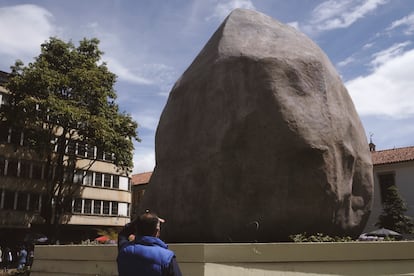
Another striking work is in the square of the University of the Rosario, in the center of the city and where before there was a statue of the founder of the city, Gonzalo Jiménez de Quesada, that a group of indigenous Misak lay during the protests of 2021. Now there is a huge stone, of six meters, painted with red lipstick kisses. “I don’t understand her, if I tell her the truth, but she has her grace,” says a seller of Esmeraldas de la Plaza, Lizandro, who observes it every day. Is called Giving weight to some kisses, and it is From Iván Argote, a Colombian based in Paris who hopes to make a kiss hugging the stone on November 7, two days before the term of the Biennial. Will be one of several Performance in the streets of Bogotá.
The Biennial also seeks to restore the confidence of the Bogota with their city. “I love to see people enjoy the art in the street without thinking that they will steal them,” says an older woman in front of the San Francisco Palace, a building of the early twentieth century that some was an assembly, and where there is a wooden and metal sphere and other materials. The huge structure is from Paisa Alejandro Tobón, who seeks to evoke the materials that existed in that same place for more than a century.
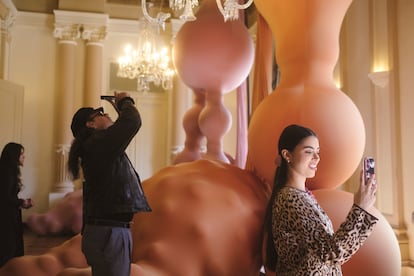
International works accumulate in that palace. There is a huge projection of a steam flag made by the Irishman John Gerrard, in a landscape so arid that evokes the dry future of the world if natural resources are still exploited to the current rhythm. There are also the inflatable balls of the Spanish Eva Fàbregas that, surrounded by an enormous orange and violet fabric, evoke eroticism or, as a tourist says, “they could be the intestines.” There is also the Peruvian Ximena Garrido-Ecca, who presents Botanical insurgencesa huge hydroponic bean crop in a sophisticated hydraulic system made in ceramics.
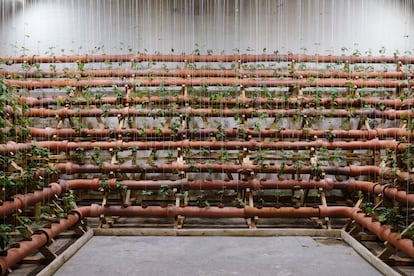
Mexico City, another metropolis recognized for being the epicenter of art, is the city invited to the Biennial. One of his most striking representatives is Yunuen Díaz, who installed, in the square of the Gabriel García Márquez Cultural Center, some nests made of Chusque, an Andean bamboo. Inside the songs of birds and voices of poets of the two cities are heard. “As if to fall asleep,” says the woman who is no longer afraid of thieves.
But what has this biennial is a great Bogota pride. In a sample in the American Colombo Center is the city of Pablo Adarme, who ‘cooked’ some cakes with the shape of the homes of the Venice neighborhood, where seconds and third floors are built wider than the first. Tunjuelito, Kennedy, Ciudad Bolívar or the monument to the flags are the emotional places that the capital has formed and that appear evoked in canvases, facilities, photographs.
“As has happened with rock to the park and sauce to the park, which are already the rights of citizenship, it is necessary that the biennial be installed in the cultural calendar, regardless of electoral changes,” says José Roca, curatorial advisor. That is something that mayor Galán also wants, he said at the inauguration. “It is necessary that this biennial be consolidated as a city project beyond the governments of the day, and that, through the appropriation made by the citizenship of the artistic ecosystem of Bogotá, all the resources and efforts necessary for its realization are guaranteed,” he said.
In a country where biennials have been rather ephemeral, it leaves the path drawn for its next edition, the BOG27, which has already secured the budget. Councilor Sandra Forero also advances in a regulation that allows protecting the periodicity of the Biennial, to be an obligation of the mayors who come.
But in the meantime, not all exposure spaces are so visible, some seem hidden. On a ground floor of the Cinemateca in the capital is the work of María Fernanda Cardoso, a Bogota who has been living in Australia for years, perhaps the farthest country with presence at the Biennial. In a dark living room he exhibits photographs of some spiders from Oceania, tiny and with colors so vivid that they seem painted. Paradise spidersIt is called the work. He recorded them interact, seducing in what looks like a ballet that is glimpsed on a huge screen. In addition, he recorded in laser the movements of the dozens of spiders, which transmits vibrations on a platform where viewers can feel arachnid dance. “Spiders do not load computer,” writes a child who draws red and orange to a spider, perhaps with the recipe to be happy at the Bogotá Biennial.
For more updates, visit our homepage: NewsTimesWire