Bolivia definitively closes the door to child marriage. The Legislative Assembly approved on Wednesday afternoon a law that eliminates the exception of the Family Code that allowed to marry at 16 years with the permission of the parents or judicial authorization. The reform seeks to “eradicate marriages and unions, many of which are led by family agreements that violate the rights of minors, exposing them to situations of abuse and violence”, according to the report published by the Chamber of Deputies. The feminist movement applauds a rule that begins to seal a great debt to girls.
The modification corrects a legal contradiction that persisted since 2014, when the code of the families and the code girl, boy and adolescent were simultaneously approved. While the latter categorically established that the minimum age to marry was 18 years, the first opened an exception for 16 and 17 year old teenagers, provided they had consent of the tutors. For this little slit they also sneaked into early unions and even weddings with much lower girls. According to data from the Civic Registration Service (Sereci), from 2010 to 2022, the number of adolescents between 13 and 17 years who married was 11,297. Of this amount, 10,012 (89%) were girls and 1,285 (11%) boys. Girls used to be married to men of an average of between 20 and 35 years. Sometimes, even with lords 60 years older than them.
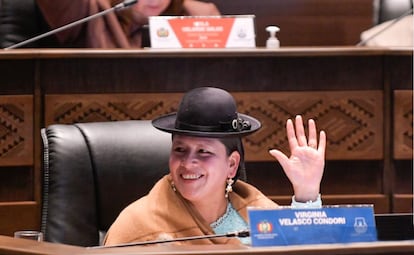
For Senator Aymara and promoter of the norm, Virginia Velasco Condori, this is a victory “above all, for the most vulnerable girls”: “It is a promise that our teenagers will no longer be forced to marry, to leave school or to load responsibilities that do not correspond to them,” he said on the phone, hours after the sanction, approved by two thirds of the camera.
Velasco clarified that, although the law is not punitive, the Criminal Code, in its article 154, sanctions the breach of duties and the authorization of prohibited acts. Therefore, Civil Registry officers who allow marriages or unions of minors can be criminally prosecuted for those crimes. “You have to change the chip of those who continue to defend that it is a custom. It is not, it is violence. You cannot continue with this speech,” he added.
This is also a victory for international organizations that have been accompanying the process, such as Save The Children who alerted in a statement that the legal union in minors “hide heartbreaking stories: sexual violence, unplanned pregnancies, manipulation and labor and sexual exploitation.” The committee against torture goes further and ensures that the conditions in which these girls or adolescents are married “are similar to torture: cruel, inhuman and degrading.” To the cry of neither wives or concubines, Bolivia becomes the 14th country of the region to prohibit child marriage, after Colombia that abolished it at the end of 2024, according to a UNICEF count.
For Mónica Bayá, representative of the human rights community and legal advisor of Equality Now, the measure is a victory for the rights of the minor and a “key” that, he expects, opens many other doors. “This is the tool that can allow to delve into preventive measures,” says this recognized Bolivian feminist. “It is essential to talk about social policies in the education sector that empowers girls and keeps them in the educational system to understand that there are more expectations in addition to marrying and being a mother.”
This law has been going from office in office during the last three years after almost a decade of visibility of the harmful effects for children in the country; such as school abandonment, loss of autonomy and children’s pregnancies. The data of the National Health Information System (SNIS) show that between 2020 and 2023 there were 8,855 pregnancies of children under 15 years and 139,021 of adolescents aged 15 to 19. Bayá also insisted that this should be a “concern” that involves society as a whole. Also to men. The challenge, according to the expert, will be greater in the rural areas of Bolivia where these unions are more normalized.
Child marriage in Bolivia is a phenomenon that is usually given mostly in rural areas, for old family practices and pressures. In some cultures the early unions are usually linked to agreements between families or the expectation that the woman assumes the role of mother and wife from childhood. Between 2014 and 2023, 4,804 adolescents from 16 to 17 years were recorded with “alarming consequences”, according to official data.
“Work continues”
Bolivia joins an increasingly long list in Latin American countries that recognize the right of girls to be that: girls. 14 countries of the region (Colombia, Chile, Mexico and the Dominican Republic, among others) have totally prohibited these unions understanding the historical debt with childhoods. And it is that 21% of the women in Latin America and the Caribbean who are now between 20 and 24 years old had married or lived with their partner for the first time before the age of 18 in 2023, according to UNICEF. This is a percentage that has been stable for 25 years and 2% higher than the world average.
After the initial euphoria, Senator Velasco reminded El País that “work continues” and that it will also take place in rural communities. “You have to talk in different languages, I will speak in Aymara in the territories. We will see how to get advertising and posts on social networks to bring this conversation to all corners of Bolivia, but this is a great first step. Today is a celebration.”
For more updates, visit our homepage: NewsTimesWire