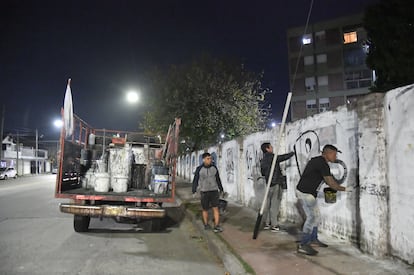
In the city of Buenos Aires there are walls that change all the time. The first minutes of the 19th of a Wednesday have passed prior to the Buenos Aires legislative elections (they will be this Sunday, May 18) and a group of four boys approaches one of the walls in question. “Silvia Lospenno, it’s pro,” reads, in yellow letters. It is one of the applicants to legislators.
Aaron and Theo Cabral walk along, while whitening the wall with rollers. The one who follows them is his dad; The “Captain” of the team: Miguel Ángel, much better known as “El Chino”. It takes care of the letters and shading, tasks that do at the same time. The last to start and join is Ángel Arroyo. Its role is to fill in blue a part of the letters. “Santoro. 18-5. It’s now Buenos Aires,” they paint in less than four minutes, on a 12-meter wall. Leandro Santoro is the candidate of Peronism and, according to surveys, he is the one who has the most chance of being first.
“And that is the first. We are just getting hot,” says the Chinese, while adding his most important detail. For 33 years, “El Chino” has been signed to each of the 20 or 30 graffiti he can do by exit on the walls of the city that change constantly. Then the four return to the truck (Model 1980) and mix between lime, paint buckets, rollers, brushes and two water tanks. The next wall is around. Today the tour is in the south of the city and includes 20 graffiti.
If São Paulo is characterized by baptized street painted as PichaçãoBristol (United Kingdom) is recognized as the “Bansky cradle” and Berlin is “sold” as the city with the greatest concentration of graffiti From Europe, from the street painted of Buenos Aires, two qualities could be said. The first is that no other city must have so many soccer clubs painted in its streets; to the point that each team has its group of fans turned into painters.
The second that makes it unique are the political painted in their public space. They are believed to be installed by the Socialists, around 1920, and that Peronism adopted them as their own. They were only prohibited during the dictatorship. And while initially they were borne by the militants, since the 1990s, private teams are entrusted, such as that of the Chinese, which he painted for practically all political parties. It is not a national phenomenon. Most of the graffiti are in the capital of the country and in their main accesses, as well as on the big routes and the first and second cord of Greater Buenos Aires.
Maximiliano Sahonero was a Buenos Aires legislator (2015-2019). But before, and among other things, he worked as a political painter. He painted for ten years. “It has to do with our artistic idiosyncrasy,” he reflects on the other side of the phone, to add: “The main political spaces found in these graffiti a matter of belonging. The boom came after the nineties, when the graffiti became a product and the historical painters appeared. Today they continue to be done by mystique, tradition; they resemble football in the neighborhoods of the teams, by the team.
To meet the historic city to which Sahonero refers, we must look for firms. The main ones are Patita, Beto, Franky and the Chinese. The last two are residents of the President Illia neighborhood, a housing complex of 614 homes in the Bajo Flores area. In the environment it is said that it is the “cradle” of political painters and that at the time they became five painters in activity. What should be clarified is that, for example, the Chinese, for 2015, had 14 teams of painted, of four or five members each. His colleagues also had several teams. They toured Greater Buenos Aires and the city. They turned to paint 24 hours a day, seven days a week.
“It is not that the work goes down over the years or social networks. It goes down with the changes of governments,” explains Cabral. “With Macri (Mauricio, president between 2015 and 2019) he went on to paint much less. From the moment the Alberto-Cristina formula (Fernández-Kirchner, president and vice from 2019 to 2023) was confirmed, everything that had not been painted before. And now with Milei he went down again. The right-wing games do not invest so much in graffiti. They have another vision. more popular.
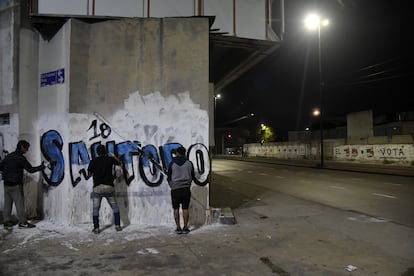
Cabral’s origins are in Illia. One day a neighbor invited him to work and said yes, without asking what to do. He lacked months to fulfill his 18 (today he has 50) and started carrying the tachos. Two years later he became independent for his first political campaign, that of 1995. Over time he would also begin to hire soccer unions and clubs, in the months prior to his elections. He also paints in his neighborhood, at the request of his neighbors who commission him birthday greetings or love statements. For 18 years his signature has been closely linked to the Peronist parties.
“If I like this work? Look at my face. I say that I will continue until I give my legs. I come with my children, we take a soda, we eat together. We have a good time. Seeing your work on the walls is something very nice. Because it is my something. His maximum dream, he adds, is that Word includes his lyrics among his typefaces.
The phenomenon of political painted even has a film. Rather, a documentary. His name is Body of font and premiered in 2015. Its director is called Julián D’Angiolillo. “There one team in the morning paints for one game and night for another. And you can sign one way for one and another way for the other or directly not to sign. It is something that happens. They have a main client, but if they get an exit for a party of another political color, they do it. Only they do not always sign it. Each team has its ways of handling,” is the first thing that counts.
The conversation turns to the messages of the graffiti. They not only serve to campaign for a choice. Many times, when a party does not finish defining their candidates, they appear painted of formulas and journalists begin with their analysis: will it be a political play? Is it true? “Over there, if you want Mark the court To someone, they commissioned painted in a certain territory. It is used as an instrument of dissemination of indirect messages to generate a kind of rumor or runs the voice. That is, they are also ways to approach the political internal. Maybe today it has more efficiency at the intra -party level than in propaganda, ”says the film director, who is also a university professor.
Sahonero responds instantly, as if it were yesterday. He says that in an early morning the same wall came to paint. The minutes left the team that painted for another candidate. After a while he came back and discovered that he had to whiten and paint for the umpteenth time. It is the day -to -day history of the trade. Some offer the “recomposition” service. They paint certain walls and ensure maintenance for one month. The painters are few and know each other. Those who get along well, agree on some walls. They are respected. Although one of the slogans says that “in the campaign there are no friendships.” In the Greater Buenos Aires of the ninety -early century, everything could end badly. There were hot areas.
“It’s like a mystery how a wall is painted. It works at night and becomes so fast that most likely the neighbor woke up and see that now the wall has another name,” says Sahonero. “It’s even mystical … the people who see you come to ask you how you do it. When I told it in social meetings, they filled me with questions about the trade. There is a lot of curiosity.”
The two most valuable walls can no longer be painted. One was that of the Lugones highway, at the height of the River Plate stadium. The other on Avenida 9 de Julio, meters from the Obelisk. With the particularity that came out several hours of the day live on the television signals of TN and Channel 13, which they transmitted with the background avenue and the names of the painted politicians. They were not the only “lost” walls. In recent years, the trade was very limited to the southern part of the city. Mainly, it is painted from the other side of Rivadavia Avenue. “There is a bit tacit agreement with the police in some places. It is accepted even if they are not allowed and are already part of the landscape,” adds D’Angiolillo. And he concludes: “In addition, painters also do social work. They are from the neighborhoods and rescue a lot of kids.”
For more updates, visit our homepage: NewsTimesWire