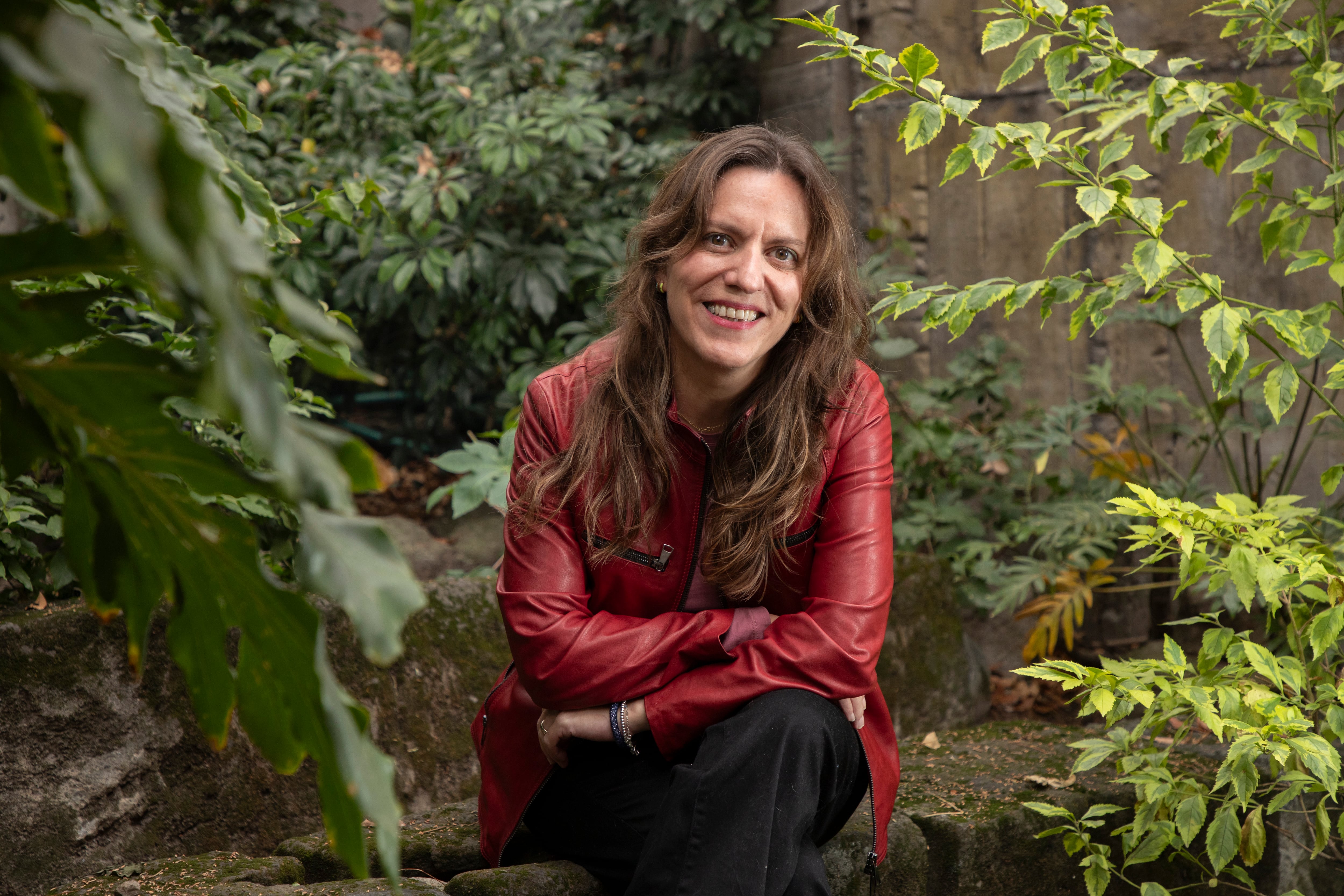
William Harvey found out how the circuit of the heart worked and wrote it down in a treatise, which he called Motu Cordisin 1628. 15 years ago the writer Daniela Tarazona found him at a bargain sale at the National Autonomous University of Mexico (UNAM) and became obsessed with this English doctor who, obsessed with understanding the body, dedicated his work to the king. From that chain of unpredictable causalities, the novel was born, as everything is born. The inhabiting heart (Almadía, 2025): Harvey is now a character and Tarazona his recreator. They are accompanied by the inexhaustible wonder of a prehistoric woman and the nostalgia for the life that was an astronaut while he circles the Earth. “For me, writing has always been about escaping from the world, reading too. And here my intention was to reflect the possibility that they are not going to catch me: these characters cannot be caught, even if they want us to follow a series of patterns, they escape, like we all escape,” says the Mexican writer.
Daniela Tarazona (Mexico City, 50 years old), who won the Sor Juana award in 2022, has worked as an editorial coordinator in museums, as editor-in-chief of travel magazines and literary supplements, and in the Ministry of Culture looking for young writers inland. “I have always had an office job, so I fit writing in between those times,” he says. That allowed him to encapsulate the job in a parallel reality. “Writing has a place for me in which it does not participate in all this need to respond to what I am supposed to write,” he narrates: “I am very interested in breaking that insistence that we all be one way, that we respond in an automatic, established, rigorous way.”
So, The inhabiting heart disorients; When it seems that we are chronologically accompanying a woman who discovers rain, a doctor who opens living bodies to feel the heart and a cosmonaut who longs to walk, a new explorer appears and the days mix and thoughts recirculate, did the man leave the cave or did he return? Is the delirium continuing or has it already stopped? Is he still inside the ship or has he already left? “You know that things are no longer, in any way, how they have been. The meaning of the words and numbers is different. You tried to write it in your log without revealing the secret, because it scared you: any sign contrary to the order, even the very text that occupied you, the sum of words could alter the future of the universe. You were referring to circular and incessant events,” writes Tarazona.
This mixture of times “reflects an intention to show how the present we are in is also a power of what we were and that is marking certain future possibilities,” the writer now explains. “I suppose all this has a lot to do with identity: who am I? Who was I? Who am I going to be? Is what we remember about ourselves what we are now or what we will be later? That wave of existence,” he points out. Tarazona describes there a memory linked to language and the transmission of affections, to emotional inheritance: “I look at you and I know that your look is the look of many ancestors.”
Tarazona finished writing this novel in Madrid, on the other side of the ocean where he began. “The book stays with me for a long time, because it takes me a long time to write, even though they are short. So it is my reading of the world, from 2016 until now,” he says. The author has lived in the Spanish capital for three years, where she investigates the history of her family—a grandfather linked to the Spanish Republic and a father who was born on the precipice of the civil war—but this interview takes place a few steps from her childhood home, in Coyoacán, south of Mexico City, before she leaves for the FIL Guadalajara.
The writer points out that she has the family book already “very advanced in number of pages,” but that then the final touch is missing: cutting it. Tarazona makes short books —The inhabiting heart It has 120 pages—with several purposes: “I like compact, short descriptions,” he says first. “I’m not interested in doing linear writing, also because I feel that I wouldn’t be good at that, I wouldn’t know how to handle those gears. I like to be consistent with what I think works best for me, which is breaking things down all the time, making a more fragmentary text,” she says. “I also think that in this world it is increasingly difficult to give yourself time to read, right?” he finally says.
The latest Inegi survey reveals that the average reading time in Mexico is one hour a day and the majority manages to read books once a week. “We are all being persecuted by a ferocious production machinery and there is little space to read, so I have wanted to deliver texts that do not require a lot of extended time, but rather are like a retreat, a substantial coexistence,” notes the Mexican author: “When one reads a book it is a meeting of two interiors, which seems wonderful to me, because they are a little untouchable.”
For more updates, visit our homepage: NewsTimesWire