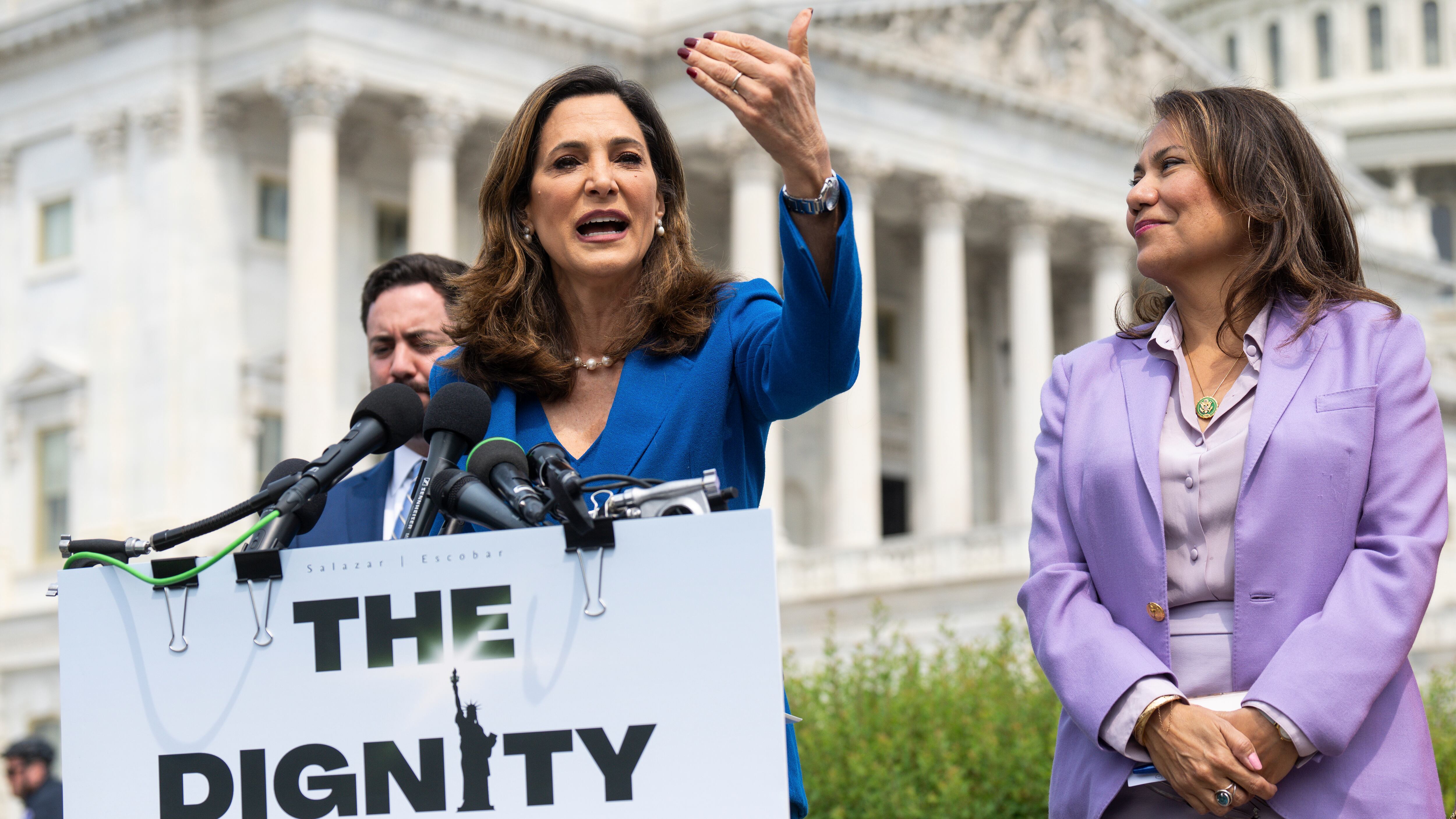
Two Latin congressmen, a Republican and another Democrat, presented on Tuesday at the House of Representatives a bill that seeks to amend what they called an “broken” immigration system. The legislation presented by the Republican representative by Florida, María Elvira Salazar and Verónica Escobar, Democrat by Texas, tries to combine conservative priorities with migratory reforms of liberal court, seeking at the same time “to stop the flow of illegal immigration” and offer “a dignified solution” for undocumented immigrants who are in the country.
The so -called Dignity Law, originally presented in 2023, covers a broad spectrum of issues that include border security, employment and economy, but has as its central axis a way so that some immigrants can legalize their status for the next seven years. For this they should have remained more than five years in the country, not having a criminal record and paying compensation of $ 7,000 to the government. The proposal does not offer a way to become an American citizen or allow the beneficiaries to receive federal benefits.
At a press conference with about twenty legislators from both matches against the United States Capitol, Salazar said Tuesday that he has been “direct witness to the devastating consequences” of the “broken immigration system” of the United States. The proposal is a “realistic commitment and based on common sense,” added the congresswoman, “especially important given the urgency of the moment.”
Salazar is a representative of District 27, which covers a wide area of Miami-Dade, a Hispanic majority county that in the past elections voted for the first time in almost four decades by a republican presidential candidate. After starting his second term, Donald Trump has promoted a vertiginous anti -immigrant agenda that has had a visible impact on the communities of the southern Florida, where he laids, arrests in the immigration and express deportations courts have created an atmosphere of fear and disappointment.
Since April, fences began to appear with ads paid by the Democrats on the most important roads in the area with illustrations of local Cuban-American legislators-Salazar; Carlos Giménez and Mario Díaz-Balart— and the Secretary of State, Marco Rubio, with a message that says “traitors”, and below “to immigrants, Miami-Dade and the American dream”. In recent months, comments are often read in social networks publications of resident legislators expressing their frustrations with the immigration processes of the Trump administration.
When the law was presented for the first time in 2023, study groups estimated that there were about 11 million undocumented immigrants in the United States. But the figure has been rapidly increasing in recent months, after the Trump government has terminated and canceled temporary and humanitarian protection programs that offered residence and work permits for hundreds of thousands of people, many residents of southern Florida. The Republican has adopted several policies to radically limit immigration, including asylum applications, and exhorted immigrants to self -portion. Recently, he canceled the temporary protection status (TPS) for Haitians and Nicaraguans. Many of these measures have been challenged in court.
Salazar, born in the little Havana of Miami of Cuban parents, has tried to place themselves at the forefront against using immigration as a political weapon and has appealed to Christian values to promote decent treatment of immigrants. He has advocated all nationalities, but the case of Cuban immigrants who entered through the border with Mexico between 2019 and 2022 and received a document known as I-220A has been particularly visible. Unlike other immigrants who entered the same way and received a different document, Cubans with I-220A, which are estimated at hundreds of thousands, have not been able to legalize their status under the Cuban adjustment law, which offers that legal route after a year.
The congresswoman was also criticized after ensuring that Trump’s government had extended TPS for Venezuelans, when she had actually been a federal judge who had blocked the president’s attempt to put an end to the program. (The Supreme Court later allowed the Trump administration to end the TPS of 350,000 Venezuelans.)
Initially, Salazar and Escobar’s proposal had eight copatrochinters – four of each game. Although it did not advance in the previous congress, which ended in January, it has been kneading greater support, until reaching more than 30 backs from both sides of the Chamber.
The broad bill also proposes a reform of the asylum system, accelerating the processing to less than 60 days by asylum officers, while the applicants remain in “humanitarian campuses” on the southern border, where they would receive “medical attention, legal support and social assistance”. Complex cases would be sent to immigration judges. Processing centers in Latin America would also be created and a new humanitarian visa would be introduced, among other forecasts.
The new revised version does not differ much from the previous one, according to study groups, although it incorporates new elements on greater border security, seeking to align with the positions of republican leadership in the camera, which remains skeptical of any form of “amnesty” to undocumented immigrants. Democrats, meanwhile, although they support legalization, have reservations on issues such as border wall and accelerated asylum processes.
For more updates, visit our homepage: NewsTimesWire
https://elpais.com/us/migracion/2025-07-15/dos-congresistas-latinas-presentan-una-ambiciosa-propuesta-bipartidista-de-reforma-migratoria.html