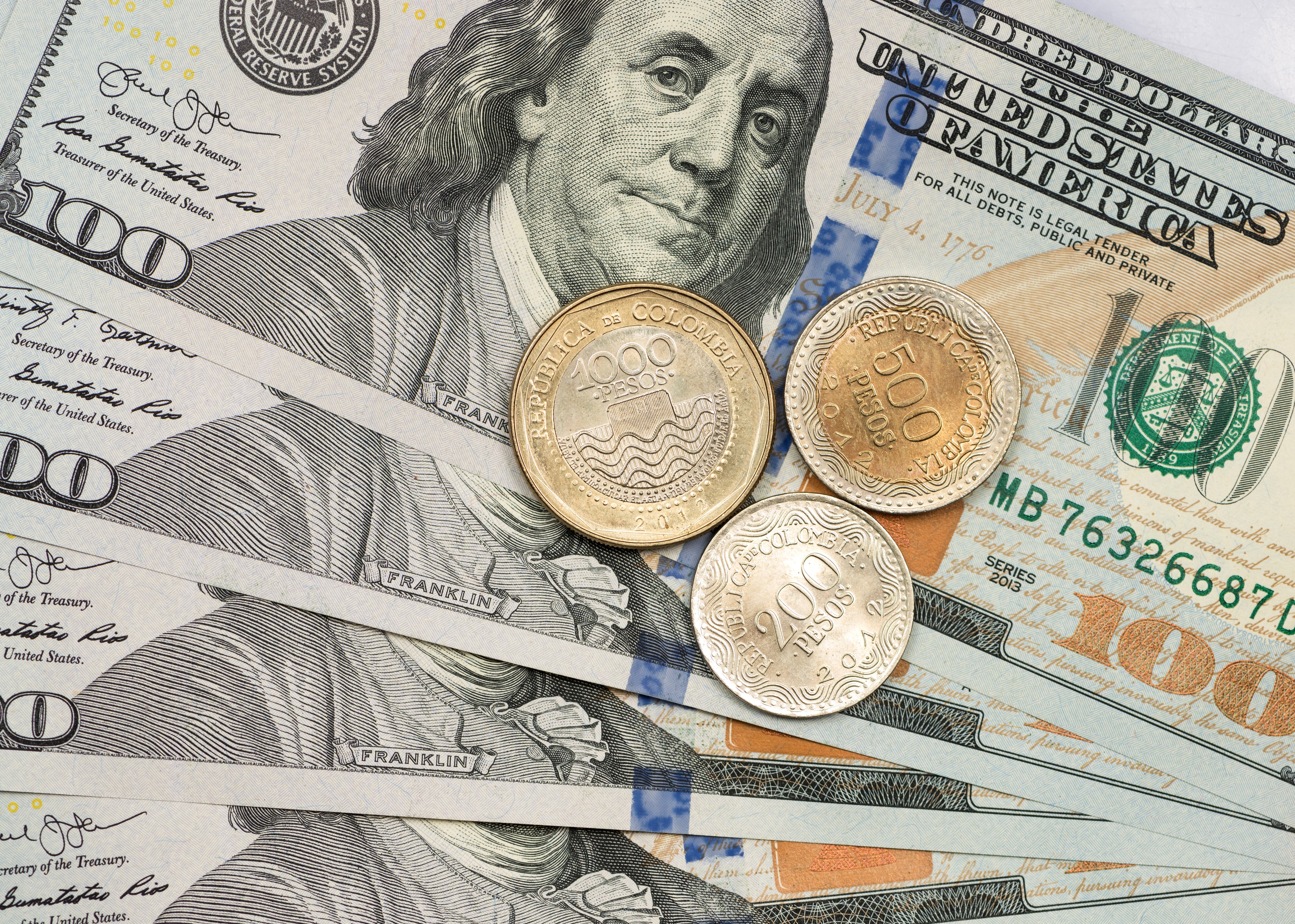
The official exchange rate of the dollar in Colombia has collapsed to levels not seen since May 2024. This Tuesday, the price reached 3,920 pesos for each unit of the US currency. A bump that has put on alert to market analysts, who are still attentive to the pendulum swings in the exchange houses. To explain the weakness of the coin of the world’s world, experts stress that for a few months they have evidenced one of their most steep value losses since 1973. That is why the euro, the Brazilian real or the Mexican weight have also gained ground.
At the beginning of the government of Gustavo Petro, in 2022-2023, market analysts prioritized in their analysis the reaction of investors and their influence on the exchange rate. In those days, the ads of the social reforms of the Executive marked the pattern in the exchange dynamics of the country. With the passing of the months, however, the waters calmed down. The weight regained vigor and the reflectors concentrated on other matters. “The behavior of the dollar in Colombia, in general, has a global explanation. Today we can link its weakening to the tariff policies of the United States or the Federal Reserve policy,” explains the chief economist of the Corficolombiana financial Financial Julio Romero.
The current weakness of the dollar evokes the first seventies. At that time, Republican President Richard Nixon suspended the conversion of the golden currency – apilar of the World Monetary System – as a firewall against the exit of reserves before the accelerated fiscal and commercial deficit. Today the most powerful country in the world faces similar problems. Felipe Campos, chief economist of Fiduciary Alliance, recalls that inflation in the United States, despite being moderate (2.7%), registered a slight rebound in July because of President Trump’s tariffs.
It also emphasizes that the American unemployment report, presented last Friday, showed an increase of a percentage point up to 4.3% in August. For the analyst, these are data that have underpinned the weakness process: “This has led to the market to give a 100% probability to the Federal Reserve to reduce interest rates on September 17. and even with a 9% probability that the reduction is 50 basic points. All this has contributed to the weakness of the dollar.”
It is the combination of all these factors that leads to the financial analyst Andrés Moreno Jaramillo to point out that the current context has accelerated the entry of capital to the emerging countries. The result? A positive cycle that is reflected in the strength of its local currencies. In addition, remember that the European Union, the United Kingdom and the United States maintain low or stable interest rates, unlike many Latin American countries. Therefore, investors do not find in these regions developed great opportunities to improve their yields.
Moreno supports his thesis clarifying that the index in the bags of Chile and Peru has risen significantly in recent months. To this, Julio Romero points out, the prices stability of some key raw materials for the economies of the region has contributed. In the case of Colombia, for example, the price of oil barrel has stopped falling and remains around 61 dollars. A level that is not ideal for the business, but has shown upward trend. In any case, oil represents about 40% of the country’s export income. And its stability favors the entry of dollars and strengthens the appreciation of weight.
The chief economist and research director of Credicorp Capital, Daniel Velandia, emphasizes that the global dollar has fallen on average almost 10% since the beginning of 2025, which represents the most pronounced fall in 52 years. In addition, it emphasizes that the current worldwide risk aversion favors Colombian weight. In that context, Velandia points out that the weight is among the five most volatile currencies in the world, next to the Brazilian Real, the South African Rand, the Turkish lyre and the Russian ruble. This issue is explained, especially by the high fiscal and commercial deficits of the country.
At this point the experts put on the board some local monetary policy factors. Julio Romero argues that an important part of the drop in the dollar could be associated with an “unconventional strategy” of financing promoted by the Ministry of Finance. It refers to an operation aimed at converting executive assets into dollars to buy pesos in the exchange market. It is also a recipe to handle the bulky public debt. In summary, the fragility of the dollar is anchored to the country’s financial policy. “Are Swaps that the government is doing so that there is abundance of dollars in the exchange market, ”summarizes Moreno Jaramillo.
For more updates, visit our homepage: NewsTimesWire