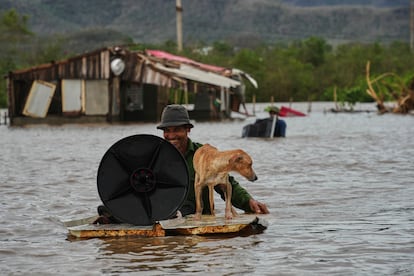
Minguito He didn’t know he was famous until people started stopping him on the road. They wanted to verify that he was indeed the man who, in the middle of a river flood, after the passage of the hurricane Melissa through Cuba, he grabbed his television like someone grabbing a family member who was about to drown, giving life to an appliance. A photographer from the Associated Press agency saw it, pressed the shutter, and the moment became the portrait of the Cuban disaster: a man with his olive green military beret and a crooked eye, rescuing what could no longer be saved, carrying under his arm what he knows is destined to die.
In the midst of the lack of communication with eastern Cuba, Minguitoor Duany Calzado Despaigne, 40, and his television, were for a moment almost the only thing we knew about the devastation that the hurricane brought to the country. Minguito It went viral, his face reached places he didn’t know, far from the small town where he lives on the outskirts of Santiago de Cuba, and people saw him who, under other circumstances, he should never have encountered.
The activist Yasser Sosa Tamayo went to visit him days later, and from him we learned that Minguito He lived in a house with wooden walls and a fiber roof that the wind blew away. He raised animals that the hurricane made disappear. It had a bed, a fan and several vessels that he can’t find now. He has dedicated almost his entire life to making charcoal, a job he did to raise the 35,000 pesos (about $77) that his Panda television cost. The moment he knew that the house was flooding, he didn’t grab anything else. “Television is life,” he said. He used to come home from work and sit down to watch any program on the air, all the enjoyment was on that screen. The artifact did not survive Melissabut Minguito wants to keep it. “To remember him, how am I going to throw him away?”
So that a portrait like this can exist, Minguito He had to be a guy with too little. The hurricane in Cuba always hits the people who have the least, or who have almost nothing, the hardest. The hurricane, in the end, uncovers the hole of misery.
Prior to the passage of Melissamy father and I were on the small balcony of a four-story building in the southern from Miami. There was an air that removed everything, even memory. “Do you remember when the cyclones came and we slept on the roof?” asked my father, who has been away from home for almost three years. I wanted to know, actually, if he remembered what we once were.
That image returns to us frequently, especially in the solitude of the emigrant. Under the sky, clear and still, we were freed from the heat of the days without light. We lived in a coastal town west of Havana, which was shaken dramatically by any cyclone or hurricane. Those days were particular, they still are. The voice of Cuba’s most popular meteorologist, José Rubiera, crept into the living room of the houses while there was light, and people did exactly what Rubiera ordered: they propped up roofs and windows, accumulated some food, filled any container with water, in a previous struggle with the cyclone, or taking from the hurricane beforehand what they would not be able to recover later.
The day of the cyclone was long, of waiting, so much so that we arrived tired or asleep at the time when it finally passed over us, or crossed us from within. In my memory as a child, there was no greater joy: no friend from the neighborhood went to school, a domino table was set up early, and the house was filled with neighbors, something that for me was a party, actually unrelated to those people who were going to lose everything the next day.
Orlando, a washing machine repairer, or Esperanza and Tatá, a couple of coal workers almost 80 years old, moved to our house. I didn’t realize how lucky we were, having, at that time, a house without luxuries, but with concrete walls and roof, which was going to stay right where it was, almost impossible to be blown away by any passing wind. For us, Cubans, trained to think that we were the inhabitants of a country without social classes, the cyclone divided us and, for the moment, status was marked by a consistent ceiling, or a rechargeable lamp to illuminate the blackout, even the water tank to bathe, flush the toilet and cook at the same time.
The morning after the cyclone passed, almost always wet, dirty and gray, was the moment most anticipated by my father and me. We went out hand in hand to tour the entire town, and we were doing a roll call and amazement: the tamarind tree that collapsed; the pig that Pupo managed to save in the bathroom; the village where my father worked, now roofless or flooded; Yamilet’s house, whose windows were knocked down by the wind; and that of my little friend Fuentes, into which the entire North Sea entered.
Each loss meant a caravan of haggard faces, people upset by what the sea had appropriated, angry about the television that they would no longer be able to turn on, or the wet mattress that would take days to dry. The town became an inhospitable place, from which each cyclone tore off a limb: the doors of the computer center, which then were not there to replace; the primary school roof tiles, which flew away; the polyclinic, increasingly destroyed. There were houses that a cyclone knocked down in stages: the kitchen, then the bathroom, then the living room, and thus an entire family ended up sleeping, eating and bathing in a room of what was their home. As the days went by, we got used to living with less.
The cyclones and hurricanes continued to arrive. The window that the hurricane did not take away Flora (1960), Kate (1979) took it. The street that the hurricane did not raise Michelle (2001), or the walls that he did not tear down Charlie (2004), did Wilma (2005). And to the disaster that the previous ones had left was added that of the ike (2008) or Gustaf (2008). And if the accumulated poverty was not enough, the hurricane Irma (2017) or Ian (2022) reinforced the misery. The accumulated damage no longer seemed to be the fault of a specific hurricane, but of something much more consistent, long-lasting and powerful.
Very few recovered from a hurricane. With the days, always delayed, and to the desperation of the people, a water pipe began to appear, they restored some electrical transformers, and they distributed tiles for the roof that the next cyclone was going to collapse. He never went to our people, but in some of the most devastated places Fidel Castro sometimes appeared in person, ran his hand on the shoulders of the victims, carried a child who was up late at night, and repeated, in his many versions, that in Cuba the cyclones were not human tragedies, but battles to be fought together. Or even more so, that they were proof of the moral strength of the people. Castro guaranteed the speech of the future, and now, with the passing of Melissais Lis Cuesta, the wife of ruler Miguel Díaz-Canel, who has said that the “hurricane is not stronger than the will of this people.”
But the town is exhausted, as if the biggest hurricane, the system, had not just dissolved. Noris, the old woman with the noble laugh, did not start cooking with firewood or sleeping in “little cloths,” without a mattress, the day she passed. Melissa. The toothless peasant has mud on the ground because his floor was always dirt. The many sheltered families did not have a decent place to live for a long time. The United Nations claims that there are more than 3.5 million people affected by the recent hurricane, but in reality there are many more people who spend the year surviving the storm.
The international community and exiles have mobilized to send food, clothing or medicine. “In Cuba everything is needed,” is what they say. Ships arrive from Venezuela, the UN collects millions, other governments join in, and Marco Rubio, Secretary of State of the United States, is willing to lend a hand, but without “intermediaries”, that is, without the Government of Havana participating in the distribution. There are those who agree with the Cuban-American, after so many times that Castroism has ended up pocketing what belongs to the people. There are those who criticize aid as “alms.” There are those who ask that Cubans stop, at least for this time, worrying less about politics and more about the child whose clothes were blown away by the wind, or the mother who does not have milk to feed him.
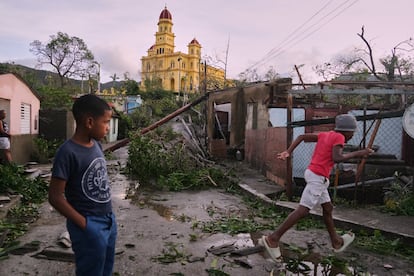
The balance of the hurricane is not what it leaves at the moment, but the poverty it accrues. He who lost the little he had will be much more humble than yesterday. For the hungry family, the bag with donations will only relieve them of the day’s dinner. The light is not going to come, because in truth it had been gone a while ago. The neighborhoods will barely have water, as almost always. Because the country did not collapse again, the storm had been there long before.
For more updates, visit our homepage: NewsTimesWire