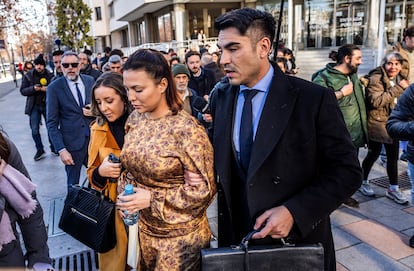
Judge Adolfo Carretero has agreed to prosecute former deputy Íñigo Errejón for an alleged crime of sexual abuse against actress Elisa Mouliaá. This is stated in an order, which was issued this Friday by the head of the Court of Instruction Number 47 of Madrid. After an account of the events, the judge states that “there being no eyewitnesses to the events and having some reference testimonies and expert evidence, the main evidentiary evidence is the statement of the injured party.” Errejón’s defense has announced to this newspaper that it is going to appeal Carretero’s decision.
Carretero, who was in the spotlight of a good part of the feminist movement for the incisive interrogation of Mouliaá on the day of his statement, decided this Friday to send Errejón to the stand, alleging that “it is not necessary that there be full evidence, but that minimal evidence is enough that does not allow a possible conviction to be completely ruled out, that is, that acquittal is inevitable.” In the order, the judge has insisted that it is not up to his court to determine whether the version of the actress or that of Errejón is credible or not, but rather to a sentencing court: “The evidence exists and has not been totally distorted by the version of the investigated person, his expert and documentary evidence, so the procedure cannot be archived in this instance, under penalty of the investigating judge taking over the role of the judge.”
For his part, Mouliaá’s defense, Alfredo Arrien, told this newspaper shortly after reading the order: “We have received it with joy. Elisa believes more and more in justice, although let us not forget that her path has been long and tedious and the worst thing is that almost no one outside has believed in her.” And he highlights that the instructor has considered his statement as fundamental evidence: “His story has managed to convince a judge that he is not especially the champion of feminism, far from it. And, knowing the type of profile of a judge that he is, if that profile, old-fashioned, has believed it is because the circumstantial evidence and the statement were sufficient.” “Now society needs to create it, that is the challenge for it,” he adds.
Arrien refers to a key moment, the harsh interrogation of Mouliaá by Judge Carretero, whose video was leaked and half the country was able to attend the instructor’s questions and comments on a delayed basis that outraged a good part of society, especially the feminist movement, and even the General Council of the Judiciary was forced to initiate an investigation against the instructor’s actions, which was archived a month ago. “She was very drunk, are you sure?”, “She told him: ‘Leave me alone’?”, “it is not understandable that you did not make a gesture” or “you are a woman used to dealing with the public, how could you not tell them that those conditions were not acceptable?” were some of the questions and comments that the actress faced.
It all happened one night in September 2021. They had both attended a party together and, according to Mouliaá’s testimony, the 40-year-old politician sexually assaulted her by kissing her without her consent when they were going up in the elevator and, later, he put her in a room of the house, closed the door latch and touched her numerous times without her consent, even removing “his virile member.” Afterwards, they drove to Errejón’s home and there he tried to have sexual relations again, at which point she criticized his behavior and reproached him for making her feel uncomfortable and violated.
The possible three crimes against sexual freedom on an ongoing basis, as the judge mentioned in his order, occurred after she attended the presentation of a book by Errejón (the politician presented Yet. From the fast years to the future at the Círculo de Bellas Artes in Madrid on September 22 of that year); a meeting in which, the victim emphasizes, “always maintained a correct attitude.” Until then, both did not know each other personally, although they had been exchanging messages for a year through the social network Instagram and the instant messaging application Telegram. At the end of the public event, she invited him to go together to a party that two friends of the actress were holding in an apartment in Madrid.
The instructor recalls in his order that the main evidentiary evidence is the statement of “the injured party” and three aspects are fundamental that support the credibility of her testimony: “Before the events, she did not have any spurious motive, enmity, hatred or revenge”; “his statement is essentially coherent,” although he recognizes some gaps, such as whether or not the door to the room had a latch, but considers them “secondary details”; and “the delay in the complaint according to the Supreme Court is something to take into account, but it does not mean that it is false,” he says about the three years it took him to report. Furthermore, Carretero points out that Mouliaá declared that she delayed doing so because of “fear of the personality of the accused and only when she saw that other women were commenting on similar events in the media.”
Carretero also considers that the fact that the actress had reported the events in the media, “even in exchange for remuneration,” does not diminish her credibility. Well, as stated in the order: “Well, they do not differ from what was said before this court, having the right to tell their privacy as they wish in a democratic State.” The judge considers that it does not affect the credibility of her testimony that she had had any “inconsequential” conversation with Errejón after the reported events and explains: “It is common for battered or abused women to maintain contact with their aggressors, either out of emotional dependence or so that they may apologize.”
For its part, Errejón’s defense, which has warned that it will appeal the order, regrets that the judge “justifies, in an incomprehensible way, Ms. Mouliaá’s contradictions in police and judicial offices, which distort the requirements of the absence of incredibility, verisimilitude and persistence in the incrimination.” Also, that, according to them, “it ignores what was stated by the impartial witnesses who have testified during the investigation phase, and who were present at the party, and relies solely on the witnesses on the side (relatives of Elisa Mouliaá), proposed by the complainant, who were not present at the party,” adds Errejón’s defense.
The former Más Madrid deputy and co-founder of Podemos left politics in October 2024 when allegations of improper behavior committed against several women became known. In a statement, he announced that he was leaving his seat, announcing that he was immersed in “a personal process and psychological support” and admitting that he had “reached the limit of the contradiction between the character and the person.” “The pace and way of life on the political front line, for a decade, has worn out my physical health, my mental health and my affective and emotional structure,” he alleged. A few days later, Mouliáa filed a complaint against him for an episode of sexist violence that he had allegedly suffered at the hands of the former politician three years earlier.
For more updates, visit our homepage: NewsTimesWire