The country offers in the open America section for its daily and global informative contribution to sustainable development. If you want to support our journalism, subscribe here.
The Sun appeared on the Torres del Paine National Park, in Chilean Patagonia, when a couple of tourists, accompanied by a park ranger, spotted something that did not fit with the landscape. It wasn’t a puma. Nor a guanaco or a condor, usual species of the area. On the path carts, in La Pampa del Serrano – a low vegetation plain, less than a kilometer from the park’s administration – a southern fine marine wolf rested (Arctopoca Australis). The species, common in the coast of southern Chile, measures between 1.5 and 1.8 meters long, has an elongated and snorted snout, and weighs between 90 and 120 kilos. He lay there, far from home: almost 50 kilometers from the nearest sea.
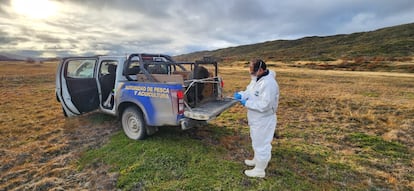
It was mid -morning on Wednesday, May 7. The sighting – the first registered of this species in the most emblematic National Park in Chile – activated a chain of reactions. From the park they gave notice to the National Fisheries and Aquaculture Service (SERNAPESCA), an agency with legal competence on the country’s marine fauna. As the Southern Fine Wolf is a protected species in Chile, it cannot be captured or manipulated by people outside this entity.
Two hours later, a Sernapesca team confirmed that it was a youth specimen, clear fur on the back, active, without visible wounds or signs of alteration. Lawyer Ximena Gallardo, regional director of that agency, says she was an energetic animal, that “she moved away from people.” Transferred in a metal cage to a beach in the Río Hollemberg sector, 25 kilometers from Puerto Natales, the sea lion went into the sea and began swimming without difficulty, until it looked away.
How did it get there?
Although unusual, sighting has a possible explanation. According to Mauricio Ruiz, Regional Director of Conaf in Magallanes and Chilean Antarctica, the animal could have entered through the Channel Lordet, in Puerto Natales, an area of fjords connected to the ocean. That channel receives the waters of the Serrano River, which in turn connects to the Gray River, which enters the park. It is believed that this river route allowed the animal to advance several kilometers inwards. According to Ruiz, he could have traced the course following favorable currents and salmonids or other fish.
Thus, on the Carretas path, the wolf was not so far from the water. A few meters away, an active channel crossed the vegetation. According to Gallardo, in territories such as Tierra del Fuego, with similar geographies, similar cases have already been documented: marine wolves that trace rivers in search of food, rest briefly on land and then return to the sea.
It is not an unusual behavior. The marine wolves, explains Marino Biologist Jorge Acevedo, specialist in Marine Mammals of the CEQUA, Center for Studies of the Fire-Patagonia and Antarctic Quaternary, dedicated to scientific research, feed and rest in the sea, but also on land, where they rule or dry between paths.
For Acevedo, although it is a rare event, it is an expected behavior: “The common marine wolf also does. It can overcome rivers and reach the most inside lakes. And the same with the elephant seal,” he explains. “In addition, the fine youth wolf is more patiperro, more brave, more tramp.”
While, according to Acevedo, it was not a lost animal and most likely, after rising, it could have returned to the sea, the authorities decided to intervene to guarantee their safety. The decision, says Gallardo, was preventive, given the risk of terrestrial disorientation or predation.
But for Conaf, what happened cannot be as a simple anecdote. For the regional director, it is an alert signal: something is being modified in the park’s ecosystems, and it is convenient to look more closely. “Indeed, there are changes in the behavior of fauna,” says Ruiz. And although it emphasizes that many of these displacements follow natural patterns – “the fauna moves based on food: where there are more guanacos, the pumas arrive; where there are more hares, the foxes appear” -, it does not rule out that climate change is altering routes and habits. “It’s not new: it arrived to change many fauna behaviors.”
In a context of accelerated environmental transformation, meetings like this, so unusual today, could become more common. For Ruiz, it’s time to prepare. Therefore, he says, when they update the management plan of the Torres del Paine National Park, they will pay special attention to the new dynamics in the behavior of flora and fauna.
For more updates, visit our homepage: NewsTimesWire