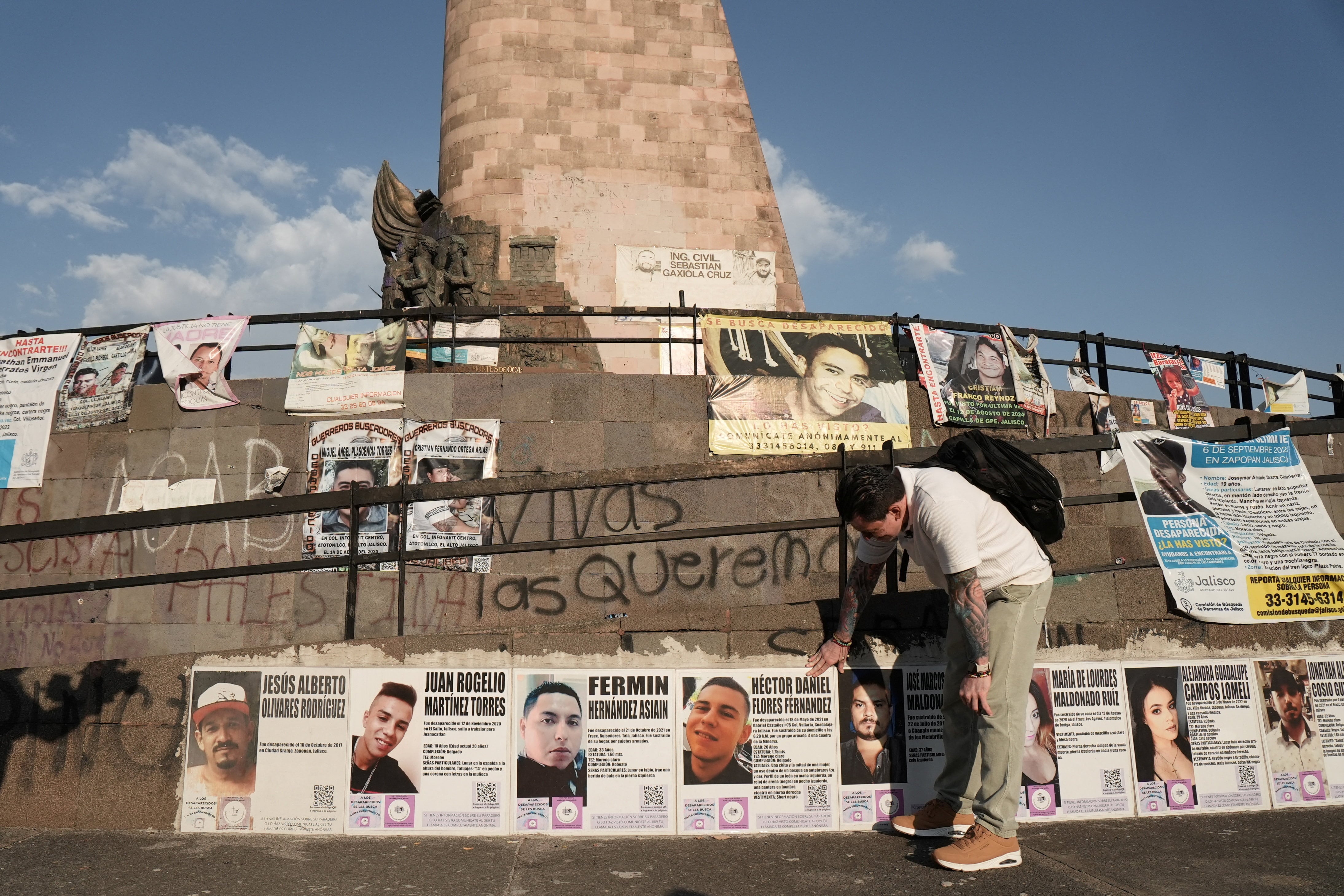
The presentation this Friday of the disaggregated version of the registry of missing persons in Mexico has generated, as was foreseeable, even for the Government, a great controversy, anchored in the distrust of some of the citizens in the data presented. The Executive has said that, of the nearly 130,000 people who have disappeared in the last 20 years that appear in the database, two thirds, just over 80,000, must be taken with tweezers, due to errors and deficiencies in the records or due to contradictions between the disappearance reports and the bureaucratic activity of the presumed disappeared. Part of these shortcomings arise from the poor actions of the prosecutor’s offices these years.
The head of the Executive Secretariat of the National Public Security System (SESNSP), Marcela Figueroa, in charge of the new classification, has indicated that as of today the country has 41,328 missing people, whose cases are registered with the necessary data for their search and who, in addition, have not had any activity after their disappearance was reported. Civil society organizations have requested this Friday that work be done to correct the more than 40,000 cases in which the records present errors or deficiencies, under the idea that a deficient report is not enough to remove cases from the database.
Despite the Government’s didactic intention, doubts stem from the complexity of the message emanating from the National Palace. How many missing persons should the country count then, 43,128? What about the rest? How many of the others should be taken off the list and how many shouldn’t? How is it possible that there are more than 40,000 people reported missing who have gotten married, or had children, or changed their address, or filed taxes, after they were reported missing? These and other questions outline the uncertainty in these hours. But a bigger one is planned for all of them, which targets the prosecutor’s offices.
Figueroa explained this Friday that, of the 43,128 incontestable cases of missing persons, the prosecutor’s offices only initiated an investigation in 3,869 cases. That means that, in almost 40,000, investigating agencies, especially state ones, avoided doing so, for whatever reason. This figure reflects a criticism shared by a good part of the groups of relatives of missing persons in Mexico in these years of violence: the negligence, apathy or apathy of the prosecutor’s offices when it comes to taking complaints. And even more so, to investigate the cases that come to them.
A crisis known worldwide, Mexico has lived the last 20 years subjected to very high levels of violence. The evolution of criminal groups linked to drug trafficking, the creation of specialized armed forces by these groups, the arm fights, their subsequent independence and incursion into new business models, and the State’s hesitations in the face of all this, define the horror. In this context, thousands of people have disappeared at the hands of organized crime, the result of their revenge, or recruited, enslaved at their service. There are also many others that have disappeared at the hands of the State, the Army, the Navy, state and municipal police…
For a long time, Mexico lacked a reliable database of victims of this crime. Furthermore, until eight years ago, the country had not even classified the crime of disappearance committed by private individuals, apparently the most common of these two decades, without forgetting the cases of forced disappearance, committed by State agents. With the arrival of Andrés Manuel López Obrador to the presidency, already in 2019, the newly created National Search Commission began an effort to have a first reliable database. Thus, the National Registry of Missing and Unlocated Persons was born.
But the problems did not take long to arrive. In view of the growth in the numbers in the new registry, López Obrador announced an analysis of the cases, with the intuition that there were repeated entries, cases that, despite being solved, were still in the database, etc. In December 2023, his Government presented a purge, similar to the one now, which provoked criticism from groups and organizations because it brought down more than 21,000 cases suddenly. Of the 113,000 cases that were counted then, the Government left it at 92,000. Journalistic investigations then revealed that the new account considered people who were still missing to have been located, among other errors.
Given the controversy and criticism, the López Obrador Government led, without clarity about the registry, to a rarefied atmosphere with the groups. The problem was not so much the pruning of the database, that too, but rather the government focus. The Executive had focused on statistics, harmful to its image, instead of solving the true underlying problem: the nullity in many cases of the prosecutor’s offices in the investigations and the loneliness of the families of missing persons, forcibly converted into the true investigators of their cases.
Thus, of the figures presented this Friday, what is striking is that they reflect the narrow legal path marked by the reported cases, a detail compared to the tens of thousands that remain unrecorded in official investigations. The Miguel Agustín Pro Human Rights Center, which has monitored dozens of cases of missing persons in the last decade and a half, has pointed out: “Recognizing that there are only 3,869 open investigation folders shows the obstacles that families face in reporting, especially in risk contexts, where criminal networks prevail that reach the prosecutor’s offices.”
The Pro Center’s demand illuminates the shadows of the report presented this Friday at the National Palace and makes evident the need to establish tighter controls on the actions of the investigative agencies, the state ones, but also the federal one, in the hands of Ernestina Godoy, a person close to the president, Claudia Sheinbaum. The question now starts from geography: which prosecutor’s offices handle the lowest ratio of open investigations, compared to the number of registered cases of missing persons? When these numbers are made public—if they are made—the question will necessarily revolve around why and doubt will point to the capabilities of the federal government to prevent prosecutors’ offices from remaining stuck in the past.
For more updates, visit our homepage: NewsTimesWire