The accepted silence within many German families after World War II has marked the society of a country that had to learn to live with its history. How to explain to the children the terrible crimes that were committed during Nazism? The MITLäuferas the Germans are called who were carried away by the Nazi current without resisting, they were the vast majority of the German people.
After the war, nobody wanted to consider the question of what would have happened if they had not been carried away. The parents did not talk to the children, but, in any case, with the grandchildren. However, even now, 80 years after the end of World War II, it is difficult to talk about it, although no one doubts that without those millions of MITLäuferneither Hitler, nor their acolytes would have been in a position to commit a genocide – around six million Jews died during the Holocaust – of that magnitude.
The theme resurfaces when emptying the floor of grandparents or parents, some families discover hidden documents at the bottom of a closet. In the case of Hans Gräser, he did know about his father’s Nazi past in the SS, but not much more. That is why he could not avoid being surprised to find a series of documents that he did not know when at the end of last year his mother, 101, moved to a residence and had to dislodge his house in Heidelberg.
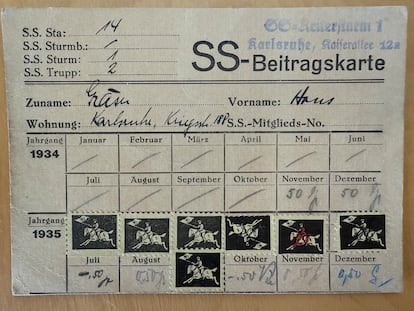
“I had never seen these documents. Neither the card of belonging to the SS, nor the denazification report …”, explains at home while leaving the papers scattered on a table among which is, for example, the AhnenPasswhich documented the Aryan lineage, or the Cross to the Merit of War signed by the Führer. “I learned then that I had been a member of the Nazi party,” he says about what he found in one of his father’s desktop drawers. “I knew he was in Riga (capital of Latvia). Also that he was judge of the Regional Court. But my father did not tell me what he did in Riga during World War. That is what they always say, that the parents did not talk to the children,” he says.
Gräser, 79, is a historian specialized in medieval times. For him it was difficult to think that his father was in Riga from 1941 to 1944 as part of the Nazi machinery and never spoke with him of that issue. In that area, mass murders such as the Rumbula massacre were committed, where about 25,000 Jews were killed. Therefore, when he discovered now that his father got out of reiter-SS (horse units) in 1939 when he entered the Wehrmachtas the armed forces of Nazi Germany were called, he does not understand why he hid it.
“The SS were always considered an elite. And in that sense it may be that I said that I did not want to know anything about the Nazi party, which seemed too vulgar,” elucidates about his father’s reasons, who died in 2009 with almost 99 years and never talked about it.
“It seems that he only dedicated himself to civil things. But of course, everyone there, even if he didn’t shoot, had to know what was happening.” For Gräser it is “difficult” to face this past. How to ask a father if he saw or was involved in any of those terrible crimes?
With his mother he spoke at some times about that time. “But I was always surprised how naif it is,” he acknowledges. “My mother, who did not find out about the crimes committed during the third Reich until the end, did not be interested in the subject at all and completely repressed it,” he adds.
His mother, Margarethe Gräser, now lives in an elderly residence in the city of Weinheim, where his daughter resides. She was 22 when the war ended and was pregnant with her first child, Hans, whom she called her husband, because in September 1945 she did not know if she was still alive or not. The child is the product of the last permission that soldiers received at Christmas 1944, a moment they took to marry. “Almost all my schoolmates were born in September as me,” Hans recalls as a postwar curiosity.
“On the first Christmas after the war it was the first time they allowed him to write a letter from the jail,” explains Margarethe Gräser, sitting in her residence room. “It was there when we knew I was alive and that I was in American captivity,” he adds. From that moment on, her husband, who was in a special field of high Nazis positions, had allowed to write a letter a month until his release in July 1946. The letters arrived with remains of powders used by Americans to verify that there were no hidden messages.
At that time, she had moved to live with her family to her grandmother’s old house in the center of Heidelberg, after the Americans occupied her home in Tauberbischofsheim. “They were not interested in our apartment in Heidelberg because it was very old and there was no central heating,” recalls Margareche Gräser.
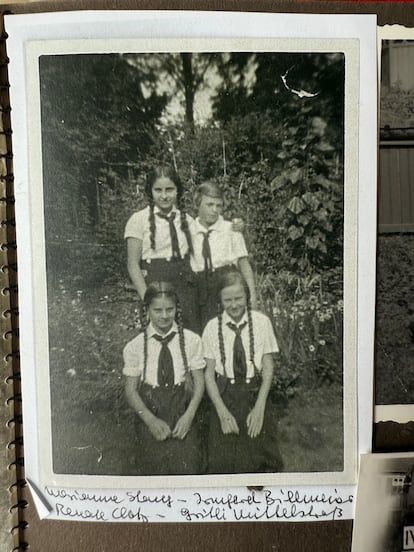
It is difficult to go back in time. She was a girl when Hitler amounted to power in 1933. He remembers her time in the female branch of the Hitler youth, whose belonging was mandatory since 1936. “I liked to be part of a group of so many girls because I only had brothers. I liked to sing with them, play sports and things like that. The truth is that I lived that time in a positive way.”
Then he was in the obligatory work service of the Reich (RAD), where the young women helped mainly in the care of livestock and the field. Remember little of those years, but he was lucky to be in quiet areas. Nor does he know how he learned of the end of the contest and ensures that he did not know “of the atrocities of the war” until he ended. It is hard for you to remember. “It has been a long time,” excuses himself.
“Somehow, we didn’t want to believe it. My husband probably knew more about it,” he acknowledges. “The flowering of Germany during Nazism, so to speak, was seen as something good compared to the previous era, when Germany was going through a very bad time. We did not know anything about the crimes that were committed. Those who lived were, I think, very reserved and cautious when talking about it. And in the newspapers, of course, they always published only good things,” he adds.
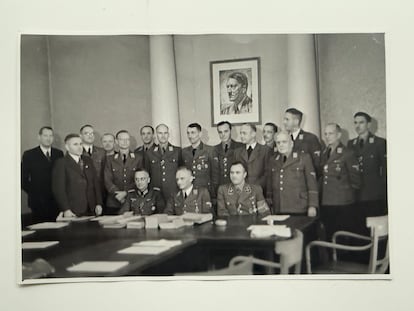
While after the war, many Germans hid their Nazi past, the Gräser family was always aware of theirs. “He told a little of his passage through Berlin or Riga,” says his widow. “They were rather formal things, what he did as a lawyer. He was not very interested in politics. As an official, he had to enter a nationalist organization and entered the SS,” he confesses.
His family read his memories of that time in some memories he wrote when he retired. Throughout 200 pages he recalls, for example, how in 1932 he listened to Hitler for the first time in a rally in Karlsruhe. “Because of its content, it impressed me little, the brothea controversy predominated, but I witnessed the suggestive force with which the spirits of the listeners were heated,” he said.
In 1938 he moved to Berlin. “The SS had special tasks in Berlin. At least half of the service consisted of forming an honor guard in the events in which the Führer participated, in surveillance services, in parades and the like,” he wrote. “Of course, in autumn of 1938 I had to travel with my unit to the party’s congress in Nuremberg to parade against Führer,” said Hans Gräser Father.
In Berlin, the night of broken crystals also lived, as the events are known from November 9 to 10, 1938, when thousands of businesses, synagogues and Jewish homes were attacked by the SAs and almost 100 Jews were killed.
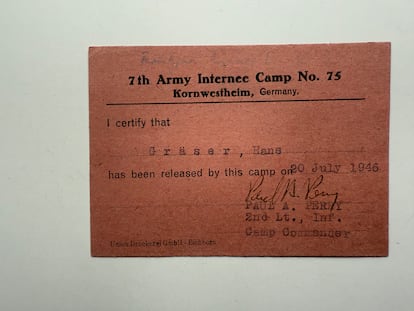
His appointment as judge of the Regional Court of Berlin came the following year, almost at the same time he was called to ranks, so he never really exerted the position in the German capital. Upon being part of the Wehrmacht He left the SS, where he had come to hold the position of Rottenführer (Section leader).
He lived the surrender of Warsaw, was in the battle of France and after an injury, ended in 1941 assigned to the legal department in the office of the office of Reichskommissariat Ostland In Riga, where, according to himself, he dealt with all non -criminal matters. In the last months of the contest he was injured by shrapnel in the eastern front. Those wounds ended up saving his life, probably, because he was evacuated to west of Germany.
Together with these memories, in which he omits any mention to the crimes committed by the Nazis, his son now has the writing that his father attached in the denazification report required by the allies to be rehabilitated. In him he recounts the positions he had and where he was until his arrest on May 9, 1945 and asks to be qualified as MITLäufer. He worked as a gardener in a cemetery in Heidelberg until in 1949 he was again a judge.
This appointment made years later his name appeared on the call Brown book in which the German Democratic Republic (RDA) denounced almost 1,800 economic, political, general and admirals of the Bundeswehr and senior officials for their real or assumptions with the Nazi regime. The German federal government dismissed the book as “communist propaganda work.” However, Hans Gräser when he saw his name offered to pre -retire, but his superiors did not see reason for his resignation and continued in his position.
How much did you omit about its history? It’s hard to know. His family now wants to request the Federal Archive of Germany all the documents to see if what is about it is the same thing you already know or there is something else. They are from the Germans who want to know. Not everyone wants.
For more updates, visit our homepage: NewsTimesWire