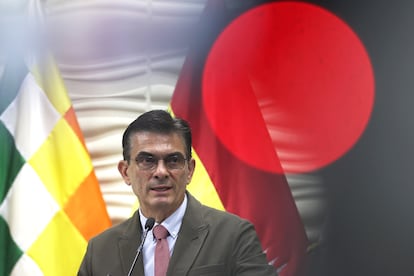
The president of Bolivia, Rodrigo Paz, promulgated on Wednesday night a decree with more than 120 articles that eliminates the subsidy on gasoline and diesel that the Government has assumed for 20 years. Paz has described the document as a “historic economic rescue for the country” and has justified it as an urgent decision to reduce the fiscal deficit and slow the economic deterioration that led to double-digit inflation.
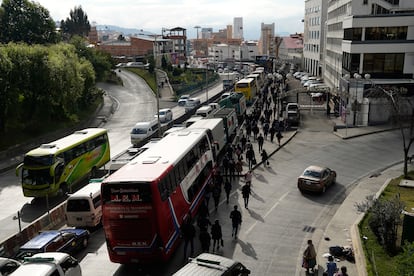
The impact caused by the measure has been immediate: the price of public transport has doubled since this Thursday. In addition, there are already demonstrations and street closures by regional labor unions, as is happening in the city of El Alto, adjacent to the La Paz government headquarters. To try to reduce the social impact, the decree includes a 20% salary increase, an increase in income for older adults and an increase in the bonus Juancito Pintointended for primary school students.
Paz maintained that the elimination of the subsidy does not mean “abandonment, but order, justice and clear and transparent redistribution”, but he justified it as necessary to stop the deterioration of the economy, which has worsened since the International Monetary Fund (IMF) predicted in its last report a recession for Bolivia until 2027.
The monetary collapse in the Andean country is largely due to the shortage of dollars, whose main income to the country came from the export of gas. The sale of hydrocarbons has been reduced by 40% since 2014, but the subsidy has remained, which has represented a high economic cost for the State. Official data show that maintaining subsidies costs the State 3.5 billion dollars a year. “We assume a country wounded in its economy, without international reserves, without dollars, without fuel and with inflation,” said Paz in one of his constant diatribes against the previous mandates of the Movement Towards Socialism (MAS). The accusations were not limited to the speech: several truth commissions were formed that led to various arrests, including that of former president Luis Arce.
Negative reactions
Negative reactions to the realignment emerged almost immediately. In Bolivian cities, there are long lines to try to get fuel at a subsidized price. Several drivers consulted by the press expressed their concern about what is coming: “It was a necessary measure, but it hurts. We expected it to be applied in 2026, at least after the holidays; it will be a hard blow for commerce at this time,” said one of them. Without state financial support, the price of gasoline went from $0.54 per liter to $1. Diesel, for its part, rose from 0.50 to 1.40. Given the new prices, the public transport driver unions declared an emergency and gave the Government a period of 24 hours to withdraw the measure. The Bolivian Workers’ Central (COB), meanwhile, concluded an emergency meeting that will confront what it has called the “hunger decree.”
The decree was criticized even by the majority of the benches of the Legislative Assembly, chaired by Vice President Edmand Lara, in permanent disagreement with Paz since the day after taking office. “We categorically reject these measures and consider that it was not the time to apply them, because the only thing they will cause is more poverty, more unemployment and the increase in the cost of the family basket, affecting the most humble sectors,” said the vice president, accompanied by the heads of the parliamentary blocs. For Lara, the elimination of the subsidy should have been gradual. “The lifting of support had to be carried out as our economy, still very hard hit, was reactivated,” he said.
On the other hand, businessmen do not look favorably on the containment measures enacted by Paz. The president of the Federation of Private Businessmen of La Paz, Rolando Kempf, criticized that the Government has not attended to their requests for meetings that also include worker representatives. “The salary increase is very difficult for businessmen to assume in these conditions (…); many companies will go bankrupt and others will considerably reduce their staff,” he predicted.
The Minister of Economy, Juan Gabriel Espinoza, has gone out to put out the fires. First, he called public transportation drivers to dialogue, indicating that the increase in fares “has no technical justification.” He later admitted the impact of the decree on the family basket, but promised that “it will not be significant.” “There will be no shortage of oil, there will be no shortage of chicken, there will be no shortage of eggs. The supply is assured. There is a collective psychosis fueled by chains of misinformation,” criticized the official.
For more updates, visit our homepage: NewsTimesWire