The smallest ally of the ruling coalition has prevailed. With only six senators, the Labor Party has stopped the intention to bring forward the revocation of President Claudia Sheinbaum’s mandate to coincide with the 2027 elections. Thus, Morena has been forced to mutilate plan B of the president’s electoral reform to advance it in the Senate of the Republic without its core content. The minutes will be sent to the Chamber of Deputies to conclude its legislative process with only three issues: the reduction of council members, the limit on spending in state Congresses and the obligation of senior electoral officials to earn a lower salary than that of the President of the Republic.
This new setback, which adds to the shipwreck of the president’s first initiative in the Chamber of Deputies, outlines a minor reform, which does not specify Sheinbaum’s original objectives: reduce spending in the electoral system, reduce party financing and reconfigure proportional representation in the Legislative Branch. Plan B, generally approved around 11:00 p.m. this Wednesday, is a minuscule change compared to the purposes with which, eight months ago, the presidential electoral reform commission was created, of whose forums, surveys and technical works only a few lines and modifications to three constitutional articles (115, 116 and 134) remained.
After three months of negotiations and despite having signed a commitment in the Ministry of the Interior, the PT bench stood by what it had warned since last week, when it made it clear that it would not support the reform of article 35 of the constitution if it allowed Sheinbaum to be recalled on the same day as the federal and local elections of June 6, 2027 and to eliminate the lock that currently prevents the president from campaigning in the 60 days prior to the recall consultation. The PT proposed as an alternative to carry out the recall in August, but the government and Morena refused, and thus the fate of the new initiative was decided. As agreed with Morena, the PT has presented a reservation to vote specifically on the part of the opinion in which the issue of revocation was addressed. As article 35 is not modified, Sheinbaum’s revocation could only be called during the three months following the end of his third year; that is, between October and December 2027, so that the consultation takes place in April 2028.
In a session that began at 5:30 p.m. this Wednesday, the coordinator and historical leader of the PT, Alberto Anaya, has gone up to the Senate rostrum to confirm his position. “The PT will generally support this initiative of law and modification of the Constitution. We will be in favor. But we separate ourselves from the content of the opinion with regard to article 35 of the Constitution,” he said, provoking applause from the PAN, PRI and MC benches, an opposition that had been warning for days of the damage that the reform would cause to fairness in the elections and that, in the heat of the debate, has summarized its rejection in a phrase by Alejandra Barrales: “We want a female president. acting, not a campaign manager.”
Alberto Anaya wanted to qualify his rejection of the essence of plan B, with a long speech in which he vindicated the role of the PT as a historical ally of Andrés Manuel López Obrador in his three presidential campaigns, and of President Claudia Sheinbaum in all the reforms that she had presented to the Legislature since October 2024, before the election. “The coalition that allowed the president to come to power today is stronger than ever, in 2027 and 2030,” he stated, provoking applause from the Morenistas, but hours later, his six senators have closed the president’s alternative plan.
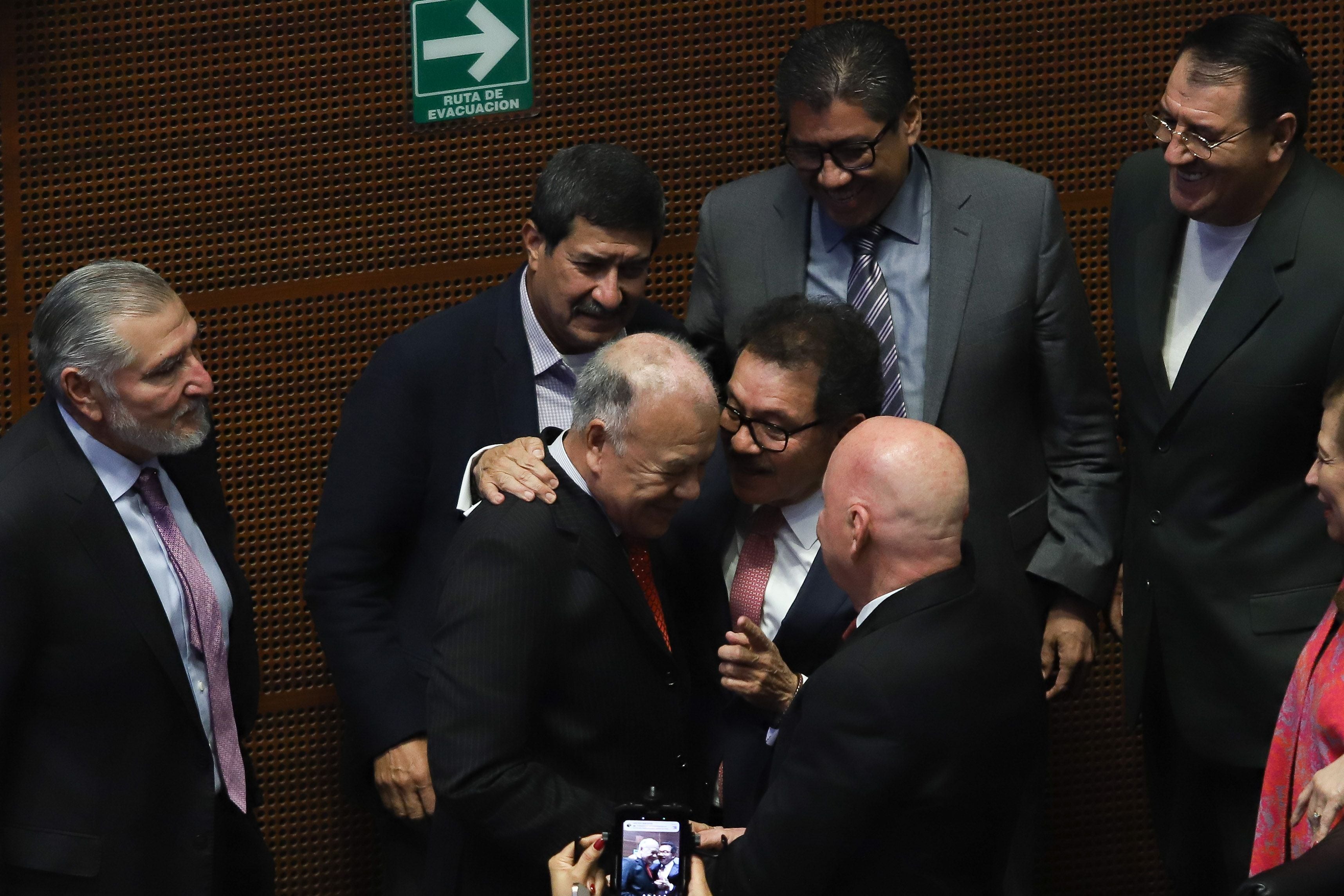
The message from the coordinator and national leader of the PT has been followed by an image loaded with political readings in view of the 2027 election, in which the goal is to keep the Let’s Keep Making History coalition alive. In the middle of the seats appeared the coordinators of Morena’s allied parties: Manuel Velasco, for the PVEM, and Anaya himself, both with their hands clasped and raised, a gesture that sought to combine triumph and cohesion. Minutes later, Ignacio Mier, leader of Morena in the Senate, and PT member Geovanna Bañuelos joined the scene. The snapshot, more than a spontaneous celebration, has seemed like a message of unity from the 4T, so sullied in recent weeks. Everyone raising their arms as if nothing had been broken, as if the discrepancy over one of the most sensitive points of Sheinbaum’s plan B did not show cracks in the ruling coalition. Instantly, Mier spread the scene on his social networks, with a message: “Those who dreamed of the division of our movement were once again left wanting.”
Before the vote in general, the debate lasted for more than three hours, with a position from each parliamentary group and two rounds of speakers for and against the ruling. The discussion was used by the opposition to expose the errors of the ruling party in the political reform process, evidenced in the rejection of its own allies, and to attack Sheinbaum, the involuntary protagonist of the session in the upper house. “The intention is to make inequality constitutional in favor of the ruling party; putting the president in the election is absurd,” said Clemente Castañeda, coordinator of the Citizen Movement. “What they want is to involve the president in campaigning with public resources,” denounced PRI member Carolina Viggiano. “This is not seeking a revocation, what they are seeking is a re-election of the president. Moena is falling in the polls and they need the image of the president as a political lifeline,” said PAN member Mayuli Martínez.
In contrast, Morena has defended the virtues of plan B, and has sent Gerardo Fernández Noroña, Lucía Trasviña, Malú Micher, Saúl Monreal and Óscar Cantón Cetina to the stand, to contain the fire against Sheinbaum and deny that the failure of the reform implies the end of the alliance with the PT and the Green. “It would be a failure to have rejected it in its entirety, like plan A. The opposition failed, as they thought they were not going to implement the president’s initiative; it is a failure for them,” Mier declared before the vote.
Around 11:00 p.m., the full Senate generally approved the ruling, with a qualified majority of 86 votes in favor and 42 against. After approval, a dozen reservations registered by all parliamentary groups are expected to be processed; among them, the PT’s reservation that eliminates the changes that were proposed to article 35 of the Constitution regarding revocation of mandate.
For more updates, visit our homepage: NewsTimesWire