The King has taken advantage of his Christmas message, the most important of the year, which millions of Spaniards receive when they prepare to celebrate Christmas Eve in their homes, to warn of the “disturbing crisis of confidence” in the institutions that democratic societies are going through, including the Spanish one. And remember the “disastrous consequences” that the advance of “extremism, radicalism and populism” had in the past, which feed on disenchantment, misinformation, inequalities and uncertainty. “The tension in the political debate causes boredom, disenchantment and disaffection,” he warned.
In the face of these threats, Felipe VI has called for dialogue, respect in language and listening to the opinions of others, “exemplary performance by all public powers” – in a veiled reference to corruption – and empathy with the most vulnerable. Coexistence, he stressed, “is not an imperishable legacy”, but “a fragile construction”, which must be preserved. “Fear only builds barriers and generates noise (that) prevents us from understanding reality in all its scope,” he said.
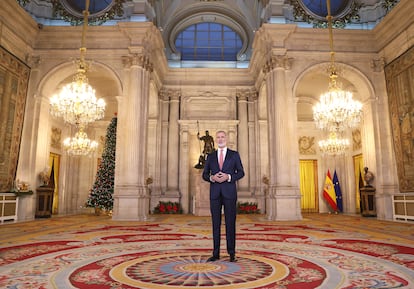
For the first time, Felipe VI delivered his speech standing up, to accentuate the image of dynamism. It has also been the shortest of the 12 Christmas messages that he has addressed to the Spanish people since his proclamation in June 2014. Unlike on other occasions, in which he has reviewed the main problems that afflict society, this time he has preferred to focus on an almost single message—the need to “preserve trust in our democratic coexistence”—to gain communicative effectiveness. The setting chosen, for the third time, was the Royal Palace, more solemn than La Zarzuela, where the Royal Family resides. And inside this, the Hall of Columns, where 40 years ago, on June 12, 1985, the accession of Spain to the European Communities, the current EU, was signed.
His first words were precisely to remember that anniversary, an “exciting and mobilizing” step that allowed Spanish society to close a long period of distancing itself from Europe and join a common project that “not only brought modernization and economic and social progress,” but also strengthened democratic freedoms. He also highlighted the 50th anniversary of the beginning of “our democratic Transition”, as he referred to what happened in November 1975, when the restoration of the Monarchy followed the death of the dictator. Without mentioning his father, Juan Carlos I ―who has just published Reconciliationa memoir in which he vindicates his role in the Transition, has stressed that this was, “above all, a collective exercise of responsibility.” The courage of those who led that process, overcoming doubts and differences, allowed “the Spanish people as a whole to be the true protagonist of their future and to fully assume their sovereign power,” he said.
The achievements achieved then – among others, a Constitution “large enough for us all to fit in” – have served as a preamble to refer to current times, “certainly demanding.” The King has painted a gloomy picture, in which inflation limits the possibilities of progress for many citizens, the cost of housing is an obstacle for young people to carry out projects, the technological revolution generates job uncertainty and climate phenomena sometimes have tragic consequences, such as in the Danaa of Valencia.
These problems, he assured, “are not resolved with rhetoric or voluntarism,” but require “will, perseverance and vision of the country.” Spain has shown that it has the capacity to respond to challenges such as economic crises, health emergencies and pandemics, he continued, but to do so it is necessary to share objectives “and the root of every shared project is coexistence.”
At this point, he has addressed the core of his speech: the need to preserve coexistence, because this “is not an imperishable legacy”, but rather a “fragile construction”, which requires the care of everyone. Its greatest threat, according to Felipe VI, is in “a disturbing crisis of confidence” that “seriously affects the spirit of citizens and the credibility of institutions. Extremism, radicalism and populism feed on this lack of confidence, misinformation, inequalities, disenchantment with the present and doubts about how to face the future,” he stressed. After recalling that these phenomena had “disastrous consequences in the past”, in reference to fascism and Stalinism, he called for “preserving trust in democratic coexistence”.
After ensuring that it is not about singling out anyone or “seeking other people’s responsibilities”, he asked what red lines should never be crossed and then listed some essential rules of conduct that have been almost eradicated from the political debate in Spain and that some parties even presume to despise, such as “respect in language” or “listening to other people’s opinions.” He has also mentioned the “special exemplarity in the performance of all public powers”, “empathy” and “the need to place the dignity of the human being, especially the most vulnerable, at the center of all discourse and all policies.” Although the King never refers to specific examples, his words occur in the context of the chain of corruption cases that undermine the Government and also in the midst of controversy over the dehumanization of immigrants who feed Vox and the PP with measures such as the eviction of an institute in Badalona that has left more than 400 people exposed to the elements.
In the face of growing political polarization, the head of state recalled that, “in democracy, one’s own ideas cannot be dogmas; nor can those of others be threats.” And that “moving forward consists of taking steps, not running at the expense of another’s fall.”
To conclude, he wanted to send a signal of optimism, emphasizing that each historical moment “has its own challenges” and that the current ones are no more difficult than those successfully overcome by those who lived through the transition, 50 years ago. “We will be able to achieve our objectives, with successes and mistakes, if we undertake them together; with everyone participating, proud, in that great project of common life that is Spain,” he concluded. Like every year, he said goodbye, in his name and in that of the Queen, Princess Leonor and Infanta Sofía, wishing a Merry Christmas in Spanish, Basque, Catalan and Galician.
For more updates, visit our homepage: NewsTimesWire