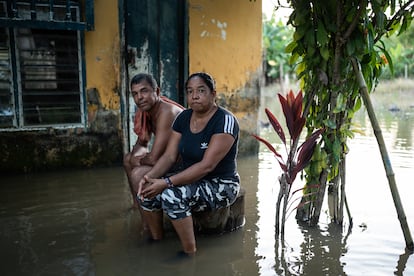
Farmer María Isabel Méndez woke up the last five days in a flooded house. When he woke up, he saw the water covering the legs of his bed, the blackened walls of the room where he was born 47 years ago, and the wheelchair that his uncle used until he died a few weeks ago. Every morning he decided to stay: he had nowhere else to go and he thought that the Sinú River, overflowing since Saturday due to torrential rains, would recede. But on Wednesday he decided that enough was enough. The water did not stop rising and María Isabel feared that the bacteria that accumulated around her would harm her or, worse still, that the house would collapse with her inside. He moved to a shelter made of plastic, wood and palm at the entrance to his farm.
“It never crossed my mind that this could happen,” he says. The rains were not limited to ruining some crops, as on other occasions. This time the river overflowed, reached the house and destroyed all the production of beans, eggplants and chili peppers, which the peasant woman sold for the nearby markets. It took him by surprise that it was in February, in the middle of the dry season. A cold front is hitting the Colombian Caribbean, and in the department of Córdoba it has produced an unprecedented catastrophe after the Urrá hydroelectric dam overflowed. The Government estimates that there are more than 156,000 victims and almost 100,000 hectares flooded.
María Isabel lives in El Platanal, in the rural area of the municipality of Lorica. Unlike other places in the department, where the water began to go down, in this area the crisis is greater every day. The damage is not only to appliances or furniture, as in some city neighborhoods. The 130 families in the village are worried because their livelihood is threatened: they lived off the destroyed crops. For now, the only solution for María Isabel has been for her partner to make more motorcycle trips for a neighbor or pick more corozo, a local fruit, in five-hour days for which they pay him 25,000 pesos (about $7).
He delayed the decision to leave home as long as he could. “We are so stubborn that we don’t go out until we see that the water is up to our knees,” he says. “I can’t assimilate that I have to pick up everything, say goodbye to my things and go to sleep outdoors,” he adds. The floods have deepened the anguish he feels since his uncle, who was his adoptive father, died. “I gave him food, I bathed him, I changed his diapers. He dies, and now this other calamity happens,” he says. He remembers that his uncle had a senior citizen’s allowance that assisted them in the rainy winters, but now he won’t even have that.
The debts
Claudia Ramos lives on the farm next door, also flooded. “I was born here, I left when I was a girl and lived in Valledupar with my mother until I was 22,” says the woman, who is now 42. She obtained titles in stylist and agricultural technician. He returned to La Doctrina, the township to which El Platanal belongs, when his father started growing papayas, about 15 years ago. Then he died and she stayed with her stepmother. They both live in a fuchsia building that is now full of water, and have taken refuge in a friend’s house in the urban area.
Claudia’s great concern is the peasant association that she has led since she returned to El Platanal. “I formed it because they don’t listen to just one person. We are 26 women and four men, and we have sweet potatoes, melons and fish to work as a community,” she says. Claudia is distressed to think that the sweet potato project involved each of the women taking out a loan of four million pesos (about $1,100) that they had just begun to pay. “There are no sweet potatoes to pay the debts,” he emphasizes. The company they sold to has given them an additional loan so they can stay afloat until they can harvest again, but that means even more problems ahead.
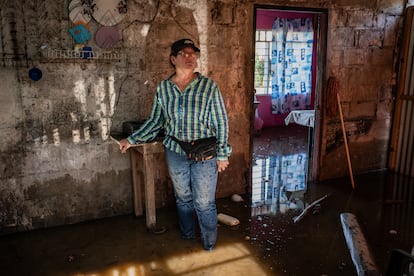
She feels no anguish for herself or her stepmother. “I know how to get around the city. I have an engineering contract with the Government and I can go as a stylist to Bogotá,” she says. He is also not worried about the material losses of his house. “My brother died electrocuted a year ago, and we gave away his little things. All of that is recovered,” he emphasizes. But she is overcome by the guilt she feels towards her colleagues. “I brought them into the association for their well-being and they trusted me. And now they are worse than before: they entered without credit and were left in debt,” she says. “The idea was to share 5% of the profits for Easter. Suddenly those moms were counting on that profit.” It’s the only time he cries.
the chickens
The anguish of debt is also experienced in the wooden and zinc house that Gelbel Cárdenas and Aura Ramos live in. In October, the couple took out a loan of one million pesos ($1,100) and added savings of 400,000 pesos (another $100) to buy 200 chickens. After four months, they would have about 180 eggs a day, which would give them an income of 180,000 pesos ($23). But the humidity, the rain, “the coldness,” killed half of the animals. The 100 survivors have moved from the corral to the couple’s house. They jump to the rhythm of vallenato, which supposedly keeps them animated. “I pray that they survive to pay the debt, which has a monthly payment of 130,000 pesos,” says Aura.
Gelbel says that in recent years they have become accustomed to floods—two pigs drowned last winter—but that they did not happen when he was born, 56 years ago. “My grandparents lived here and the river filled up, but never like this,” he says. “Now there is one growing after another, every year,” he adds. Aura points to the Urrá hydroelectric plant, which she believes has caused all the problems since it was inaugurated 26 years ago. And now the most unexpected thing has happened: it rained in February, when they had grown corn and not the rice they plant in winter because it resists rain.
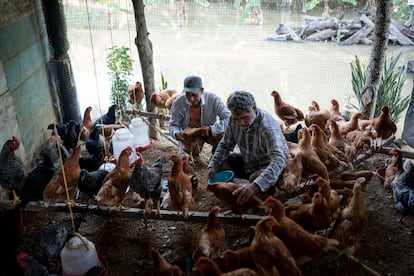
The couple has filled their house with bags of earth that withstand the passage of water, at least for now. The dirt floors are dry and the chickens are safe. But it is not enough. “They say that more and more water is coming,” says Aura. “And now the rainy season is coming,” adds Gelbel. So they have started to build a plastic and wood shelter like María Isabel’s. They don’t think they’ll ever live there—the water won’t reach that far, they think—but it will be for the chickens in case they start dying again.
Gelber and Aura have different positions on the possibility of moving. She says that “she is bored” of the floods in winter, that she is frustrated that there is now one in February and that this is the worst of all the floods that the river has had. “I want the Government to help us fix the house or get out of here,” he says. Gelbel looks at her in silence and, after a few seconds, adds: “Or that they leave us here, but with a good, higher entrance.” He is joined by his brother, who emphasizes that they have always lived there. Aura laughs and agrees with them. “What we have to do is bring 70 dump trucks of dirt,” he says. Men insist on their affection for the land. She agrees with them again: “Well, we’re staying here. No problem.”
María Isabel comments the same thing, back in her flooded house. “I have never thought about moving. You have everything here, your roots, you are used to your land. You are not going to start over somewhere else,” he says. Afterwards, he comments that he would consider the idea as long as it is on a farm just like his: in the countryside, with the same crops of beans and eggplant. “I only agree to move if they give me those guarantees. I don’t want them to keep me like a fine rooster, tied up.”
For more updates, visit our homepage: NewsTimesWire