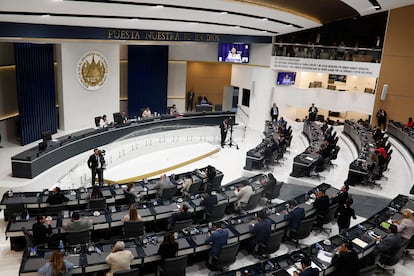
The afternoon of this July 31, while El Salvador commemorated the journalist’s day in a climate of systematic harassment and exile for the critical reporters of Nayib Bukele, his loyal legislative assembly approved a reform of the Constitution to grant the popular president his greatest political ambition: indefinite re -election, in a turn – expected, but transcendental – that consolidates an increasingly autocratic power model.
The reform was approved with the 57 votes in favor of all the deputies of the official new ideas and the three votes against the only opponents and also contemplates the reforms of articles 75, 80, 133, 152 and 154 of the Salvadoran Magna Cart 50% plus one, as currently contemplated in the Salvadoran Constitution, in force since 1983.
#Plenaria66 | With 57 votes in favor, we approve of articles 75, 80, 133, 152 and 154 of the Constitution of the Republic, in relation to the positions of popular election, in order to grant total power to the people to decide on their rulers. pic.twitter.com/gspnxpaqik
– Legislative Assembly 🇸🇻 (@asambleasv) August 1, 2025
“Historically, re -election has been allowed in El Salvador for almost all positions of popular election, without prohibitions, without particular conditions, and the only exception so far has been the presidency,” argued the official deputy Ana Figueroa in the arguments prior to the vote. “Salvadorans are going to have the power to decide how long they want to support the work of any public official and including its president,” he added.
In addition, the reforms establish that the presidential mandate will be six years instead of five, with entry into force from the next presidential term. Figueroa defended that express reform sought greater stability in electoral cycles. “In this way we are also allowing the country to achieve greater legal certainty at this time,” he said.
The approved reform provides that the current presidential period – which began on June 1, 2024 – will end in advance on June 1, 2027, with the aim of unifying in that year the presidential, legislative and municipal elections.
In El Salvador, elections are held on average every two years due to a stepped electoral calendar that includes different types of elections at different times. Not all public positions are chosen at the same time, which responds to a logic of democratic alternation and institutional control. However, this design generates an almost constant electoral cycle. Bukele has been critical of that scheme and has proposed to reform it towards a mid -term elections model, which would concentrate the elections every three and six years. Something that its legislators are doing, but leaving the door open for indefinite re -election, a vice shared by Latin American autocrats.
The initiative was included in the agenda of this Thursday of the plenary session, with dispensation of processing and without legislative debate, something that allows a constitutional reform endorsed by the current formation of Parliament, which has 57 of the 60 votes. Bukele began last June his second term that his critics called illegal, since several articles of the Constitution prohibited him, after a change of criteria of the Constitutional Chamber of the Supreme Court, that the first legislature dominated by new ideas in 2021 appointed in an irregular process.
The opposition deputy Marcela Villatoro said that the current official deputies “removed the masks.” “They have made a public confession to kill democracy disguised as legality. This is the chronicle of an announced death that has been manufactured in this legislative assembly for several years,” he criticized.
An old Bukele temptation
During his first term, Bukele several times that he would seek immediate re -election, appealing to the constitutional prohibition. “No, there is no re -election,” he said in 2021. But his position changed after September 3 of that year, when the Constitutional Chamber, composed of magistrates imposed by his party, reversed the historical criteria and enabled his nomination to a second consecutive mandate.
Supporting the resolution of the Chamber, Bukele announced on September 15, 2022 that he would seek re -election in 2024. “I have decided to run as a candidate for the presidency,” said the president.
On October 26, 2023, Bukele officially registered his candidacy before the Supreme Electoral Court, which approved it on November 3 despite the challenges of the opposition and constitutional lawyers. Then, on November 30, the Legislative Assembly granted him a license to absent from the position during the last six months of the mandate, as required by the constitutional article reinterpreted in 2021.
With the express constitutional reform, a longly anticipated process is closed, marked by the legalization of indefinite re -election, a goal that Bukele pursued from the beginning of his mandate. Although he entrusted to his vice president Félix Ulloa the elaboration of a project to reform the Constitution for that purpose, he never needed to resort to him, because the institutions folded to his will.
For more updates, visit our homepage: NewsTimesWire
https://elpais.com/america/2025-08-01/el-salvador-de-bukele-ultima-una-reforma-expres-de-la-constitucion-que-permitira-la-reeleccion-presidencial-indefinida.html