The country offers in the open America section for its daily and global informative contribution to sustainable development. If you want to support our journalism, subscribe here.
In the Bolivian Altiplano, 3,800 meters high, living from agricultural production becomes increasingly difficult. “A few years ago, a partner of mine, told me: ‘If this year, the harvest does not give, I will have to go to the city to look for work,” says Nico Mamani, producer and agronomist of the municipality of Ayo Ayo. In this region, the weather was always dry, but in recent years the droughts became more frequent, the second largest lake in the country – the poopó – dried, and food security is already at risk. At 31, Mamani is one of the few young people who decided to stay in the countryside as a producer: “Many do not see future here, and prefer to go to the city or even another country.”
In Ayo Ayo, most producers sow potatoes, haba, quinoa, barley, in addition to having some cattle heads. The majority of production is for self -consumption and a part is sold in markets. But in 2019, Nico Mamani decided to plant some hectares of Cañahua, a pseudocereal, such as quinoa or amaranth. Your advantage? It grows faster than quinoa (140 days against 160) and is more resistant to droughts, two very useful characteristics, since the rains are increasingly late and scarce in the region.
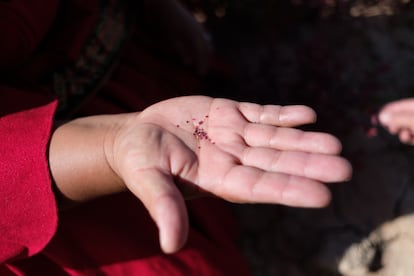
In addition, the grain is very nutritious, due to its high protein rate, fibers, iron and phosphorus. “My idea was that, with a more resistant crop, the harvest is good every year and that our children do not have to migrate”details the producer. The plant, which reaches about 15 centimeters high, can have a green, yellow or purple color, depending on the variety, and is harvested from the end of April in mid -May.
“Before no one had an interest in Cañahua”
Six years later, Nico Mamani is the president of the Association of Producers of Cañahua de Ayo Ayo, which brings together 22 producers. “Every year, we have two, three or four people who come to see us to start producing Cañahua and join the association”, Explain. Unlike their other crops, members of the collective sell the vast majority of their production in Cañahua. As the Andean grain harvest fails very rarely, that ensures stable income every year.
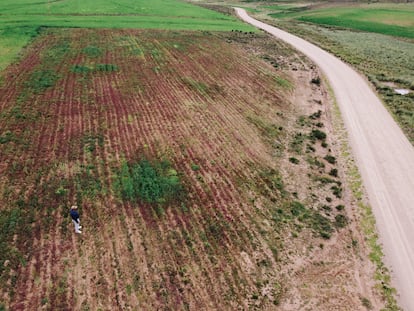
As quinoa, this grain is cultivated in the Andes for hundreds of years. But from the 50s, its production was going down. “People began to emigrate to the city and the knowledge and benefits of Cañahua were not transmitted to the youngest,” analyzes Trigidia Jiménez, president of the National Cañahua Network in Bolivia. In addition, there was no important market for sale. “More before, nobody had interest in Cañahua,” summarizes Justina Layme Quispe, member of the Association of Producers of Ayo Ayo. Cañahua did not disappear, but the planted surfaces were very limited and destined for self -consumption, mostly in the shape of Pito, a precooked flour.
After dedicating years to rehabilitating cultivation and promoting its consumption, Trigidia Jimenez managed to gradually recover the Andean grain. “Trigidia helped us a lot when we started,” says Nico Mamani, while heading to a plot in his small truck. “I bought our production at a price higher than the market.” Thanks to the National Cañahua Network, the producers received certified seed – of higher quality – and tools, and regularly collaborate with agronomic research programs led by the National Institute of Agricultural and Forest Innovation with which they seek to improve the processes.
Better yields and conquer the urban market
But did Cañahua get the rural exodus? “I think there is still a bit to say yes,” says Mamani. First, Cañahua prices are much more stable than those of Quinoa (which can be worth twice, but up to three times more), but still remain low, around 1.4 dollars per kilo.
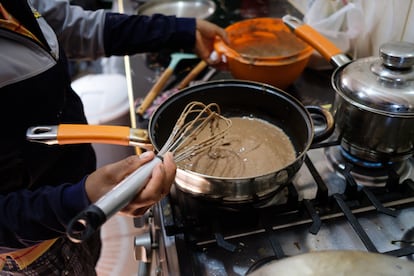
To face this problem, producers plan to sell transformed products, such as Cañahua bread. Trigidia Jiménez Franco, for example, is testing with premix for pancakes or energy bars of Cañahua to conquer the urban market. Among other achievements, the producer has managed to include products based on this grain in the subsidy for pregnant and breastfeeding women distributed by the Bolivian state.
On the other hand, in Ayo Ayo, the yields per hectare remain low. “We have a lot to improve,” says Wilmer Quispe Calle, 43 and vice president of the Ayo Ayo Association. That, he explains, “would allow to improve the profits of each producer and I think it would be an argument to convince new producers.”
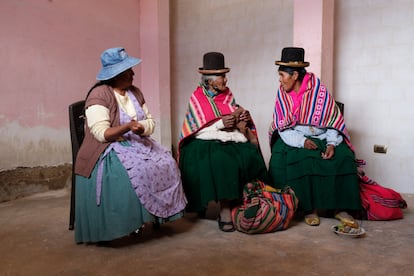
There are still few young people who have dared to stay to grow Cañahua. Many of the producers are older, such as the Sisters Justina and Eugenia Clotilde Layme Quispe, 72 and 74, respectively. “Our children work in clothing workshops in Argentina,” they say. “There is that belief that one will have a better life if you go to the city or abroad, but many times the conditions are worse, with a lot of work and few hours to rest,” Complete Nico Mamani.
Despite that, he does not lose hope. “It is a challenge. Getting that this resistant crop is also a source of good income and that, in a few years, the children inherit the lands of their parents with the certainty that this product does,” he says. For Jiménez Trigidia, we must continue to promote the advantages of the Andean grain, especially in the cities. “I have always defended the idea that everyone earns with this crop: consumers, because it is more nutritious than most cereals, and producers, for that resistance to climate change.”
For more updates, visit our homepage: NewsTimesWire