When on March 15 at 6.48 PM Judge James E. Boasberg verbally ordered the Donald Trump government to stop the deportations of Venezuelan migrants from Harlingen airport (Texas), Franyeli Carolina Zambrano Manrique was already on the plane, dressed in blue pants, gray gray gray combined with the shoes and handcuffs of feet and feet hands, what was uncomfortable every time it was uncomfortable every time He wore a piece of sandwich or a sip of water to his mouth. For that afternoon, almost night, a first flight from the global airline X was furrowing the Mexican sky and a second moved over the Gulf of Mexico (Gulf of America, according to Trump). Ignoring the warning of the Judge of the Federal District Court of Washington, a third plane, that of Franyeli, prepared to take off and land, she supposed, at Simón Bolívar airport, in the Metropolitan area of Caracas. But that never happened.
“I felt joy and sadness at the same time returning to Venezuela,” says Franyeli, 30. The group of women who were going to be deported was 18, but only eight got to the plane at the Texas airport. The officers were hurried, they did not want to waste time, or that nothing prevented them from carrying out the expulsion. Franyeli warned that he would arrive in Caracas, and in Maracaibo his father and five children were waiting for him. The other women did the same. Scarleth Rodríguez, for example, asked his mother, in Antímano, to have a stew chicken ready.
However, the eight Venezuelan women, according to them and their relatives, were “kidnapped” and “deceived” by the agents of the Immigration and Customs Control Service (ICE). It was not until after a few hours when they discovered that they had not taken them to Caracas, but that they had first landed in Guatemala and then in El Salvador.
The last days they had been the longest in Franyeli’s life. On Saturday, February 8, she drove with her husband Rolando Barreto Villegas, 34, heading to St. George, in Utah, where they planned to spend the weekend in a hotel room. About four in the afternoon, two migration officers stopped the car. When confirming that they were of Venezuelan nationality, they were informed that they had arrest orders, although they remained in the country as beneficiaries of the temporal protection status (TPS). Already in the ICE office, the officers wanted to know what they worked on. She, fixing nails; He, in construction work. They had been married for ten years.
They also asked if Rolando prostituted her or if they belonged to any criminal gang. They were told not. They inquired if they had tattoos. Yes indeed. And some coincided with the list of drawings that the officers showed them, and in which there were stars, crowns, a lion, a rose and the phrases “real to death” or “daughters of God.”
Franyeli and Rolando refused to sign the document in which they should admit that they were members of the Criminal Band of Aragua, but did not matter. That was, in reality, the moment when his return trip began. They were handcuffed and transferred to the Henderson detention Center, in Nevada, where the officers “kicked food with their feet and, if spilled, picked it up from the floor.” After a month locked, some guards reached the cell of two by four meters that Franyeli shared with another Venezuelan inmate. They woke her up. Franyeli seemed strange. It was three in the morning on a Friday. “I always saw that deportations came out on Tuesdays, that’s why I was very surprised,” he says.
Franyeli asked where they took her, but the officer did not decipher her Spanish, and she did not understand her English. Between so word he heard when he said “ICE”, but could not find out what they were doing with her. After a few hours he knew that he was going to be deported to Venezuela. “Obviously I was glad,” he confesses. Chained with feet and hands, they transferred her to another detention center where she came to see her husband with a group of Venezuelan men. He imagined that they were going to send them together to their country. On Saturday, March 9, they were uploaded on an airplane that later landed in Washington, where they collected 17 other men and two more women. They took course to Texas.
Six days later, from the detention center in which they remained, they went out in buses full of migrants to the airport. Scarleth, 21, was euphoric. He had been detained for nine months, since the border authorities were delivered in August 2024. They never allowed him to get out of prison and now, even if he was deported, he was going to be free. “She was happy because she came for Venezuela,” says his mother, Yelitza Rodríguez, a street vendor from the streets of Antímano, who prepared the stewed chicken that his daughter asked before leaving the United States. “I felt that I was going to arrive in surprise, that I was going to cover my eyes behind.”
“ICE officers did not let us open the windows of the plane”
Almost an hour after the first order to stop deportations, Judge Boasberg requested again – written this time – that Trump’s administration returned to US soil the three planes that had come out from Harlingen. By then, the first flight was already in Guatemala, the second flying over Mexico, and a third was still on land. A day before, the current president had signed an executive order invoking the law of foreign enemies of 1798, created for war times but now used to justify the expulsion of people considered part of an invasive force.
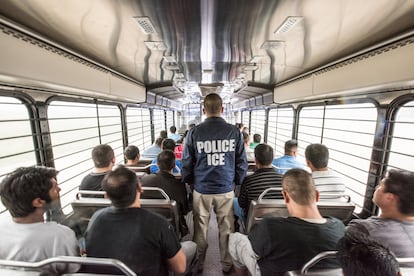
The Global X flight in which Franyeli was finally taken off above the judge’s word. Her husband was on another plane. Franyeli does not remember exactly how much it was, but the trip was long. If I needed to go to the bathroom, an ICE officer accompanied her. At eight women it seemed rare that the aircraft windows stay closed all the time. “The officers did not leave us at any time to open the windows of the plane,” says Franyeli.
When the plane landed the first time, they were informed that they were in Guatemala, but that they would continue towards Caracas. When they landed for the second time, they themselves realized that this was not their country. “Hey, Marica, this is not Venezuela, there is too much riot,” said one that reached up a blind. When Franyeli appeared, he saw that, indeed, it was another place. “We started crying, men to scream, saying that we were not going to get down,” he says.
Among the uproar, the negatives to sign the documents they gave them and the screams, an officer “became violent.” Franyeli remembers how the ICE agent, with Hou-02 identification, gave a woman “a woman”, and another dragged her down the hall of the plane. They were scared to see, from the window, the way they went down to the men who had arrived in another aircraft. “They grabbed them, threw them down the stairs, and when they fell down they raised them and removed them,” says Franyeli.
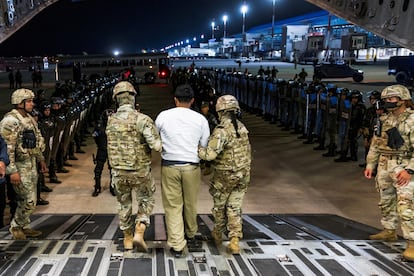
Those men were the 238 inmates that the world would later see, through images disseminated by President Nayib Bukele, down almost to trail by the ladder of a plane until he arrives, handcuffed and dressed in white, at the center of the confinement of terrorism (CECOT), the place that the Salvadoran government made available to the American to house Venezuelan emigrants. This is the mega jail with the capacity to house up to 40,000 inmates that Bukele shows the world and hides a terrifying prison system with about 120,000 inmates, the highest imprisonment rate in the world.
Since then, organizations and judges have condemned the sending of Venezuelan inmates to El Salvador, ensuring that it violates due process. A study by Human Rights Watch (HRW) showed that, of forty cases of Venezuelans deported to the Central American country, none has a history as “criminals.” HRW has also described these deportations as “forced disappearances.” The detainees not only remain incommunicado of their relatives and lawyers, but unable to attend their hearings in the United States. The Trump government, meanwhile, has not issued an official list with the names and exact number of people sent to El Salvador, a group that other Venezuelans later joined. On March 31, the State Department reported that 17 alleged gang members had been deported to that country, and on April 13, Salvadoran Security Minister confirmed that they received another 10 people from Guantanamo.
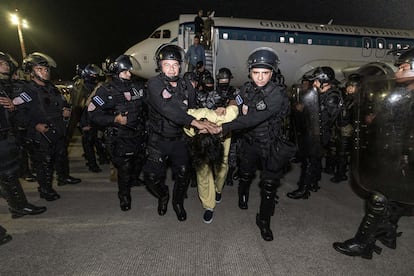
Neither the list that made public CBS News nor the US authorities have ever mentioned the eight women who also arrived in El Salvador. The same day they landed, without getting off the plane, they were returned on a direct flight to the United States. “The officers on the plane already had the order that they were not going to receive us. They told us that we were in El Salvador, but that the women were going to be returned,” says Franyeli. Until today there is no official explanation of why they took them and why they returned them, but it is known that the CECOT is a prison exclusively for men. Completely forgotten by the press or politicians, they now ask for help to do justice for what they were done.
“That they sports it already, it is not just what they are doing”
Gladys Yoleida Caricote Tovar’s family, 28, doesn’t know what to do or how to help her girl. Since he returned from El Salvador, he remained in a Texas detention center, where they hit her a few days ago. “He called me and told me that they hit her, they have it full of bruises, they threw the food on his face, they have it locked in a punishment room,” says a relative who asks to remain anonymous.
Gladys has been in the hands of ICE since December 10, 2024 arrested her in Colorado, in front of her mother and three minor children. The young woman was transferred a few days to the Texas detention Center and her children delivered to a substitute family. Grandma could only recover them weeks later. Gladys thought, the day they went up to the plane with seven more women, who was finally going to get to Venezuela and get out of life in jail. I couldn’t stand the confinement anymore. “She feels bad, these days gave her a panic attack, they had to take her to the doctor,” says her relative, who implies that they at once send her to her country. “May they already deport her, it is not just what they are doing with her.”
It is the same as Yelitza asks for his daughter, who was also recently beaten in the detention center since he has returned from El Salvador. “My daughter no longer wants to be in the United States, she wants her deportation,” says the mother. “I don’t know what to do, or where to get there, or how to look for it and bring it. I want it to come, that country is very inhuman. It called me crying, he told me that I couldn’t stand it anymore, that he was going crazy.”
Of the eight women sent to the CECOT, only three have been returned to Venezuela. The rest remains in detention centers without knowing for how long. Franyeli was deported on April 5 to his country, where his father and children were received at the usual house, which he wanted to fix with the money of his work in the United States to return to live in it at some point. Rolando, her husband, remains incommunicado until today in the Cecot, and Franyeli does not know how to pay a lawyer to attend to his case. “It’s strong, I’m still assimilating this, waiting to know about Rolando,” he says. With the days he will look for a job and return to the usual life, the one he had before leaving, the one that one day wanted it to be different.
For more updates, visit our homepage: NewsTimesWire