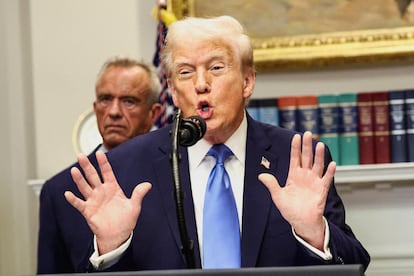
As a prophet of the pharmaceutical industry, Donald Trump grabbed the microphone from the White House this Monday and sent a message to all the pregnant women in his country: “Do not take Tylenol,” he told them in reference to this brand with which in the United States the paracetamol is marketed. He even asked that, if possible, they would endure any episode of fever or pain. “Fight with nails and teeth not to take it.” Then, he repeated almost ten times: “Don’t take it.” Although that supposed link between acetaminophen and autism is not backed by science and medical organizations immediately came to deny it, the president took out his test a test perhaps never before kneaded by researchers: in countries like Cuba, where “they have no money” and, therefore, they consume much less Tylenol, people barely deal with autism, the condition that they present in the United States.
“There is a rumor, that I do not know if it is true or not, that in Cuba they do not have Tylenol because they have no money for it and they basically have no autism. And there are other parts of the world that do not have Tylenol and have no autism. That already says a lot,” said Trump, guarded by his secretary of health and human services (HHS), Robert Kennedy Jr., the well -known anti -Vaccine efforts to investigate the condition and that, for September, they would know “what has caused” what they considered an “autism epidemic.”
At the moment, the statement provided by Trump that assured that Cuba was free of autism is denied by the numbers. An article published in Medicc Review In 2017, data from the Ministry of Public Health of Cuba that ensures that 1 in 2,500 Cuban children had been then diagnosed with autism. Last April, an official media reported that there were 3,500 people registered with the autistic spectrum. They also stressed that the prevalence of autism is 0.4 per 10,000, a lower rate than in other countries. However, some experts point out that a sub -registration could be due to the difficulty of establishing the diagnosis.
“Cuba also has autism. Much. Do we have prevalence rates similar to the US or other countries with more resources? The conjectures indicate that no. But none of that is proven,” said Dr. Yoysy Rondón, National Coordinator of Autism and other neurodevelopmental disorders at the Borrás Ivory Hospital in Havana, in statements to the specialized environment Autism Sportum News This year. Nor is it true that paracetamol has not been sold in Cuban pharmacies or that relatives from abroad do not provide those of the island with medicines, including Tylenol. That also increased since in 2021 the General Customs of the Republic authorized the import of drugs without limit of amounts and exempt from the payment of tariffs, in the middle of the Pandemics of Coronavirus that sharpened the health crisis in the country.
The Cuban scientist Eduardo López-Collazo, of the Health Research Institute of the University Hospital La Paz (IDIPAZ), in Madrid, assured El País that although he recognizes that “the lack of medicines on the island is notorious”, it cannot be said “that there is no consumption of paracetamol”, the analgesic that appears in the national form of medicines issued by the Ministry of Public Health of Public Health of Cuba, and that depending on the countries Offer acquires other names such as acetaminophen, datril, bakers, liquiprin and others, to the popular Tylenol.
López-Collazo, on the other hand, would not dare to affirm, as Trump did, that there is “a low incidence of autism in Cuba, since both the diagnosis and the monitoring and registration of this and other pathologies are very deficient due to the generalized crisis that the island lives”. “Cuba is not a good model to test the hypothesis that relates paracetamol during pregnancy with autism,” he said. He also insisted that studies that suggest that this type of hypothesis “are very weak and merely correlation.” “The scientific consensus is that autism – or, in more technical language, the disorders of the autistic spectrum (ASD) – does not have a single cause. For now, we describe it as a set of conditions with multiple roots, in which genetics and the environment interact in complex ways.”
Some US institutions have turned on the alarms in the face of the statements of the Republican leader. The American School of Obstetrics and Gynecology reported that the president’s suggestions “are not only very worrying for doctors, but also irresponsible if the harmful and confusing message is taken into account that they transmit to pregnant patients.” The Kenvue company, behind the Tylenol brand, insisted that more than a decade of research confirm “that there is no credible evidence to link acetaminophen with autism.”
The Crusade to get medications in Cuba
On Monday, when Trump made the controversial statements that related paracetamol and autism, several activists on the island had begun a campaign to collect analgesics through social networks, with a message in which they highlighted the need to collect Paracetamol, widely used to relieve pain or lower fever. It is the way that many have found to agency medicines in the midst of a crisis that, according to the government itself, has caused a shortage of 461 medicines of the 651 that make up the basic picture of medicines, that is, 70% of the drugs that the population needs.
In a WhatsApp group in which people ask and offer what they have, Vero is responsible for managing the distribution of medicines in the municipality of Pinar del Río. “In pharmacies there is almost no medication, it’s no longer as before, that you were with a recipe,” he says. He also ensures that the group’s mothers fear their children will be sick. “Let us fall into a hospital, because there are no medications or inputs. That terrifies us,” he confesses.
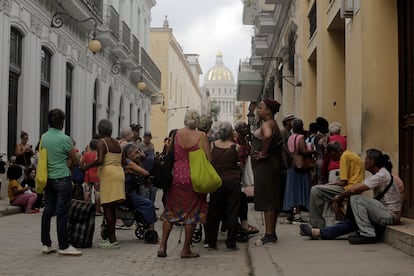
The other option that Cubans remain is the almost unattainable black market. In the country circulate lists of medicines that mostly arrive from abroad, where there is no lack of 500 grams paracetamol and a large number of other drugs impossible to find in state pharmacies.
Dianisleidys López Zayas, from Pinar del Río, mother of a six -year -old autistic child who during his pregnancy never took Paracetamol “because it was not necessary”, she is “disappointed” with the attention they give to children with autism in Cuba. Today you have to buy the valproate or the clonazepam that your child needs in sales groups and prices that your pocket does not hold. The same happens to Ania Argudin Páez, whose 13 -year -old son suffers from Lennox’s disease and is decompensated because he does not have Clobazam. His mother, who earns a salary of 2,800 Cuban pesos every month (just over $ 6 in the informal market) has to buy the sluts of pills at 500 and 600 pesos (between 1 and 1.5 dollars). Sometimes, buy the paracetamol to relieve fever. “I feel very overwhelmed by this situation,” he says. “My child depends on those medicines not to convulse and we have no support from the government or any institution.”
The latest study of the Cuban Observatory of Human Rights (OCDH) reflects that in these moments only 3% of Cubans get medicines in pharmacies. The cause, according to the authorities, is the absence of imported components that are used in the preparation of medicines. But the lack of medications adds to the general shortage in which Cubans live, and that leaves them without electricity, without drinking water, without food and, consequently, without a system that guarantees their health services.
For more updates, visit our homepage: NewsTimesWire