María Escalona Fernández got up this Wednesday and went to look for the first Barinas bus to Caracas, a stretch of almost eight hours that travels excitedly, almost incredulous to know that she will meet her granddaughter. Maikelys Antonella Espinosa Bernal, the two -year -old girl who became the last symbol of Nicolás Maduro’s claims to Donald Trump, arrived in Venezuela in the morning. Her mother had denounced her “kidnapping” the day that the girl was given to a substitute family in the United States, depriving her parents of her right to be with her.
“Finally the rescue was already achieved,” says the paternal grandmother to El País, when she still is missing a few hours to reach the capital, where the little girl remains. “Thank God, the girl is in her land.”
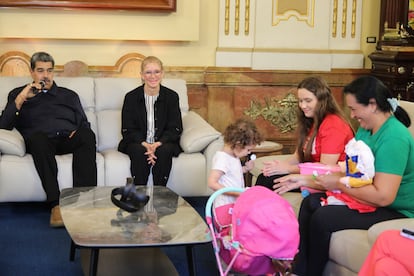
Dressed in Blanco, Maikelys arrived at Simón Bolívar International Airport, where the first Venezuelan lady, Cilia Flores, received it, which took her in arms to the Miraflores Palace. At the headquarters of the Venezuelan government, her mother was waiting for her, Yorely Bernal, 20, who was deported on April 25 from Texas. It was Flores who gave the girl to her mother and maternal grandmother, who broke into tears and hugs as they saw her. Maduro, witnessed the encounter from the rear, hastened to say that “the dear girl of all” had arrived. Then he added: “She is all of us’s daughter and granddaughter,” he said.
Since the little girl and her parents arrived at the border last year and delivered to the US authorities, Maikelys has lived in custody of the refugee relocation office and was delivered to a substitute family that kept her under her care all this time. According to Fernández, for months they only knew about her through video calls that the caregiver made to Venezuela.
The day his mother was going to be deported, after being accused of belonging to the criminal band of Aragua, immigration officers told him that they would give the girl to return together on the plane to her country. But that never happened.
For several days, relatives did not know about their whereabouts. “We have not known more about the baby,” said paternal grandmother to El País at the beginning of this month. “We don’t know in what conditions, or where, or who is.” In the midst of the family’s clamor to take Maikelys back, the Venezuelan government capitalized the cause that became one of the many faces of the anti -immigrant crusade of the Donald Trump administration.
From state television, Maduro repeated that “the parent’s parental authority” was exclusively from her biological mother. And he demanded that the US government return it: “The United States government only has one way: recognize the mother of the mother to her parental authority, to have her legitimate daughter and return her immediately.” He also warned that, otherwise, Venezuela was “prepared to go looking for the girl Maikelys where you have to look for her.” The Supreme Court of Justice also issued a preventive measure of family reunification where the return was required in a “safe and healthy” way.
After Caracas accused Washington of “stealing” Venezuelan children, the US authorities alleged that the father of the little girl, Maiker Espinosa, 24, was a “lieutenant” of the Aragua train, which is why he was sent with 237 Venezuelans to the center of the confinement of terrorism (Cecot), in El Salvador. The Department of National Security (DHS) also insisted that the mother was dedicated to the “recruitment of young women for drug smuggling and prostitution.”
According to the DHS, the decision to have the girl under her custody was based on a matter of “safety and well -being.” “We will not allow this girl to be abused and to continue exposed to criminal activities that endanger her safety,” they said in a statement.
That contrasts with the image on Wednesday. Maikelys did not arrive alone in Caracas, but as part of a group of more than 220 Venezuelan migrants deported from the United States, in one of those flights that Maduro was resisted before, but that has accepted again since Trump’s arrival. The Venezuelan president even thanked the Republican for the return of the girl, which described as “a deeply human act,” and left the path open for possible negotiations with the Trump administration. “There have been and there will be differences, but it is possible, with the blessing of God, advance and resolve many issues,” he said. Maduro also said that he aspires to “very soon” can “rescue” from El Salvador to the father of Maikelys and the 253 Venezuelans who remain in the mega jail of President Nayib Bukele since March.
For more updates, visit our homepage: NewsTimesWire