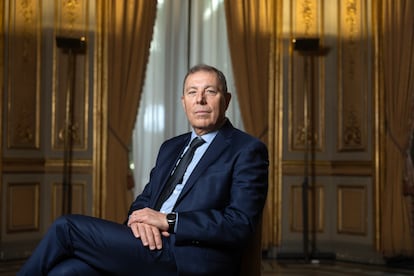
At a time when Latin America is experiencing tensions, mainly due to the military escalation of the United States regarding Venezuela, in “Uruguay democracy is stable,” celebrates Gabriel Oddone (Montevideo, 62 years old), the country’s Minister of Economy and Finance. In an interview given this Tuesday at Casa América, in Madrid, Oddone recognizes that Uruguay and all of Latin America have to face the problem of inequality, which he defines as “a great challenge” for the continent. The leader admits that the country “has not made any achievements” when it comes to addressing child poverty, which affects 32% of children under six years of age, according to Unicef. The minister is part of a Government of the Frente Amplio, the party of the iconic and recently deceased José Mujica, which has managed to keep this country away from the rightist turn that neighboring Argentina has experienced. In the midst of a visit to Spain that will also take him to France, Oddone assures that he will speak with the authorities about the trade agreement between the European Union and Mercosur, which the minister hopes will be signed before the end of 2025.
Ask. It gives the impression that Uruguay is a stable country within a fickle context. What are the keys to that behavior?
Answer. Our political party system handles dissent well. I would say that is the key. Citizens recognize the ability of Uruguayan politicians to represent them. And that makes democracy stable, that public debate has levels of quality that are not frequently observed in other places.
Q. How are you dealing with the new US administration?
R. We have a close and close relationship with the North American authorities, as we do with most countries in the world, especially those that are relevant to Uruguay. We are facing the increase in tariffs very carefully, but the increase has been significantly less than that suffered by our competitors.
Q. Regarding the trade agreement between the European Union and Mercosur, when do you estimate it will finally be signed?
R. The date that is planned, or that at least the authorities manage, is December 20. However, we are aware that there are still several issues pending resolution, but we hope that this agreement will be signed before the end of 2025.
Q. What guarantees have the Mercosur countries established to face the rejection of the European agricultural sector?
R. There are never guarantees in an agreement of this nature and of course for the European agricultural sector this is a challenge. I envision that the European agricultural sector will progressively concentrate on specialization in some type of niche products. In addition, this agreement will also affect some sectors of activity in the Mercosur countries.
Q. The International Monetary Fund estimates that Uruguay will grow 2.5% in 2025. What are the economic perspectives managed by the Government?
R. We are forecasting an average GDP growth for the next five years of 2.6%. It is an ambitious estimate but we believe that despite the international uncertainty, Uruguay has the conditions to attract investment. In addition, some investment projects are being developed that are relevant and that will generate a good level of activity.
Q. And what are the main challenges facing the Uruguayan economy?
R. They are, first, to accelerate the long-term growth rate, which is crucial to be able to finance our social protection model and strengthen our investment attraction regimes. Second, advance in aspects linked to energy and ports, in order to generate attractive investments.
Q. They are about to approve the Budgets. What are the main new features it includes?
R. Firstly, it introduces a more transparent and powerful commitment in fiscal matters because it establishes a very clear debt ceiling. Secondly, some tax changes are introduced, since the tax is introduced on multinational companies that invoice more than 750 million euros per year, in line with the OECD. In addition, the capital increases in income from personal and real estate assets coming from abroad will begin to be taxed. These elements will make it possible to maintain tax revenues and consolidate the debt trajectory.
Q. Are they going to introduce a tax to tax the richest 1% of Uruguayans as the PIT-CNT union has proposed?
R. We celebrate that the debate is taking place, we believe it is a good debate, but it is not part of the priorities or ideas that the government wants to promote.
Q. Unicef assures that child poverty in Uruguay is double that of adults. How should we face this problem?
R. I would say that it is the main problem that Uruguay has, and we must present solutions. We are placing emphasis on strengthening the transfer scheme for vulnerable households where poor children and adolescents live. We must also strengthen the scholarship regime so that they can spend more time in the school system.
Q. Do you think inequality is the main challenge facing the continent?
R. I think it is a great challenge for the continent, poverty levels are a great challenge that we face. The economies of the region are not poor, however, income distribution has enormous opportunities to improve in all our economies. In the case of Uruguay, the system has been well resolved to address poverty among the elderly, where the other extreme of important poverty in America is usually located, but where we have not been able to have good achievements is in childhood and adolescence.
Q. What results do you expect from your trip to Spain?
R. We have a very close link, culturally and politically, with Spain. In fact, President (Yamandú) Orsi has a very important closeness with the President of the Spanish Government, Pedro Sánchez. Spain is the main investor in Uruguay, so we will be attentive to those things that interest the Spanish Executive about Spanish companies that are in Uruguayan territory and, in turn, talk about the issues of the European Union-Mercosur agreement and some other issues on the bilateral agenda.
Q. What is the position of the Government of Uruguay regarding the escalation between the United States and Venezuela?
R. We are a country with a strong vocation for peace and for the resolution of conflicts and differences peacefully. Of course we see it with concern, like any inhabitant of Latin America where fortunately conflict is quite low.
For more updates, visit our homepage: NewsTimesWire