
About 200 grams of bread, 300 grams of onion, 80 grams of meat, 30 rice and dry beans, many, three quarters of kilo. This is what the 508 prisoners of the Provincial Prison of Murcia ate on June 2, 1945. That same day, the 47 inmates who were in the infirmary also received two eggs and a small piece of hake. This is recorded in the rationing extraction certificate that was prepared in the prison that day, a menu that was practically identical throughout each day, of each month, and that, very slowly, was varying over the years. At the end of the dictatorship, in 1971, the ranch already included pork ribs, chicken, cod, mortadella or even medium egg for healthy prisoners.
The rehabilitation works that are being carried out in the old prison building, popularly known as the Old Prison of Murcia, have brought to light documents related to the pantry and the cuisine of the prison that come to complete those that were already preserved in the Regional Archive of Murcia and that shed light on the hard life of political prisoners.
In the Regional Archive, its director, Javier Castillo, explains to El País, were already preserved around 40 documents from the cooking of the prison, which were recovered in the mid -1990s, when the building, in a state of Ruina, passed from the State to the city. The file that was in jail was then emptied and took to the regional center, but, in relation to the kitchen, it is a documentation that has barely been studied and that was mainly composed of invoices and agaranes of purchase of products, he points out.
The new documentation now offers novel information: what was extracted to Diario de la Pantry to make the food from the inmates. In these “parts of rationed extraction”, as officially called, those responsible for the prison (each sheet takes up to four different signatures, of the director, an non -commissioned officer, the doctor and the kitchen manager) wrote down the products used and their quantity. Many of the parties include the number of prisoners, so it is easy to calculate how much they touched each one making a division.
Bread, potatoes, onion and beans were the basis of the menus, especially until the sixties. Rice, lentils, green beans or pork bones are other recurrent ingredients. According to the time of the year, fruits such as oranges, apricot or melon appear. Eggs or milk were almost exclusively reserved for sick inmates who, from the sixties, received some extras such as hake, jams or quince.
However, Castillo calls for caution: one thing is what these documents collect and another, he points out, what the prisoners really ate, especially in the years immediately later at the end of the civil war, when the shortage of food was extreme in the street. “In the forties, there were foods that could not be found anywhere. So the population in general, and much more prisoners, ate little and bad. In the prison system there was no control. The rage worked. The jailers themselves also went hungry. The historian Antonio Martínez Ovejero, a specialist in the history of the Civil War and the dictatorship in the Region of Murcia.
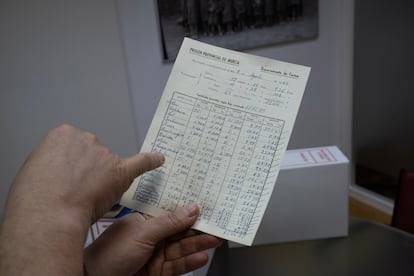
That shortage is reflected even in some of the minutes of the prison. On May 18, 1942, for example, 211,950 kilos of bread are noted for use in that day. A subsequent note indicates that “they are annulled” for “the corresponding flour quota has not been received.” In that document is not the number of prisoners that were going to consume the PAN, but, according to Martínez Ovejero’s investigations, in that year the prison reached its highest levels of occupation, with about 2,500 inmates in facilities that were designed for 300.
If the flour had received, each inmate would have had 80 grams of bread in their hands. “But not everyone ate the same, nor everyone ate every day,” says the historian. This was written by the teacher and militant of the José María Marín Jover Communist Party, already deceased, and who was held in the provincial prison of Murcia in the worst postwar years, from 1936 to 1944. In his book Prison and clandestinity under Franco He explains that, when they received not visits from relatives who took food, the inmates of the Murcia prison lived “at the expense of the tupí or triache” that gave them in the morning and “the reduced unpleasant bodrium emulsion based on half a dozen lentils danced in black water” arrived at noon and the afternoon.
“The condumio that corresponded to us was an infusion of twelve lentils about Cochambroso Barracks plate (…). Breakfast was a sugar-endless water saucepan (…). The 25 grams of bread were of saddlebon and corn,” he details in his book. According to their calculations, some 600 calories were ingested daily, when the average for a young and healthy adult should be around 2,500.
These figures do not fit what was noted in the parties, explains Luis Hidalgo, dean of the College of Nutritionists and Dietitians in the Region of Murcia, which stresses that, paradoxically, most documents show highly caloric menus, with a high contribution of carbohydrates, a sodium level well above the recommended and certain lacks in protein, vitamins and minerals. That high contribution of calories, emphasizes, contrasts with the high proportion of prisoners of the time suffering from diseases such as cocaxia, a type of severe malnutrition.
Martínez Ovejero insists that the food situation of the prisoners was moving forward as the dictatorship did. As of 1945 and, above all, from 1946, Franco, pressed internationally, pardoned the political prisoners imprisoned before 1939, so that overcrowding in prisons, also in Murcia’s, was reduced.
The parties found in about 550 inmates from the old prison in 1945. In 1968 the prison was already below its capacity, with some 60 prisoners. The figure was touching the 200 prisoners in the early seventies, but, the historian stands out, they were already mostly common and non -political prisoners.
He knows firsthand, since he spent a month between the walls of the prison in 1973 accused of participating in the organization of a student strike. “At that time, there were three political prisoners, in addition to two homosexuals, to which it was not allowed to be with common prisoners. There was no shortage. It can be said that he did not eat badly,” he says.
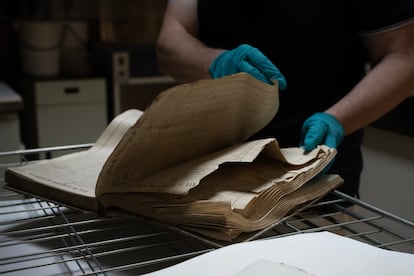
In the rationed parts that guard the regional archive, foods such as pork ribs, chicken, cod, mortadella or eggs appear at that time. In the seventies, as detailed in these parts, the food of each healthy inmate cost 21.75 pesetas per day, which rose to 34 pesetas in the case of the sick. In 1945, investment on paper was three pesetas for healthy and six inmates for the sick. During the sixties, it was 18 and 28 pesetas, respectively.
How much of that money was really consumed by the prisoners, it cannot be known exactly, since most of these people, especially those who suffered the stage of greatest shortage, have died. The official information, in any case, is available to anyone who wants to consult it in the Regional Archive.
For more updates, visit our homepage: NewsTimesWire